

A classmate of mine has a family business in Tai'an, in China's Shandong province. They build food trucks. One sells for around $20,000, goes into a container, spends four weeks at sea, and ends up selling snacks in a city the factory owner may never see.
The factory already uses AI. People there chat with it and use it to translate customers' emails.
But ask what actually gives the factory headaches and translation never comes up. Making progress videos for customers. Issuing work orders. Getting the factory and the customer to agree on what's changing. Rework when a part comes out wrong. Today's models can reach all of these. What's stopping them is the chat box.
Solving these used to mean buying systems, one at a time: too heavy, too expensive. My call is that all of it converges on one harness and a set of skills.
That is not the industry consensus. At Hannover Messe this April, Infor announced a partnership with AWS to add sector-specific AI to its MES (manufacturing execution system, the software that runs work orders on the shop floor), and Accenture and Avanade said they are building a factory-floor agent system with Microsoft. ABI Research summed up the announcements as helping manufacturers "scale and integrate their AI solutions over existing enterprise infrastructure." Writing last August, Automation World summarized Critical Manufacturing's position: the solution lies "not in replacing MES systems entirely, but in augmenting them with AI agents." That's the answer from people who sell systems to people who already bought them. The factory in Tai'an isn't in that conversation.
1. Three things the chat box is missing
Paste an English email into a chat box and you get a good translation. But the chat box doesn't know which order the email is about or what stage that order is at, and it can't change a work order. So a salesperson copies the translation out, hunts down the drawing, asks the shop floor, and comes back to write the reply.
That's the shape of AI in most factories today. The model sits beside the process and a person shuttles between them with copy and paste.
Three things are missing, and none has anything to do with how smart the model is. It needs to see the whole history of this order. It needs permission to act, such as issuing a work order. And every step it takes has to leave a record, so a mistake can be traced. Give it those three and wrap checks around the outside, and you have a harness.
Anyone who has commissioned a robot has seen a harness: teach, dry run, single step, low speed, full speed. The brain that wrote the program can't be trusted, so you wrap it in layer after layer of checks that don't depend on it. The shop floor has long had harnesses. It just never used them for office work.
2. Walk one order through
Suppose a customer in Austin emails to ask whether the side door can move back about four inches.
Alignment. The translation is easy now. The hard part is what those four inches touch: window position, exhaust, wiring, price, delivery date. Someone has to check each one, revise the drawing, and send it for the customer's sign-off. Two weeks later the customer says that isn't what they meant, and someone goes digging through the records.
Work orders. Once the customer confirms, the bill of materials has to change, the cutting and welding work orders have to follow, and the old ones have to be voided. Miss one and the shop cuts steel to the old drawing.
Video. The customer has paid and can't see anything from across the Pacific, so they want progress videos. Someone shoots them, someone matches them to the order number, someone cuts them into something watchable and adds English notes. The weekly videos for this newsletter are assembled by agents, from script through to voice, captions and picture, and I only look at sample frames. Swap in footage from a phone on the shop floor and the logic is the same.
Rework. Halfway through assembly, the side door opening hits the exhaust pipe. Someone has to work out whether the drawing, the material or the person was wrong, reissue the work orders, add up the loss, and tell the customer it will be a few days late.
Each of these four jobs reads the same order, yet today that order is scattered across WeChat, email, Excel and a salesperson's head. That is where a factory actually hurts. Take any of the four apart and what you find is a search for context.
Aligning with the customer. You used to buy CRM and PLM change workflows. A harness reads the email, checks the order, lists the impact, and drafts the reply and the revised drawing. The person commits to price and delivery.
Work orders. You used to buy ERP and MES. A harness reissues the bill of materials and work orders from the new drawing and voids the old ones. The person takes a look before release.
Progress video. You used to pay an outside editor or a dedicated hire. A harness files footage by order, cuts it, and adds captions. The person takes a look before it goes out.
Rework. You used to buy a QMS and write 8D reports. A harness lists likely causes against the drawing and inspection records and adds up the loss. The person assigns responsibility and decides the fix.
3. The systems were split by people
Why does one order need four or five systems? Because the users are different people. Sales looks at one, planning at another, quality at a third. Each has its own screens, each process gets drawn in advance, and everyone gets trained on it. Then you pay again to connect them.
One UK MES vendor quotes small manufacturers (10 to 100 employees) £28,000 to £140,000 for the first year on-premise and £14,000 to £65,000 for the first year in the cloud, with a 5% to 15% productivity dip around go-live. That's one system. Another vendor, Fabrico, says it plainly: "MES is a people project wearing a software badge." The license is only part of the bill, and the overruns tend to be in integration and people.
A model doesn't look at screens and doesn't need training. It can read the email and the drawing at the same time, along with the Excel sheet and the photo from the shop floor. The reason for keeping systems apart is gone, and the cost of keeping them apart is pure waste.
One harness handles context, permissions, records and checks for the whole factory. On top of it sits a set of skills. A skill is a few pages of plain language and a few small scripts that spell out how a job gets done, which tools to use, and when to stop and ask a person. One for issuing work orders, one for answering customers, one for making videos. When the process changes, you edit a few lines.
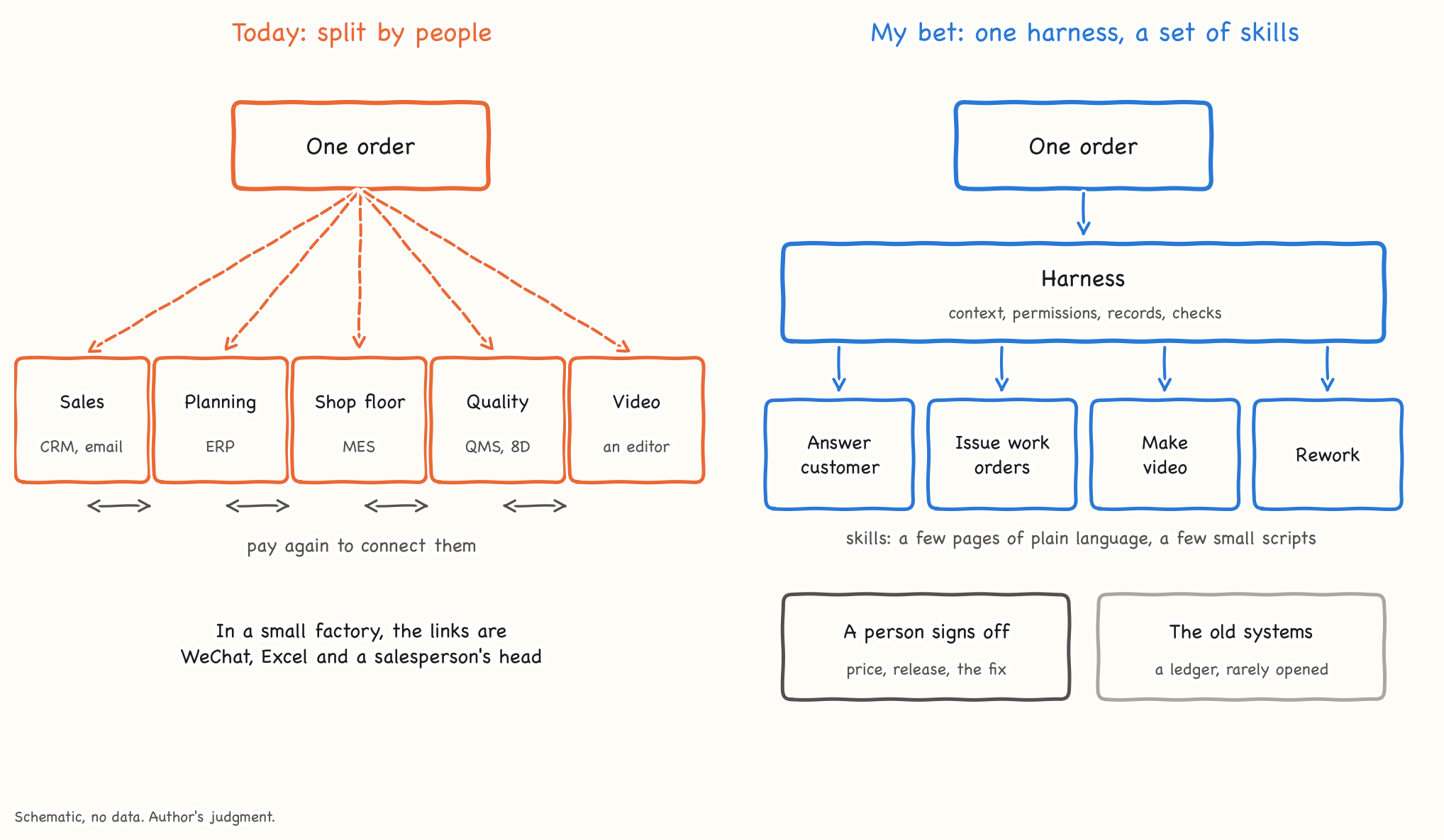
I use a harness and skills every day. I publish articles with one skill and upload videos and make images with one each, and nothing goes out without my approval. Last month, after the English version of a short post was written, the reviewing agent rejected it because half a sentence of source text was missing from a quotation. Substack is still there. I just rarely open its dashboard.
When I wrote about Schneider buying PTC, I made one assessment. Search, understanding and cross-system alignment are the read path, and models will dissolve them. Authorization, change and audit trail are the write path, and they stay. For factories that already own an ERP and an MES, those systems will retreat into a ledger: still necessary, rarely opened. A system nobody looks at is hard to keep charging for by the seat. That's where the old systems end up. A factory like the one in Tai'an skips even this step and goes straight from the chat box to a harness.
4. Rework is what stays
The difference on rework is bigger than the savings.
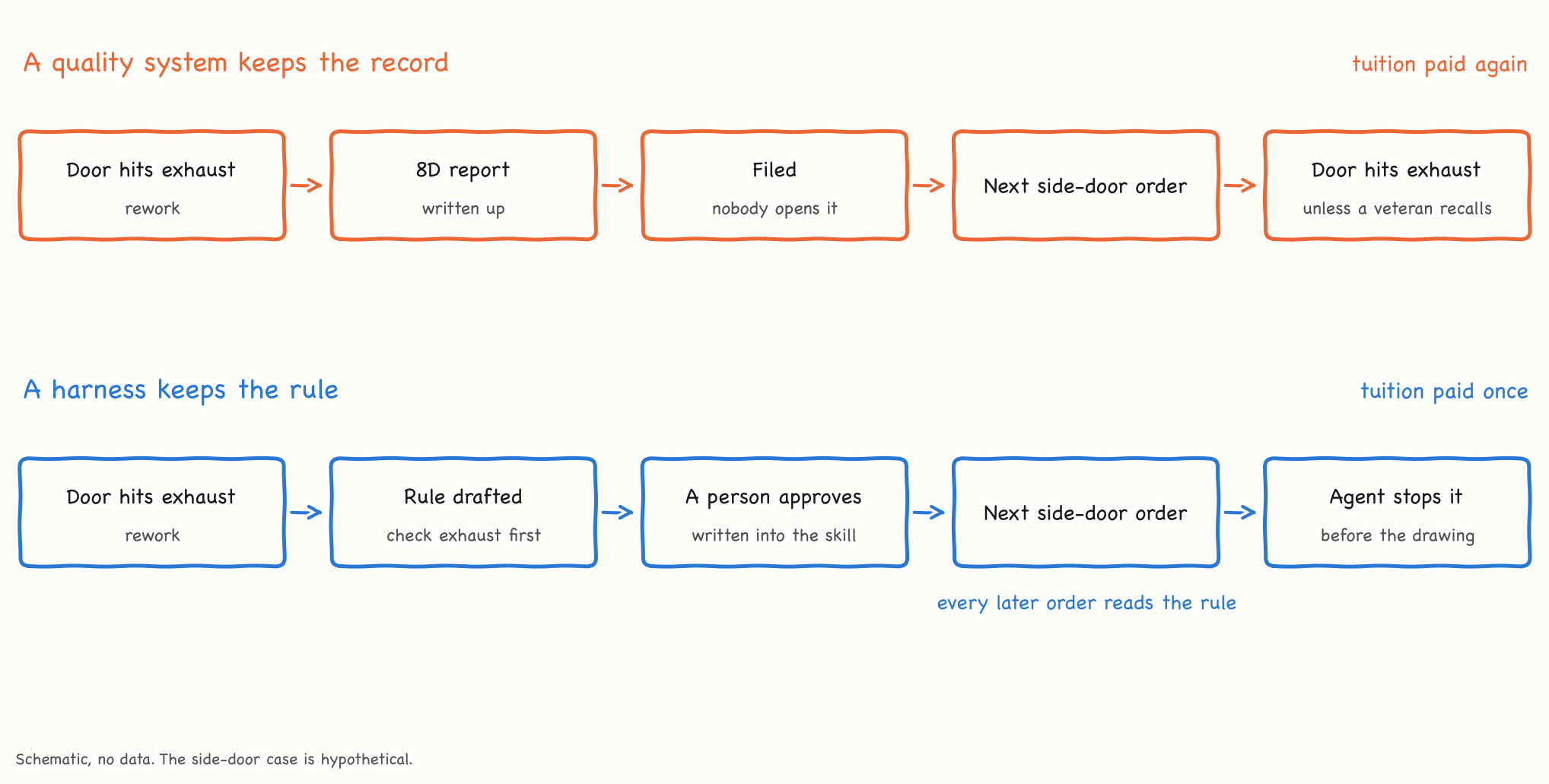
A traditional quality system records the rework, writes up an 8D (the standard eight-step corrective action report), and files it. The next time someone moves a side door, nobody opens that 8D, unless the veteran who handled it is still around and still remembers.
In a harness, the same rework can become a rule written into the work-order skill: before moving a side door, check the exhaust. The next order that wants to move a side door gets stopped by the agent before a drawing is made. You pay the tuition once.
As I wrote in the piece on physical AI, the compound interest is in constraints that don't pay tuition twice. Anyone can buy the model, and harnesses will look more and more like open-source tools. What you can't buy is the set of skills this factory built from years of its own rework. They belong to the factory and get better with use. For the first time, a veteran's experience has somewhere to live that doesn't retire and gets applied every single time.
Factories used to find it hard to switch systems because the process was locked inside the vendor's configuration. From now on the process lives in the factory's own few dozen pages of text, and the model and the tools can both be swapped. System vendors have a problem.
Writing the rule back has its own trap. If the agent writes and approves its own rules, the bad rules compound too. A person has to sign off on that step.
5. Where I could be wrong
The first counterexample is Klarna. In 2024 it said its chatbot could do the work of 700 customer service staff. By May 2025 its CEO was telling Bloomberg that cost had been "a too predominant evaluation factor," that quality had suffered, and it was hiring people again. A factory has less room for excuses than a call center: one bad dispatch costs a batch of material.
The second is compliance. Superkind, which sells agents, argues that the "AI-native MES" pitch overlooks regulation, traceability and ERP integration, and predicts that "most Mittelstand factories will run an MES and one to three production AI agents by 2028." (Mittelstand means Germany's midsize manufacturers.) I half agree. For suppliers in automotive, medical and aerospace, customers and auditors recognize that ledger, and it won't move soon. A factory like the one in Tai'an has no such constraint, so my call splits between these two kinds of factory.
The third I've written about myself: the model can lie. If the checks around a harness were written by the same model, you have a system that confirms itself. The builder can't be the verifier, and on a shop floor that has to come down to real measurement. A factory with no in-line inspection has no way to know whether the agent got it right. That's the next piece.
The fourth is who builds it. Small factories have no engineers. Whether a model can let an owner who knows the trade stand up a harness alone is something I haven't seen yet. If it ends up requiring an integrator, the math is less good than I've made it sound.
Disclosure: The author leads R&D at an industrial AI and robotics company. This judgment favors that industry, so weigh it accordingly.
6. The bets
As usual, here they are in a form that can prove me wrong, logged in my prediction ledger (the public page updates each quarter) and settled in public when due.
P25. A factory publicly states it has retired a commercial MES it was running, with an agent layer taking over. I win if it can be verified through press or company documents and covers at least one production shop. Due December 31, 2028. My probability: 60%.
P26. An open-source factory agent harness reaches real production. I win if at least 3 factories are publicly using it. Due December 31, 2027. My probability: 55%.
If P25 comes due with no example, this piece's claim is wrong and the vendors' line, augment rather than replace, was right.
If you know a plant manager holding an MES quote, send them this before they sign.
Sources:
Hannover Messe 2026, Infor, Accenture, Avanade: ABI Research, April 24, 2026.
Critical Manufacturing: Automation World, Aug. 28, 2025.
MES costs, vendor figures: TotalControlPro, 2025; Fabrico, 2026.
Superkind (sells agents): MES or AI Agent, May 7, 2026.
Klarna CEO to Bloomberg, via Customer Experience Dive, May 9, 2025.
your food truck order has a retail cousin in alibaba's qwen office 2.0 release. it puts the agent inside dingtalk group chats, takes tasks from members, and starts on its own when a rule fires, like a store clerk posting about a stock-out. the case they gave was intime department stores, where five people used to copy submissions from more than 60 store chats into a spreadsheet by hand. which app does the tai'an factory actually run its orders through? the release only mentions dingtalk groups.
great analysis, breaking down the application layer- is there an interface close to shop floor that allocates, assigns tasks like creating jira ticket or completing specific work-order?
Progress build videos are critical for cross functional alignment especially during NPI builds - almost comical how CapCut caps out for this massive time sink task right now.