

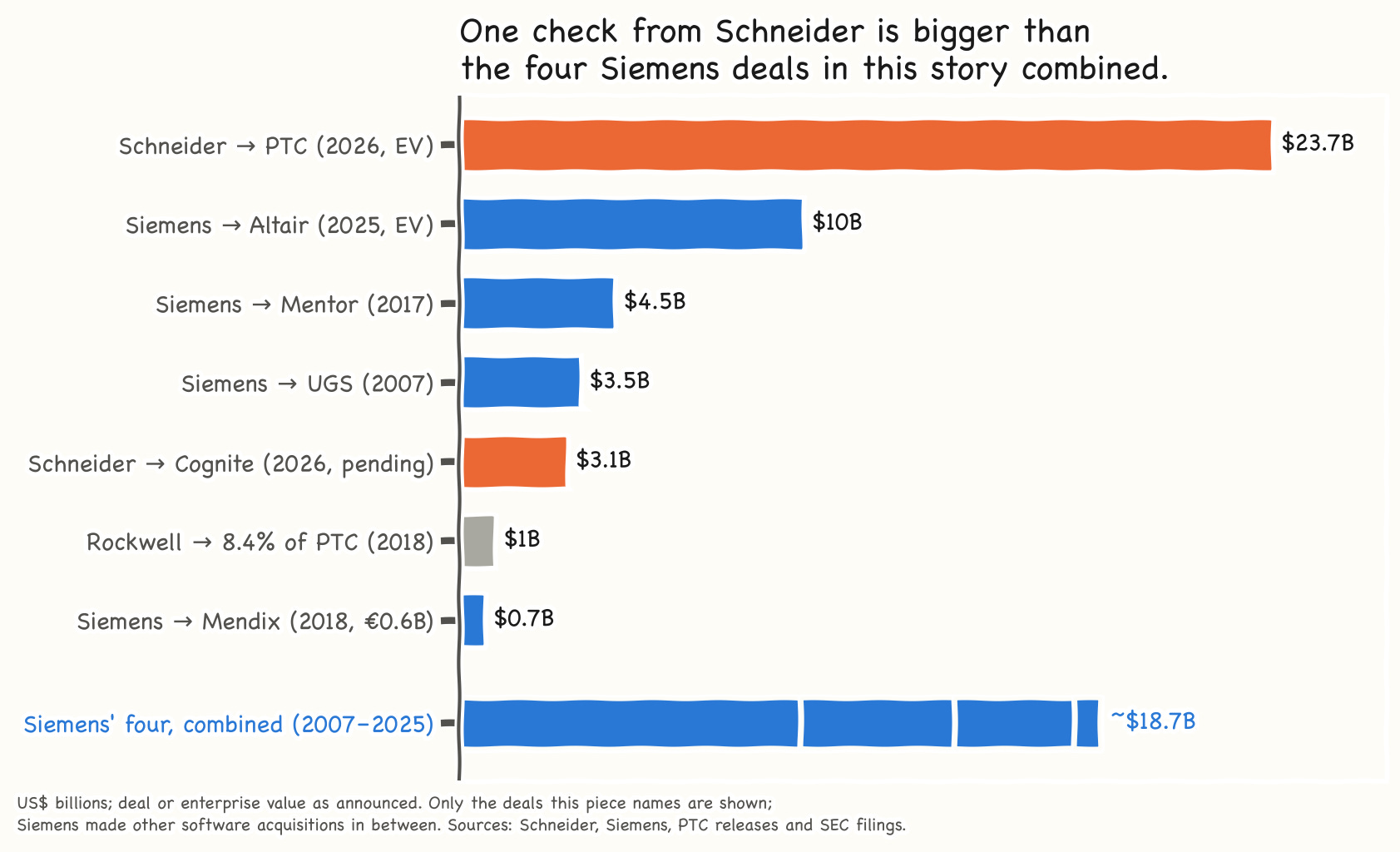
On October 5, Schneider Electric confirmed it will buy PTC, the Boston industrial software company, for $205 a share in cash. That's $22.6 billion in equity value and $23.7 billion in enterprise value once debt is included, the largest acquisition in Schneider's history. In the press release, Schneider's CEO says the combination will create the industry's most complete "Software & AI powerhouse."
When I saw the news, my head lit up. Schneider has made its move. What's worth looking at in this deal is what shows up once you peel it back layer by layer: what the industrial giants are betting on, and what the real variable in that bet is.
Layer One: The Puzzle
Let me start with the pieces Schneider is putting on the board.
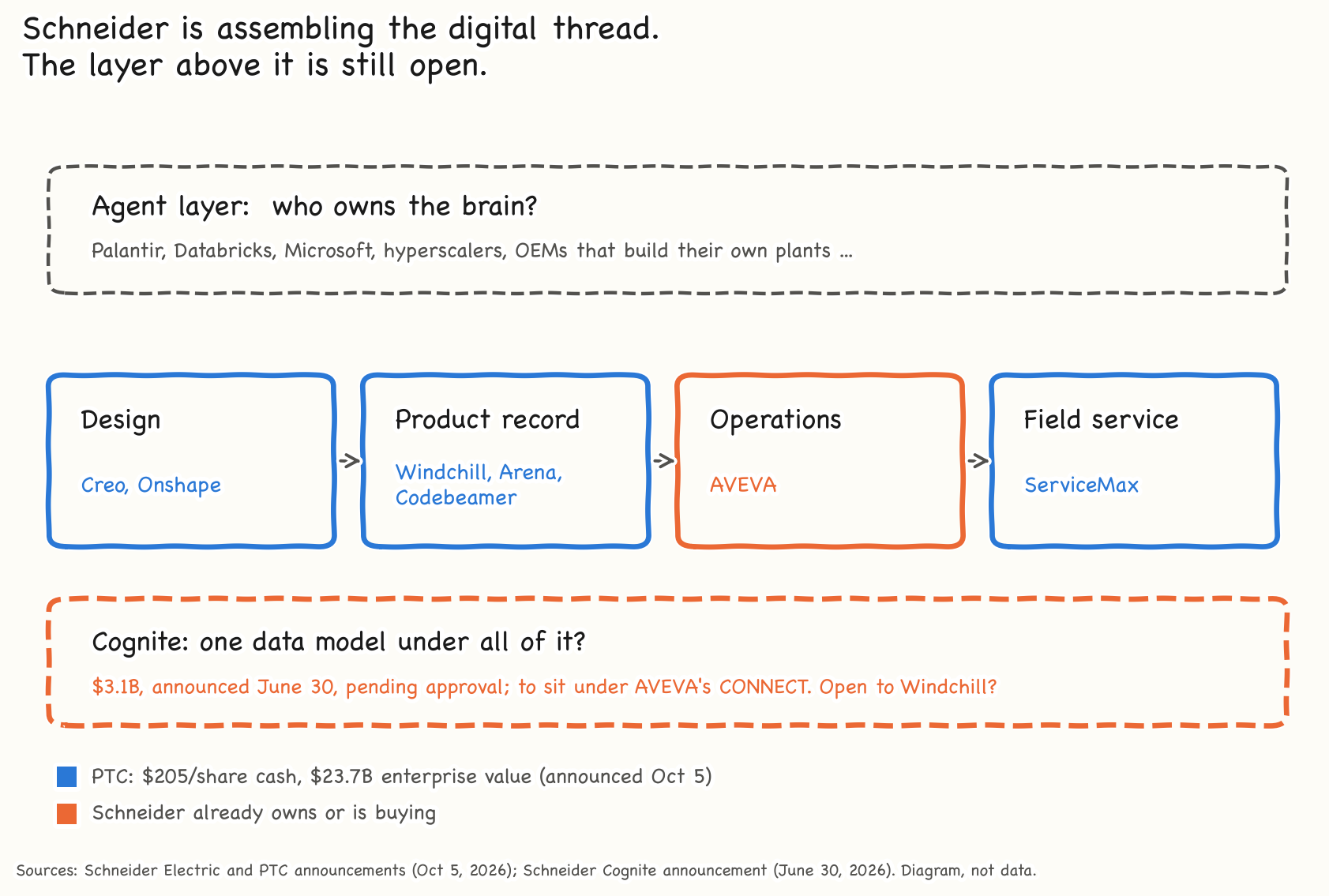
Who is PTC? An old-line Boston industrial software company with two flagship products: Creo (3D CAD) and Windchill (PLM, product lifecycle management). PLM owns a product from its first part drawing to retirement: the BOM, the revisions, every engineering change order. Around those two sits a ring of SaaS acquisitions: Onshape (cloud-native CAD; even my Claude Code vouches for it), Arena (cloud-native PLM), Codebeamer (ALM, for software and requirements traceability), and ServiceMax (field service). Worth noting: PTC has already sold off its IoT half. The sale of ThingWorx and Kepware to TPG was announced in November 2025 and closed this March. Today's PTC is a pure product-side company.
What does Schneider already have? AVEVA, on the plant and operations side, wholly owned since January 2023. AVEVA covers process design, production operations and asset performance. Add Cognite (industrial data plus AI), which Schneider announced it would buy for $3.1 billion on June 30 and which is still waiting on regulators. Cognite does the dirty work of lining up OT, IT and engineering data into one contextualized model.
Put the three together and the picture Schneider wants is clear: one unbroken data chain from the moment an engineer draws the first part to the moment a field technician shows up for a repair. The digital thread the industry has been talking about for fifteen years.
Layer Two: The Real Bet
Schneider isn't paying for PLM license revenue. The price tells you that. $23.7 billion in enterprise value against roughly $2.45 billion of PTC ARR and about $850 million of free cash flow guided for this fiscal year. That's close to 10 times ARR and about 28 times free cash flow, for a company whose ARR, excluding divested businesses, is growing at 9%. Nobody pays that for a single-digit grower because of what it earns today.
Where the money comes from says the same thing. The "all cash" comes from roughly €5 to 6 billion of new Schneider shares and €16 to 17 billion of new debt, and buybacks are expected to pause in 2027 and 2028 to make room. This is a heavy bet.
What Schneider is betting on is a position. In the AI era, whoever owns the unified product-plus-asset data model sits at the front door of the future factory. Predictive maintenance, generative design, agent orchestration: all of it eventually has to land on that data foundation. Schneider's math is simple. Let others build the AI apps, and collect a toll on the data layer.
The logic holds up. But the seat isn't empty. Palantir built its business on the ontology, and Databricks and Microsoft both want to be the foundation for industrial data too. The bigger problem is in the next layer.
Layer Three: Can It Be Integrated?
Just thinking about the integration makes my scalp prickle.
AVEVA thinks in asset hierarchies, the way process industries do. PTC thinks in BOMs, the way discrete manufacturing does. Those are two different ontologies, and unifying them is hell-level difficulty. Cognite is a data and AI company that started in Norway. PTC is an old Boston software house. AVEVA is British. On top of that sits a French headquarters with electrical-hardware DNA. Three cultures, three tech stacks, one integration. Honestly, I don't know Schneider's leadership, but I'm nervous for them.
There are three reference points.
Siemens. Siemens has been running this "buy everything from design to operations" playbook for nearly twenty years: UGS in 2007, then Mentor and Mendix, then Altair in 2025 for about $10 billion. It shows the road can be walked. It also shows how long the road is.
Rockwell. In 2018, Rockwell paid $1 billion for about 8.4% of PTC, and the story was the same one Schneider is telling today: PLM plus IoT, plugged into Rockwell's installed base of automation, to take on Siemens. Three years later Rockwell set out to sell the stake, and by 2023 it was gone. And the core of that alliance, ThingWorx, now belongs to TPG. The digital thread didn't grow out of a partnership.
GE's Predix. Built in-house rather than bought, it absorbed billions of dollars and didn't make it. Its lesson isn't about integration. It's about the story. Customers didn't buy "one platform to rule them all."
Schneider's own record isn't bad. It announced the AVEVA deal in 2017, took control in 2018, and absorbed it fully in 2023, and the products survived the digestion. At the very least, it bought software and didn't wreck it.
So this layer comes down to one piece: Cognite, and whether it can be the anchor. Schneider has already given half the answer. Once the deal closes, Cognite goes into AVEVA as the data layer under the CONNECT platform. The next step is what to watch. If that data layer opens up to Windchill and becomes the shared backbone for both the product side and the operations side, the digital thread is real. If it only serves AVEVA's own products while PTC builds its own, you have three brands hanging under one group name. And if Schneider then forces everything into "one Schneider cloud" and three roadmaps stall for three years, that's the Predix road.
Layer Four: AI Native, the Real Variable
The first three layers are all about execution risk inside the existing frame. The bigger variable sits outside the frame.
The "unified data model" moat rests on one assumption: that in the AI era you still need structured data, modeled in advance. But suppose foundation models and agents really get to schema-on-read, reasoning directly over the tangle of Windchill, SAP, historians and PDF drawings without first aligning everything to an ontology. Then the work Cognite does drops from "the only way through" to "a nice optimization."
One layer harsher: suppose AI changes the form of engineering work itself. A natural-language description becomes a verifiable design, and the design drives robots directly. Then the CAD → PLM → MES chain, which has collected license fees for thirty years, gets compressed. PTC's core asset, the structured product master record, is exactly the thing that might dissolve.
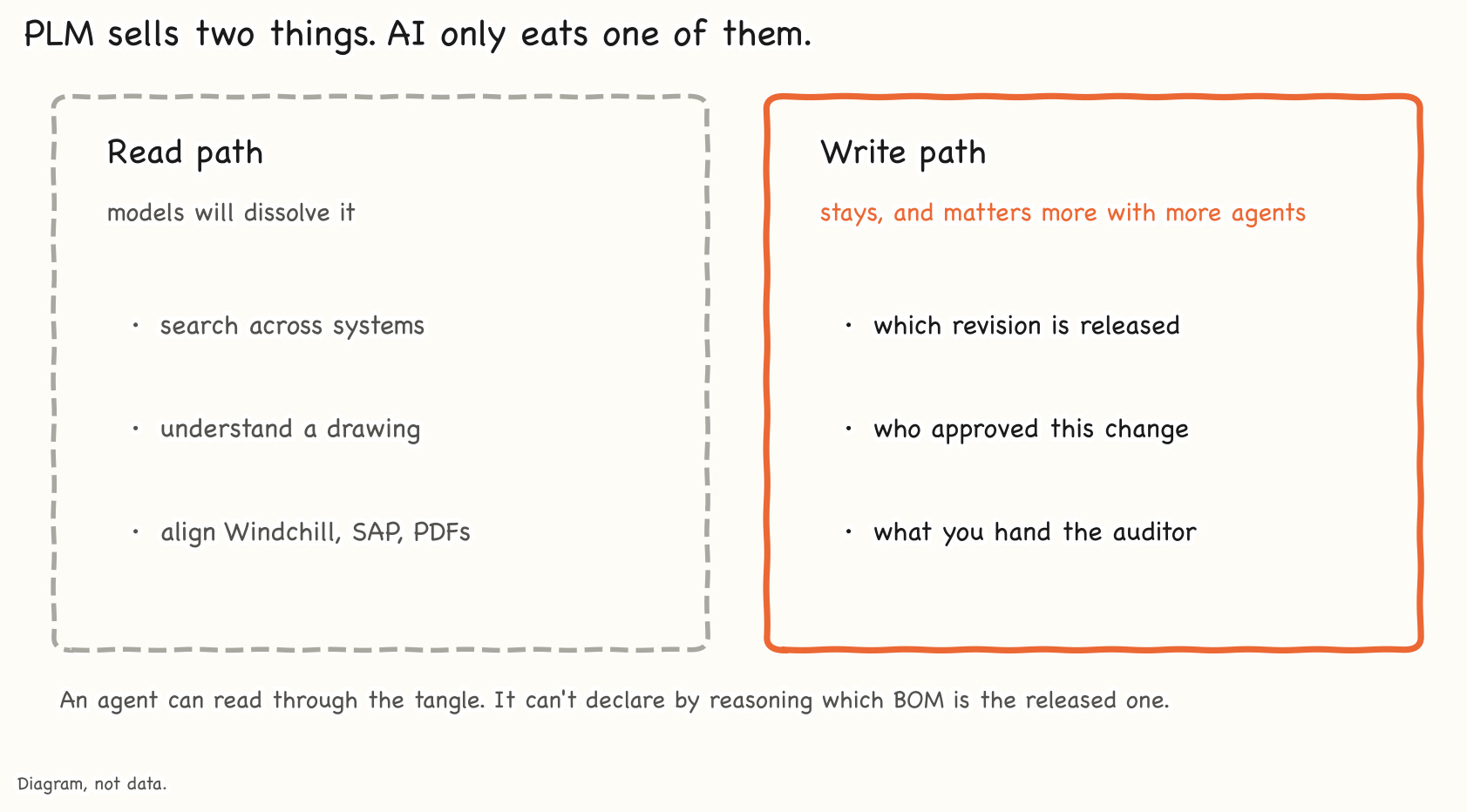
But two things need to be separated here. PLM has never sold just "structure." It also sells authority: which revision is in effect, who approved this change, what you hand the auditor. An agent can read through the tangle, but it can't declare by reasoning which BOM is the released one.
So the sharper cut is by read and write. The read path, meaning search, understanding, cross-system alignment, will be dissolved by models. The write path, meaning authorization, change, audit trail, stays. And the more agents there are, the more they need a ground truth they all accept.
That gives three branches:
AI stays at the copilot layer (a smart assistant bolted onto existing systems). Schneider wins: data layer plus distribution channel equals a toll road. That assumes it can hold the data layer against Palantir and the hyperscalers.
AI grows into an agent layer. The value of the read path gets pulled out, and what's left of PTC is an authoritative ledger. A ledger is worth something, but not $22.6 billion. Value moves to whoever owns the agent layer and the physical execution layer.
Most likely: both. Where the write path is heavy, the backbone holds, in aerospace and medical devices for instance, where one wrong BOM revision can kill someone. Read-heavy work, like divergent design, troubleshooting and documentation, gets eaten by AI-native tools.
Layer Five: What If the Factory Itself Is AI Native?
A scenario worth more thought than "AI-native companies steal PLM deals" is a new factory built AI native from day one: software defines everything, the digital twin is the main interface rather than the physical line, agents orchestrate production, and flexible robots replace fixed automation.
That flips the board over. It doesn't even need to beat Windchill. It just makes Windchill matter less, and it shakes the basic assumption behind Schneider's bet: that the future factory equals today's factory plus better-connected data.
Three walls set the speed:
Brownfield gravity. Most of the world's manufacturing capacity is existing, older plants, and greenfield builds are a minority of capex over the next decade. Schneider feeds on the installed base, and nobody takes a bite out of that quickly.
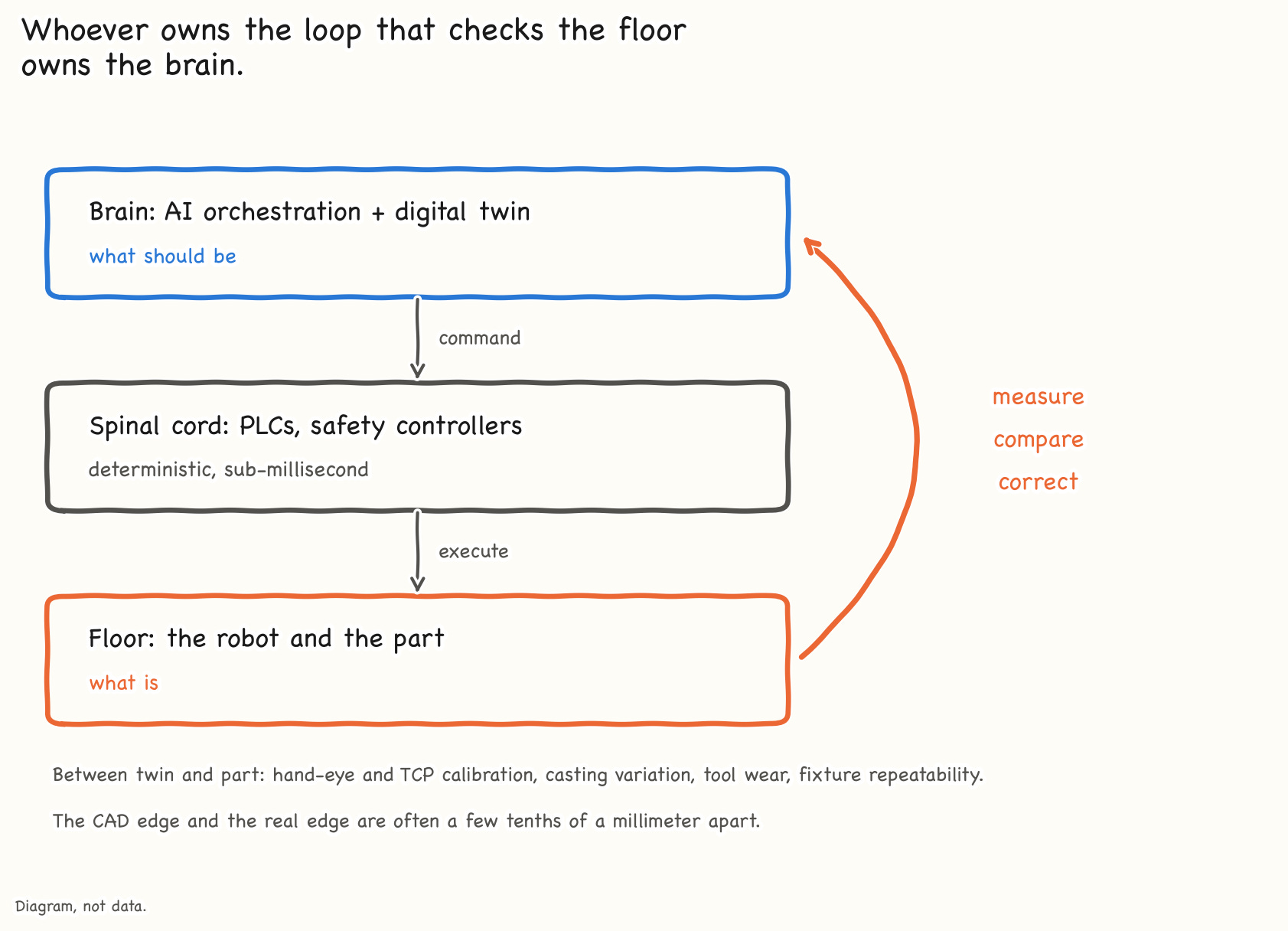
The determinism floor. Safety interlocks and sub-millisecond real-time control can't run on stochastic models. The future factory is most likely two layers: a deterministic control layer as the spinal cord, and an AI orchestration layer as the brain. The spinal cord is exactly what Schneider, Siemens and Rockwell sell. PLCs won't disappear. They'll become cheaper, more standard reflex arcs.
Value migration. The real danger isn't the factory going pure AI. It's value migrating up into the brain layer. If that layer goes to a hyperscaler, or to an OEM like Tesla that builds its own plants, then Schneider plus AVEVA plus PTC all become plumbing. Think of what happened to handset makers once the value moved to iOS and Android. This would be the industrial version.
Layer Six: From the Twin to the Floor
The factory of 2032 probably looks something like this. Decisions run through the twin first. Schedules go out in natural language. Flexible robots read the new work order and regroup themselves. Below the floor, PLCs and safety controllers keep executing deterministic logic as before.
Anyone can draw that picture. What's hard to see is the stretch in the middle.
I've spent years getting robotic processes to work on real shop floors. "The design drives the robot directly" has to pass through a long error chain on the floor: hand-eye calibration, TCP calibration, casting variation in incoming parts, tool wear, fixture repeatability. The edge in CAD and the edge on the part are often a few tenths of a millimeter apart, and some process windows are about that wide. A path that runs clean in the twin only counts on the floor after measurement, compensation and re-verification.
That points to one judgment. The brain isn't done when it computes a command. It has to know whether the physical world actually did what it was told. The data model records what should be. The hard part of a factory has always been what is. Whoever owns that verification loop of measuring, comparing and correcting is the one who really owns the brain.
Schneider's $22.6 billion is a bet that it can own that brain. Cognite and the "AI powerhouse" it advertises are aimed straight at it. If it ends up as a copilot plugin on someone else's brain, the $22.6 billion bought a more expensive pipe.
The Endgame Is Open
Back to first principles. A factory, at bottom, turns design into physical things. For thirty years, industrial software has made its money in the translation layer between design and the physical world. AI is rewriting that translation layer. Schneider understood this, and that's why it placed the bet.
Where the game goes once AI flips the table, nobody knows yet. But there are three signals worth watching. The deal is expected to close by the third quarter of 2027, and we'll know more two or three years after that.
Whether Cognite's data layer opens up to Windchill. If it does, the digital thread is a product, not a slide deck.
Whether PTC's ARR growth holds around 9%. If integration stalls the roadmap, this is where it shows first.
Whether any new plant publicly announces it will skip traditional PLM and MES and let an agent layer orchestrate directly. The first one turns Layer Five from a thought experiment into reality.
If, three years from now, the first two hold and the third hasn't happened, this piece was too pessimistic about Schneider.
If you know an engineer whose Windchill, SAP and historian still don't talk to each other, and who is being pitched a digital thread this year, send them this.
Disclosure: The author leads R&D at an industrial AI and robotics company that works in what this piece calls the agent layer and the physical execution layer. The judgments above come from that seat.
Sources:
Deal price, equity and enterprise value, financing, buyback pause, expected close and the CEO quote: Schneider Electric press release; "largest-ever acquisition": Reuters, October 5.
PTC fiscal 2026 Q3 (April to June 2026): ARR of $2.448 billion (constant currency, excluding divested businesses), growth of 9.1%, full-year free cash flow guidance of about $850 million: PTC 8-K. Valuation multiples are my own calculation from these.
Cognite: announced June 30, 2026, $3.1 billion in cash, to be integrated with AVEVA as a data layer within CONNECT; still pending regulatory approval as of October 5: Cognite/Schneider release.
ThingWorx/Kepware sale to TPG: announced November 2025, closed March 13, 2026.
AVEVA: Schneider took a 60% stake in March 2018 and full ownership in January 2023: Schneider release.
Siemens completed its acquisition of Altair in March 2025, at an enterprise value of about $10 billion: Siemens release.
Rockwell's $1 billion investment in PTC for about 8.4%, June 2018: PTC 8-K; sales began in fiscal 2022 and were complete by September 2023: Rockwell 2023 annual report.