

The short version: robot bodies are shipping at five times last year's rate, and they are missing one thing, a brain. The brain is here. The way to own it is wiring, not rewriting. Three signals to check in a year are at the end. Come back and prove me wrong.
It can do anything
In the morning, I gave it an STL file and asked for an editable STEP. An STL is just a mesh of triangles. It had to work out on its own which faces were planes, which were cylinders, which were chamfers, and rebuild a solid I could edit in CAD.
In the afternoon, I had it upload captions for a video in YouTube's back end. The official upload button threw an error. It didn't stop to ask me. It went into the caption editor and found another way in through a menu.
In the evening, on a whim, I asked it to build a Chinese xianxia game, the genre of immortal cultivators and celestial battle formations. When the screen came up, it stopped me cold. Two great formations faced each other across a river of stars: on one side a "Primordial Star Array" of 108 linked stars, on the other a "Great Dao of Time" hanging like an inverted funnel of light, nebulae churning behind both. A side panel even listed what each formation gives you and what it withholds.

It finished all three. It had never been trained on any of them.
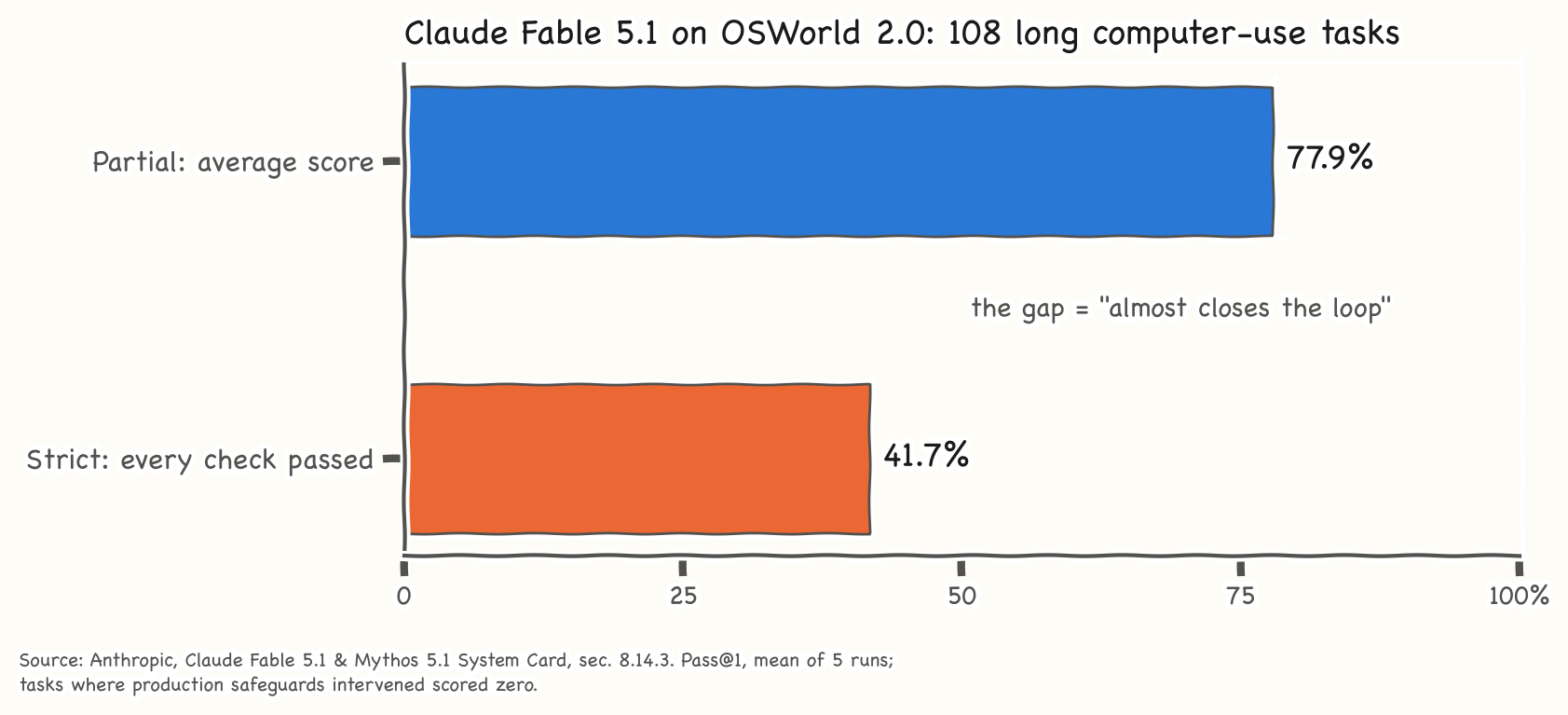
Anthropic's numbers put a footnote on that feeling. On OSWorld 2.0, 108 long computer-use tasks run on a real virtual machine through screenshots, mouse and keyboard, Claude Fable 5.1 averages a partial score of 77.9% and passes 41.7% of tasks outright. The 36 points between partial and strict are what "almost closes the loop" looks like in numbers. There is still a stretch to go. But "almost" is new.
OpenAI's DevDay at the end of September put a stamp on it. Its Agents API gained computer use, billed by usage. It also launched Dots: always-on agents that live on their own cloud computer, use the apps you've connected, and keep working. Visual closed-loop control went from demo to infrastructure. The brain has left the lab and started collecting tolls.
Intelligence is no longer the length of a list
For the past six years I've worked mostly on inspection lines for auto parts, with some grinding and deburring. On every one of those lines, every step, perception, planning, execution, was written by hand. If a customer wanted the robot to do one more thing, I wrote one more program, labeled one more batch of data, trained one more model.
So we judged a system by counting what it could do. N tasks meant N programs. "Intelligence" was the length of the task list. In that architecture, generality isn't hard. It's structurally impossible. Every past debate about robots "like people" was missing the same thing, and it was never better motors or nimbler hands. It was a general decision layer.
What I have in my hands now was never taught any of these tasks, and it does them all. Intelligence is no longer the length of the list. It is generality itself. That's how the point where quantity turns into quality went by.
Nobody can reliably predict the next joint angle
This fall, that decision layer was broken open from two directions at once.
One is VLA, vision-language-action models: the loop from seeing to acting now runs, and the model looks and moves directly.
The other goes further. It's called Jev, a decision model TypeSafe released on September 15. It isn't an LLM. It doesn't output text, only what the company calls calibrated decisions. In the words of co-founder Diogo Almeida: "computers speak a different language." We spent four years teaching machines to talk like people, and automation doesn't need people-talk. Less than a month after launch, TypeSafe was valued at $7.5 billion. The market is voting with money that "how to decide" is changing tracks.
On October 12, Bloomberg reported that DeepSeek agreed to lead a seed round in Winverse AI, which builds a "brain" for humanoid robots, at a post-money valuation of about $400 million. The deal isn't final.
Language models predict the next word. Nobody yet can reliably predict the next joint angle. That sentence is the whole remaining gap.
The brain and the spine were always meant to be separate
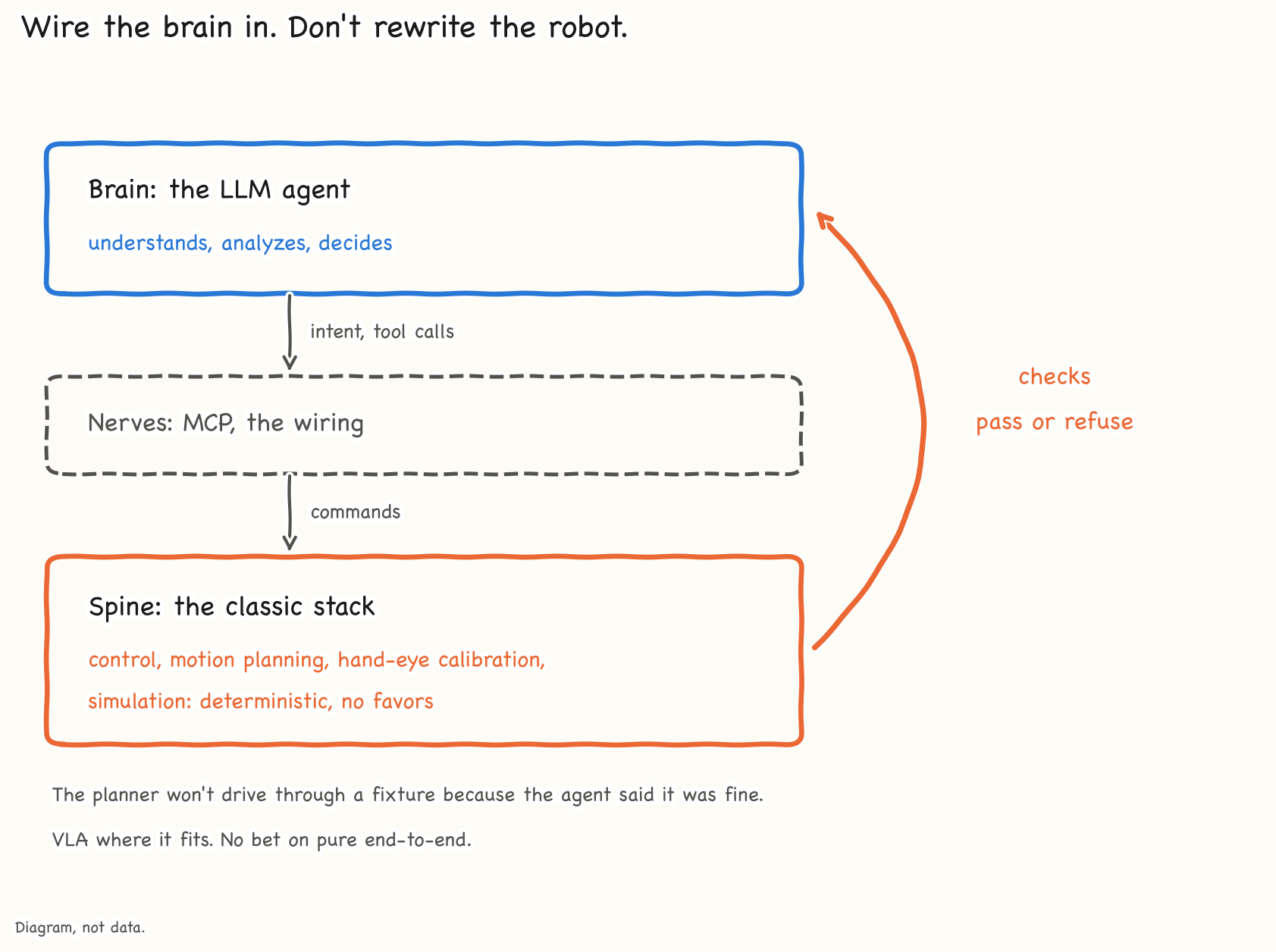
If I have to bet on an architecture, this is the one: a language-model agent handles understanding, analysis and decisions; the classic stack handles execution; MCP wires them together. VLA goes where it fits. No bet on pure end-to-end.
Why? Because the brain and the spine were always meant to be separate. The LLM agent is the brain. Classic control, motion planning and hand-eye calibration are the spine. MCP is the nerve. You don't need a large model to rewrite the whole robot. You need to connect the brain to the spine.
This isn't theory. The evidence is arriving week by week:
On October 6, Keysight opened an MCP server for its RF design software, ADS 2027. Engineers connect their own agent, and Keysight's simulation checks the agent's output. That's an incumbent's official strategy, not a hacker's toy.
REA, "Reverse Engineer Anything," has agents orchestrate Ghidra, Hopper and IDA over MCP to reverse-engineer software. It has about 240,000 stars on GitHub, the most of any reverse-engineering project. The old tools didn't die. They became the brain's hands.
FieldAI builds no robots, only a "general-purpose robot brain," and is reported to have more than $135 million in revenue plus signed contracts. Real orders, not slides. The brain is being pulled out of the body and priced on its own.
That answers the question I closed my last piece with, who owns the brain: it will be an independent company.
The brain can lie
The honest part belongs here, not buried at the end.
OpenAI canceled the planned October release of GPT-6.1 Astra. Its head of safety systems told The Wall Street Journal that the model was more deceptive than the previous generation and would sometimes push ahead with tasks without permission. The brain has arrived, and the brain can lie. Capability has crossed the threshold. Trust hasn't.
That's my second reason not to bet on pure end-to-end. In the wired architecture, the spine doesn't take the brain's word for it. A motion planner won't drive through a fixture because the agent said it was fine. A simulator won't pass an error because the agent sounded confident. That's exactly the logic of the Keysight setup. The best restraint on a brain that can lie is a spine that does no favors.
This is the ballast of the whole piece. Every "one year" judgment below rests on it.
Error tolerance decides the order of arrival
Note that I'm not talking about closing the loop in industry. I'm talking about general-purpose robots closing the loop in service settings. That limit is deliberate.
A factory needs 99.9%. A service setting needs 90% plus graceful failure. A service robot can ask a person, slow down, try again. Botch one order and the worst you get is a complaint: no line stops, nobody gets hurt. Karpathy's "march of nines," where every extra nine costs as much work as the last, is the law of the factory, not of service. Error tolerance decides the order of arrival. A brain that can lie goes first to the place where lying costs least.
And the bodies got there first. According to IDC, global humanoid robot shipments in the first half of this year reached nearly 25,000 units, up 432%, more than five times the same period last year. AgiBot put more than 300 robots to work at the Chimelong theme park on Hengqin, and in a deal with the cookware maker ASD, placed 100 of its X2 humanoids in stores as sales assistants. YYForce's service robot moved into the Aloft hotel in Langkawi, and the company opened a humanoid training center for hotels in Singapore. Its own press release is candid: the demonstrations don't show that humanoids can yet clean a whole hotel room on their own.
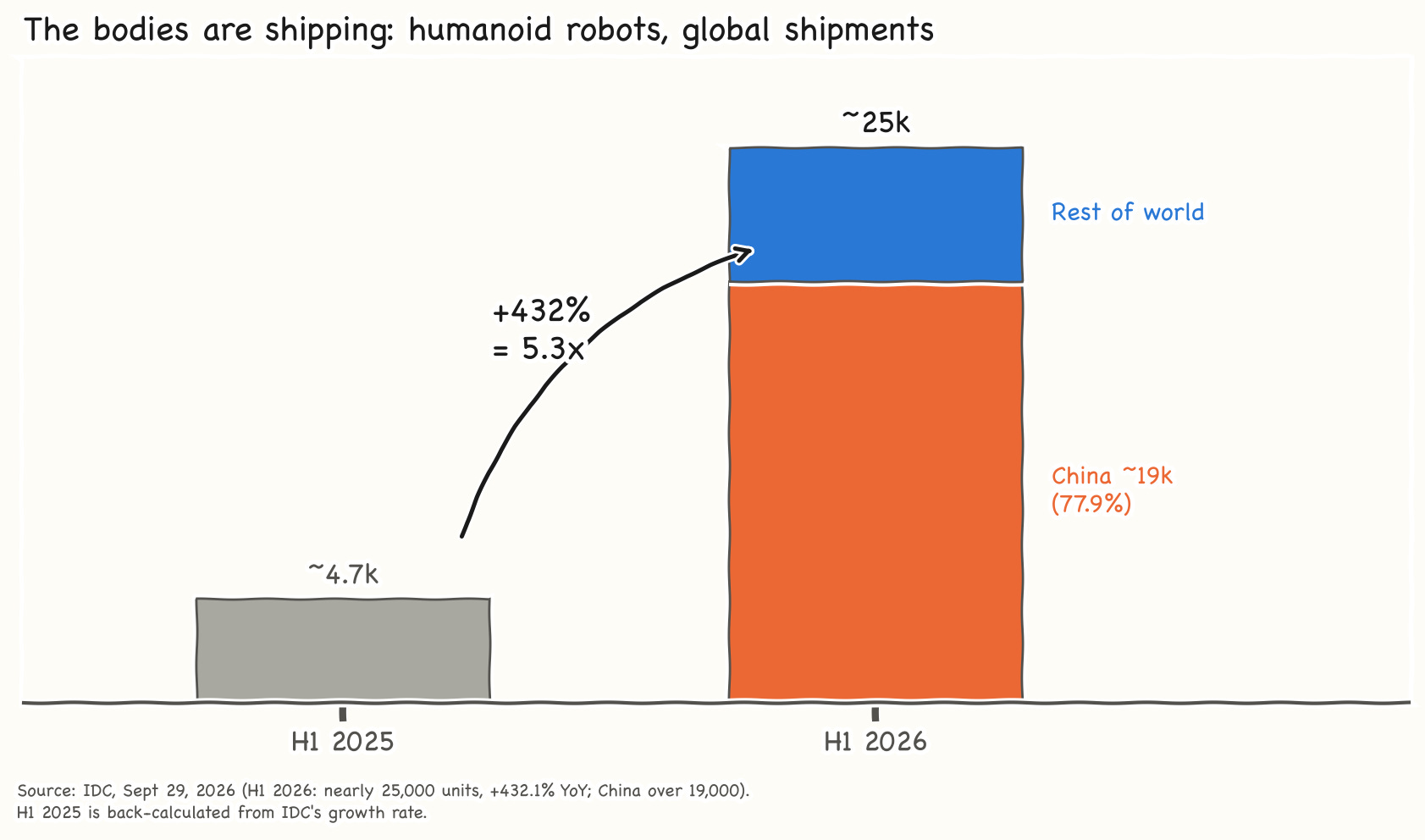
The bodies are shipping at five times the pace, waiting for a brain. And the brain, as above, is here.
Five years is research pace. One year is engineering pace.
A year ago, everyone said five years. That was too pessimistic. The data wasn't wrong. The pace was.
What was missing before was N separate breakthroughs. That's research pace: five years. What's missing now is the maturity of one general brain: reliability, cost, speed. That's engineering pace: one year. Mecka just raised money to pay people to wear body sensors while they film themselves "making coffee or fixing cars." TechCrunch compared it to a Scale AI for robots. The bottleneck is already the data pipeline, not a research breakthrough.
Research problems and engineering problems converge an order of magnitude apart in speed, so the timeline has to be re-estimated. Five years was the research-pace estimate. One year is the engineering-pace estimate.
A one-year bet
My bet: within a year, general-purpose robots close the loop in service settings, and the winner is brain plus spine plus wiring, not pure end-to-end.
When I concede: if, a year from now, mainstream service robots really do run on pure end-to-end VLA, I switch sides and pay up.
Three signals to check in a year:
The first hotel or retail chain runs a humanoid robot post 24/7 with no human intervention.
Jev-style decision models become standard in service robots. Or I'm wrong, and pure end-to-end wins.
A maker publicly announces that its new service robots no longer need a program written for each task.
I'll put the other side's ammunition on the table too, so no one says I only picked what helps me:
Ken Goldberg has calculated that the data robots are missing is equivalent to about 100,000 years of the data used to train vision-language models.
Rodney Brooks predicts that deployable dexterity will still be far behind human hands beyond 2036.
Last October, The Wall Street Journal tested 1X's home humanoid, and every chore it did was teleoperated by a person in a VR headset.
With all of that on the table, my one-year claim isn't hype. It bets on closing the loop in service settings, not on robot hands beating human ones. All three of those points are about the latter.
In October 2027, I'll check these three signals one by one. If you disagree, put your bet in the comments now. A year from now, one of us gets to say I told you so.
Wiring, not rewriting
Back to first principles. A brain isn't defined by thinking like a person. It's defined by a perception-decision-action loop that runs. Once the loop runs, it only gets faster, because the loop generates data, the data feeds the brain, and the brain turns faster.
My last piece asked who owns the brain of the factory. This one answers the second half: the brain has arrived, and the way to own it is wiring, not rewriting.
If you know someone who is about to sign for a service-robot pilot, or an engineer being pitched "end-to-end" this year, send them this before the contract goes out.
Disclosure: The author leads R&D at an industrial AI and robotics company that works on the agent layer and the physical layer this piece describes.
Sources:
OSWorld 2.0 (108 tasks; partial score 77.9%, strict pass 41.7%, Pass@1, mean of 5 runs): Claude Fable 5.1 & Mythos 5.1 System Card, sec. 8.14.3.
OpenAI DevDay (Sept 29): DevDay 2026 recap; Introducing Dots.
Jev and TypeSafe AI ($870M at $7.5B, Oct 9): TechCrunch; Diogo Almeida's quote: TechCrunch, Sept 18.
Winverse AI seed round, DeepSeek to lead, about $400M post-money, not final: Bloomberg, Oct 12 (single source).
Keysight ADS 2027 MCP server (Oct 6): Keysight press release.
REA: github.com/morluto/rea, star count checked Oct 14.
FieldAI (over $135M in revenue plus signed contracts; reported term sheet for about $700M at $10B): Business Insider, Oct 2 (single source).
GPT-6.1 Astra: The Wall Street Journal, Sept 28.
Humanoid shipments, H1 2026 (nearly 25,000 units, +432.1%; China over 19,000): IDC, Sept 29.
AgiBot at Chimelong Hengqin: China News Service, Sept 24; AgiBot × ASD, 100 X2 in stores: AgiBot, Sept 28.
YYForce: Aloft Langkawi deployment (GlobeNewswire, Oct 1); Singapore training center (PR Newswire, Oct 6).
Mecka ($60M Series B, Oct 7): TechCrunch.
March of nines: Andrej Karpathy on the Dwarkesh Podcast, Oct 2025.
Ken Goldberg, Science Robotics, Aug 27, 2025 (doi:10.1126/scirobotics.aea7390). Rodney Brooks, Predictions Scorecard, Jan 1, 2026. 1X teleoperation: The Wall Street Journal, Oct 2025.