

The short version: in Two Ledgers, One Price, an American buyer and a Chinese supplier read the same quote with two different chains of reasoning. This piece goes back to where those chains were installed: the high-school textbook. From 2000 to 2015, every Chinese high-school student took politics class twice a week for three years, and it started with the commodity and ended with state control. About half of American students took one semester of economics, and it started with scarcity and ended with price signals. Both books teach markets. One puts labor in lesson one. The other puts scarcity there. The ledgers split on page one.
In Two Ledgers, One Price, I took one thing for granted: that a purchasing manager in Ohio and a factory owner in Zhejiang look at the same quote with different toolkits, one from Econ 101 and one from Chinese high-school politics class. This time I want to know how those toolkits got installed. What the curriculum said, what order the textbook taught things in, how much it counted on the test, how many hours a week, and who had to take it at all.
So I went through the high-school textbooks both countries used between 2000 and 2015. If you're between 30 and 45 now, these are the books of your teenage years, on one side of the Pacific or the other.
Your side of the table first
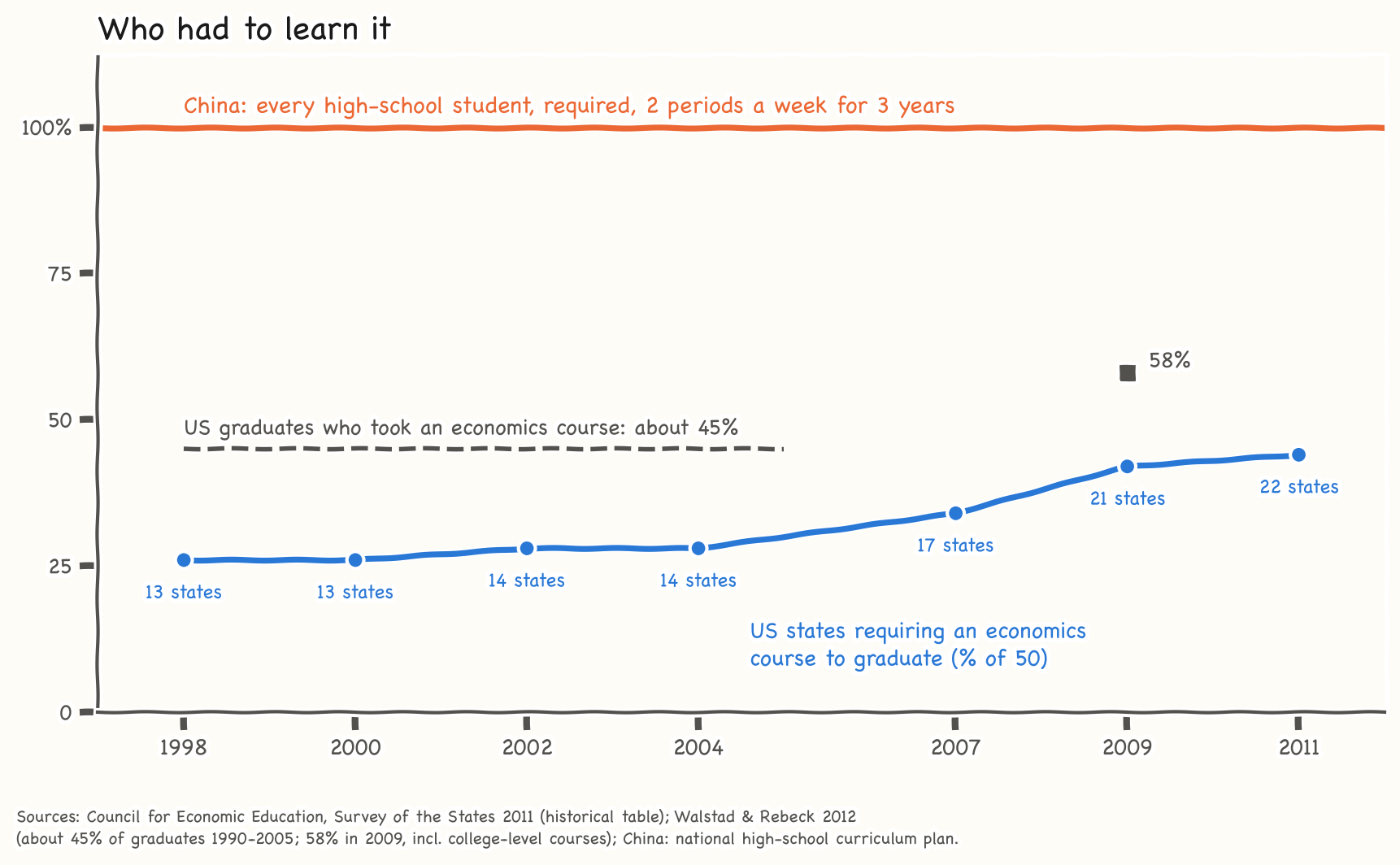
Here's a fact that surprises Chinese readers more than American ones: around 2000, most American high-school students were not required to study economics at all. According to the Council for Economic Education's Survey of the States, the number of states that required an economics course to graduate was 13 in 1998, 13 in 2000, 14 in 2004, 17 in 2007 and 22 in 2011. Some big states were in early. California has required a semester of economics since the 1986–87 school year. New York reportedly began requiring a half-credit in 1985. Texas wrote it straight into its education code: "economics, with emphasis on the free enterprise system and its benefits." Transcript studies show that from 1990 to 2005, about 45% of high-school graduates took an economics course; by 2009 it was 58%.
If you did take it, here's what you learned. In 1997 the National Council on Economic Education published the Voluntary National Content Standards in Economics: twenty standards that state curricula and the main textbooks lined up behind. The order is the argument:
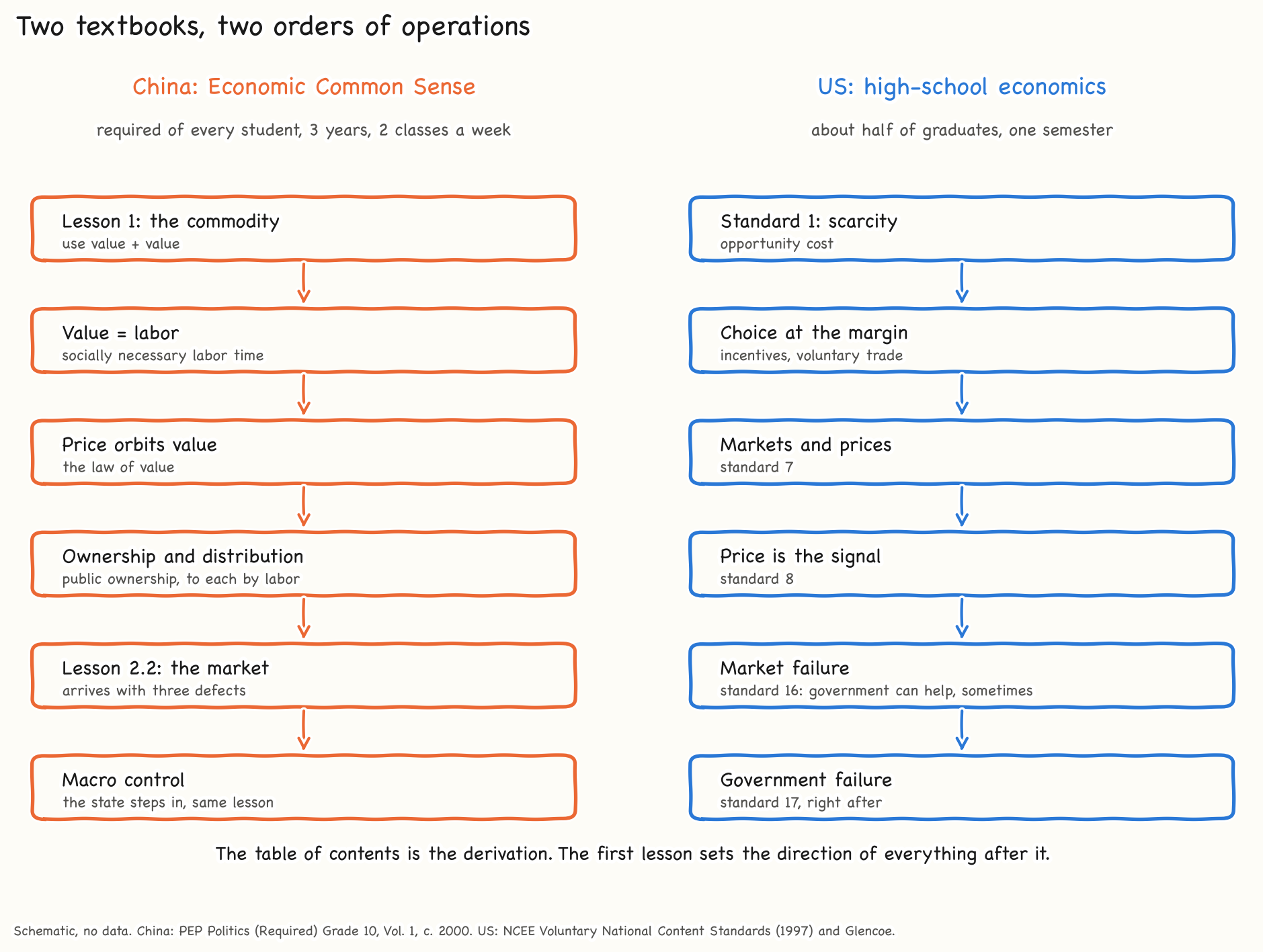
Scarcity · 2. Decisions at the margin · 3. Allocation · 4. Incentives · 5. Voluntary trade · 6. Specialization · 7. Markets and prices · 8. "Prices send signals and provide incentives to buyers and sellers" · 9. Competition · 10. Institutions · 11. Money · 12. Interest rates · 13. "Income for most people is determined by the market value of the productive resources they sell" · 14. Entrepreneurs · 15. Growth · 16. The role of government and market failure · 17. Government failure · 18. Economic fluctuations · 19. Unemployment and inflation · 20. Fiscal and monetary policy
Glencoe's Economics: Principles and Practices (Clayton, around the 2005 edition), one of the most widely used high-school texts of the period, follows the same order. Chapter 1 is scarcity, opportunity cost, the production possibilities frontier and the circular flow. Chapter 2 defines the American economy as free enterprise with limited government. Chapters 4 to 6 are demand, supply and prices as signals, which are "neutral," "flexible" and have "no administrative costs." Government shows up in chapters 9 and 10, as revenue and spending. Poverty is a subsection of chapter 14, "Economic Instability."
Three things to notice. First, you started from scarcity, not labor. There is no "value" sitting underneath prices in this book. Prices don't orbit anything. A price is the information. Second, government arrives as a matched pair: standard 16 says what government can do when markets fail, and standard 17, right after, says government fails too. Greg Mankiw's college textbook (the one that drew a reported $1.4 million advance in the early 1990s and came out in 1997) boils it down to two principles: markets are usually a good way to organize economic activity, and governments can sometimes improve market outcomes. Third, there is no distribution, no accumulation, no labor share, no overproduction. Your income is the market price of what you sell.
The authors of the standards said so plainly in their preface: they adopted the "majority paradigm," the neoclassical model most economists favor, because including "strongly held minority views" would have "confused and frustrated teachers and students." The 2010 second edition kept that language.
And if you skipped the class, you still got the toolkit, just not in a classroom. Junior Achievement brought business programs into schools from 1975 and was reaching more than four million students a year by the early 2000s. The Stock Market Game started in 1977 and had about 700,000 students playing each year by 2008. Milton Friedman's Free to Choose ran as ten episodes on PBS in 1980; the companion book was the year's third-best-selling nonfiction title. Half of American economics education happened outside the classroom. That's the part with no Chinese equivalent.
One more thing about your side: since 2015, even that one semester has been giving ground. The number of states requiring economics reached 26 in 2024, then fell back to 22 in 2026, as Texas, California and Indiana swapped stand-alone economics for personal finance.
The other side of the table: lesson one is the commodity
Now the person across from you. If they went to high school in China between 2000 and 2015, economics wasn't optional, and it wasn't a semester.
Politics class ("Ideology and Politics") was required of every high-school student for all three years, two periods a week. The old national curriculum set 192 hours in total, with economics as the whole first year. In the fall of 2000, politics and Chinese were the first two subjects to get a new nationwide syllabus. On the gaokao, China's college entrance exam, students on the humanities track took an integrated paper where politics was worth roughly 100 points, about 13% of their total score. Science-track students skipped it on the gaokao but still had to pass it on the high-school exit exam. No one got around the first-year book, Economic Common Sense.
Here is that book's order, from the People's Education Press edition used around 2000:
The commodity and the commodity economy: a commodity has two properties, use value and value → value is "undifferentiated human labor embodied in the commodity" → its size is set by socially necessary labor time → the law of value: price fluctuates up and down around value
The basic economic system and the socialist market economy: first ownership (public ownership as the foundation) and distribution (to each according to labor), and only then the market: its general features → its three defects, "spontaneity, blindness and lag" → macro-control by the state → the features of the socialist market economy
Enterprises and managers · 4. Industries and workers · then, in the second volume: 5. Taxes and taxpayers · 6. Banks and savers · 7. Markets for goods and services and consumers · 8. The world market and China's foreign trade
Two things to notice. First, the market doesn't appear until the second half of lesson two, after labor, value, money, ownership and distribution. Price is a surface; value is the substance, and value is labor time. Second, the market arrives already carrying three defects, and state control follows on the same pages. The invisible hand and the visible hand are taught together. The chain runs: markets have laws → the laws have defects → so the state steps in → socialism steps in better.
The second year turns this into method (productive forces determine relations of production; contradiction; quantity turning into quality), so "market versus control" becomes a "unity of opposites." By 17, a humanities-track student carries a toolkit of labor, value, distribution, overproduction, contradiction and control.
Then the book changed. From 2004, a new national curriculum rolled out province by province, finishing everywhere but Shanghai by 2010. Economic Common Sense became Economic Life, reordered to feel friendlier: its first unit, "Life and Consumption," opens with lessons on "magical money," "changing prices" and "colorful consumption." But when five economists (Davide Cantoni, Yuyu Chen, David Yang, Noam Yuchtman and Jane Zhang) counted words, "market economy" appeared 208 times in the old textbooks and 67 times in the new ones. The new book states that relying only on the market to allocate resources leads to inefficiency, waste and economic instability. If you're about 30 and studied in China, this was your version, and it trusts markets less than your older siblings' did.
The exam was hardening too. From 2007, the integrated humanities exam spelled out four tested abilities: retrieving and interpreting information, mobilizing and applying knowledge, describing and explaining, arguing and exploring. In the classroom that became a template: classify the issue, state the principle, apply it to the passage. Highlighted outlines, review sheets memorized until they made you sick, "the three functions of the law of value": that's memory, and it's training.
Same word, two textbooks
Put the two books side by side on the same concepts, and the difference isn't in the conclusions. It's in the definitions and the order of appearance.
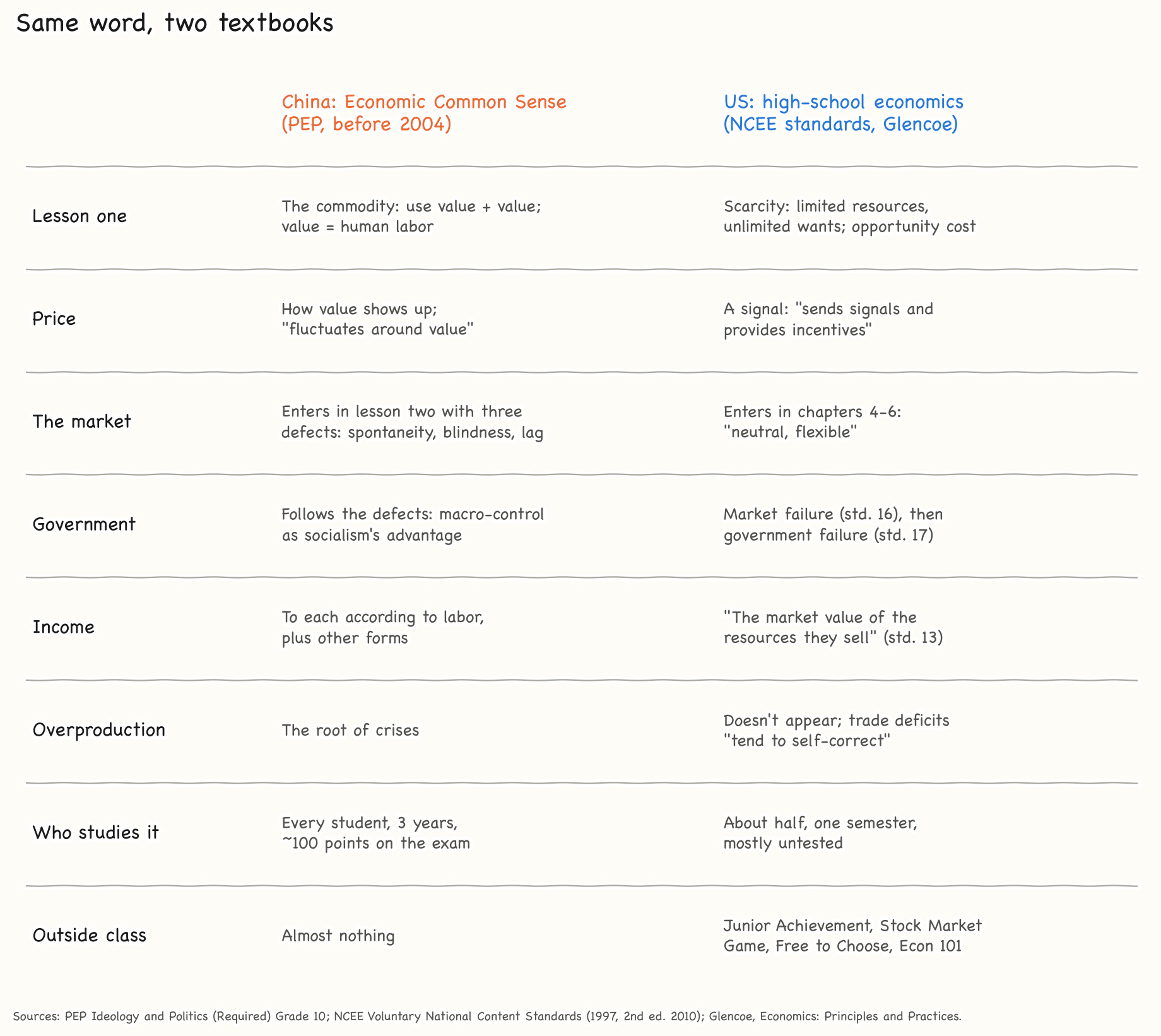
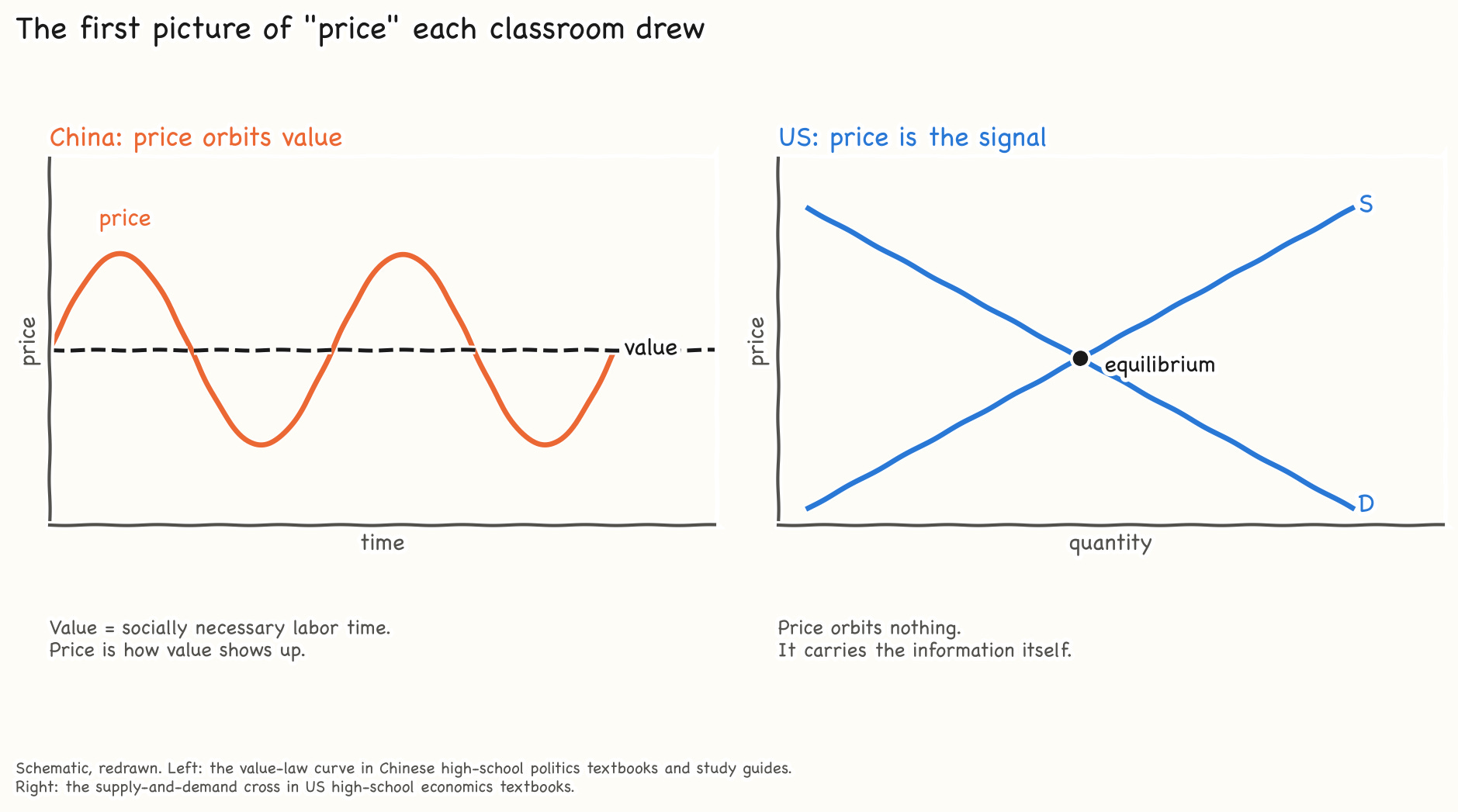
The first two rows are the ones that matter. In the Chinese book, price orbits value, and value is labor. In the American book, price orbits nothing; it is the information. Tell a 16-year-old that "price fluctuates around value," and when he sees a quote below cost his first thought is that value is moving: labor time is falling, capacity is in surplus. Tell a 17-year-old that "price is a signal," and her first thought at the same quote is that the signal is distorted: someone is subsidizing, someone is dumping, it can't last. Neither is thinking wrong. From lesson one, they were looking at different things.
Did the textbooks actually shape anyone?
This is the obvious objection: teenagers memorize, take the test and forget. Both sides have evidence, and none of it is mine.
The strongest comes from China, and it was published in the Journal of Political Economy in 2017. Because the new curriculum rolled out province by province, students one year apart at the same university had studied different books: a natural experiment. Cantoni and his co-authors surveyed 1,954 Peking University undergraduates in 2013. Students who learned from the new books trusted the government more, by 0.25 standard deviations, were more likely to call China a democracy, and were 8.7 percentage points more likely to disagree that a market economy beats every other system, a persuasion rate of about 24%. Across all outcomes, the median persuasion rate was 8%, and more than a quarter of outcomes exceeded 20%. For comparison, the paper cites estimates that Fox News persuaded 3% to 8% of its viewers. It's one elite university, so it doesn't generalize to everyone. But it shows the mechanism: change the textbook, and beliefs move.
The American evidence is thinner and points the same way. A New York Fed study of more than 2,000 graduates of four public universities found that the more economics they took in college, the more likely they were to say tariffs reduce welfare, the less likely to worry about trade deficits, the more opposed to oil price controls, and the less supportive of reducing income inequality. The authors say they can't separate what people learned from who chose to take the courses. Bryan Caplan compared 1,510 members of the public with 250 economists on 37 questions and found significant gaps on 31. On why gasoline prices rise, his model puts the public at a 22.6% likelihood of naming supply and demand, and economists at 80.8%. In other words, the American curriculum pushes people toward economists' views, just not as far, because only half take it and only for a semester.
And one counterintuitive number. On the first national economics assessment in 2006, 42% of American 12th graders reached proficient, and only 11% could analyze how a change in the unemployment rate affects income, spending and production. China has no comparable test, but any former humanities student there can recite "the three functions of the law of value" at 30. The American textbook taught a tool that few people learned to use. The Chinese textbook taught conclusions that everyone memorized.
What each book cut
After reading both, I found more in common than I expected.
Both books accept markets, and both admit markets fail. China lists spontaneity, blindness and lag; the American standards list market failure. Neither is pure planning or pure laissez-faire. The difference is dose and order: the Chinese book puts the failures on the market's first page; the American book puts them at standard 16.
Both chose a paradigm on purpose and cut the other. The American standards adopted the "majority paradigm" so as not to confuse students. When China's 2004 curriculum was being written, according to an account Zhang Boshu published in 2005, an official from the Ministry of Education's basic-education department told the writing team that "the ministry particularly stresses that, for certain basic political views, politics class simply has to indoctrinate"; in an elective module, the introduction to modern Western economics was "deleted entirely except for the Keynes part." One side cut Marx, distribution and accumulation. The other cut Adam Smith's night-watchman state and marginal analysis. Opposite directions, same cut.
Both treat their paradigm as common sense rather than a paradigm. An American student doesn't think she learned neoclassical economics; she thinks she learned economics. A Chinese student doesn't think he learned Marxist political economy; he learned Economic Common Sense, and the title says so. That's why, in Two Ledgers, One Price, Michael Pettis reads as a heretic in America and as common sense in China: neither side thinks of its toolkit as a toolkit.
And three differences. Coverage: in China, everyone, for three years, on the test; in America, about half, for a semester, mostly untested. That's why "overcapacity" and "distribution" are default words in Chinese online debates about involution, while "supply and demand" is the default in English, though only about half the people using it were ever taught it. Starting point: labor or scarcity. Start from labor and you keep asking who made it and who got what. Start from scarcity and you keep asking who bid and what the price is telling you. Outside the classroom: half of American economics education happened outside school. The Chinese version lived almost entirely inside it, and nobody spoke its language after the exam, until they sat down to negotiate with an American customer and found themselves using it.
At the negotiating table
Knowing where the glasses came from is useful the next time you're across from a supplier. Three habits:
Ask what the price means before you counter. If they say costs are falling and the industry is in surplus, they're reading value. If they say the price can't last because someone is subsidizing it, they're reading a signal. Listen for which before you name a number.
Show your derivation, not just your number. "Our labor and yield look like this, so here's the price" and "comparable parts sell here, so here's the price" are two different ledgers. Say which one you're using. They don't have to agree, but they'll know which book you're reading from.
Write the price-change rule into the contract. The two ledgers fight hardest when prices move: one side wants to adjust by cost, the other by market. A formula in the contract saves the argument about whose price is the real one.
For readers between 30 and 45
If you're around 40 and went to high school in the US, there's roughly an even chance you never took economics. If you did, chapter 1 drew a production possibilities frontier and chapter 6 told you prices are signals. If you didn't, Junior Achievement, the Stock Market Game or a talk show taught you that markets are usually right.
The person across the table, if they're around 40 and went to high school in China, opened Economic Common Sense at 16. Lesson one was the commodity, and the market didn't show up until lesson two, carrying three defects. If they're around 30, they opened Economic Life, friendlier and less trusting of markets, and memorized "the market allocates resources" and "the necessity of macro-control" in the same class.
Today those classmates sit on opposite sides of the same quote. One sees 0.7 yuan a watt for a solar module and thinks: labor time is falling, there's surplus capacity, everyone is holding on. The other thinks: below cost, can't last, must be subsidized, someone has to exit. Two Ledgers, One Price called these two pairs of glasses. This one adds: the prescription was written at 16, and it's the table of contents.
I'm not going to say which textbook is better. I'll say something else: neither textbook told its students it was a textbook. The American one is called Economics. The Chinese one is called Common Sense. Both chose a name with no qualifier. Someone who knows they're wearing glasses and someone who doesn't are two very different people. If you've read this far, you're the first kind.
The next step is concrete: read the other side's textbook. The Glencoe book can be borrowed on archive.org, and a used copy of the Chinese Economic Common Sense costs a couple of dollars on Chinese secondhand sites. Lesson one is enough. Lesson one decides everything after it.
If you know a buyer about to negotiate with a Chinese supplier, or an engineer on the way to a factory in Guangdong, send them this before the first conversation about price.
Sources:
China: Ministry of Education notice Jiaoji Han [2001] No. 3 (link); He Bin (2001) on the high-school curriculum plan (link); PEP Ideology and Politics (Required), Grade 10 table of contents (Douban); integrated humanities exam syllabus (link); Zhang Boshu, "Party education in the writing of high-school politics textbooks," Modern China Studies, 2005 no. 2 (link); Cantoni, Chen, Yang, Yuchtman and Zhang, "Curriculum and Ideology," Journal of Political Economy 125(2), 2017 (working paper).
United States: Council for Economic Education, Survey of the States 2011 (PDF) and 2026 (release); Voluntary National Content Standards in Economics, 2nd ed., 2010 (PDF); California Ed. Code §51225.3 (CDE); Texas Ed. Code §28.002; Glencoe, Economics: Principles and Practices (chapter outline); Walstad and Rebeck, Journal of Economic Education 43(3), 2012 (link); NAGB, Economics 2006 (release); Allgood et al., NY Fed Staff Report 450 (link); Caplan, Journal of Law and Economics, 2001 (PDF).