

An American spent four years building an all-American grill brush, and found that finished parts from China cost less than his raw materials at home. He filmed half of the picture. This piece is about the other half.
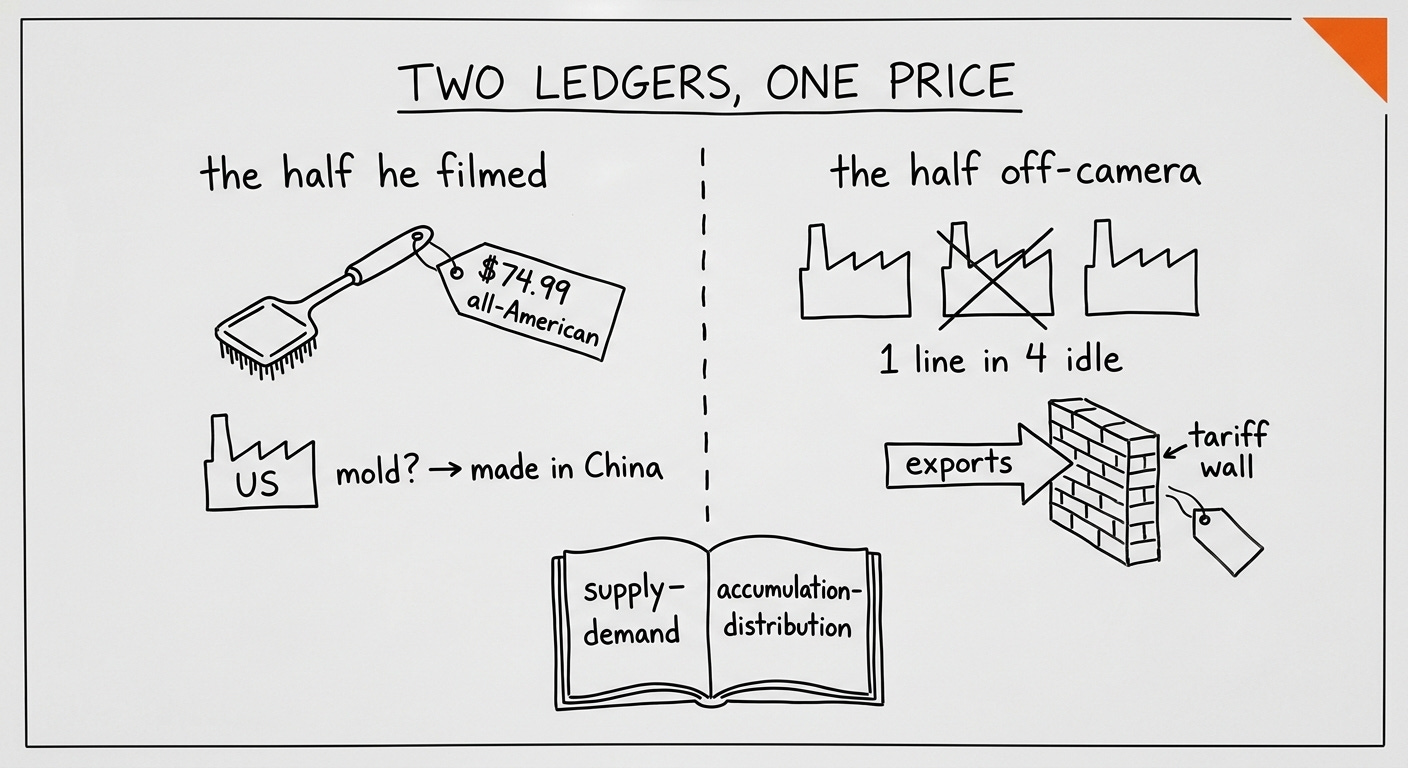
The half he filmed
Destin Sandlin, of the YouTube channel Smarter Every Day, did something genuinely instructive: he and his partner John Youngblood spent four years trying to build a grill brush in which every part is made in America.
What came out was a serialized documentary about manufacturing. A decent big-box grill brush runs twenty to thirty dollars; his sells for $74.99, and after four years they still couldn't reach one hundred percent American sourcing. The details along the way cut deeper than the conclusion. When he asked a US injection-molding shop to cut a mold, the answer was blunt: "We don't make injection molds in America… we're not good at it. We have it done in China." The American molder sends its own molds to China. Destin refused to accept that, spent about a year learning to run a CNC mill, and cut the mold himself. The chainmail was darker comedy: they deliberately routed around China and picked an Indian supplier — and when the shipment arrived, it was made in China anyway. Set out to build a one-hundred-percent American brush; the chainmail leg of it looped back through China after all.
One episode title compresses the whole saga into a single question: "How Can We Get American Materials to Cost Less than Chinese Parts?"
That question set off an enormous discussion in English, nearly all of it aimed at the American half of the picture: hollowed-out supply chains, lost tooling skills, cost structures. All true. But walk through what has to happen for a block of steel to become a finished molded part: tooling, molding, trimming, inspection, packaging, a trip across the Pacific, tariffs. Every step eats money — and the finished part still lands cheaper than another country's bare material. "Cheap labor" doesn't explain that. Neither does "efficiency." Something on the far side of the Pacific has changed what pricing itself means.
This piece is about the half that never made it on camera: the physical reality on the Chinese side — and, just as important, why people on the two shores run two entirely different chains of reasoning on the same price.
The other half, in three numbers
Physical reality first. This part needs no ideology — just a few public numbers connected into one chain.
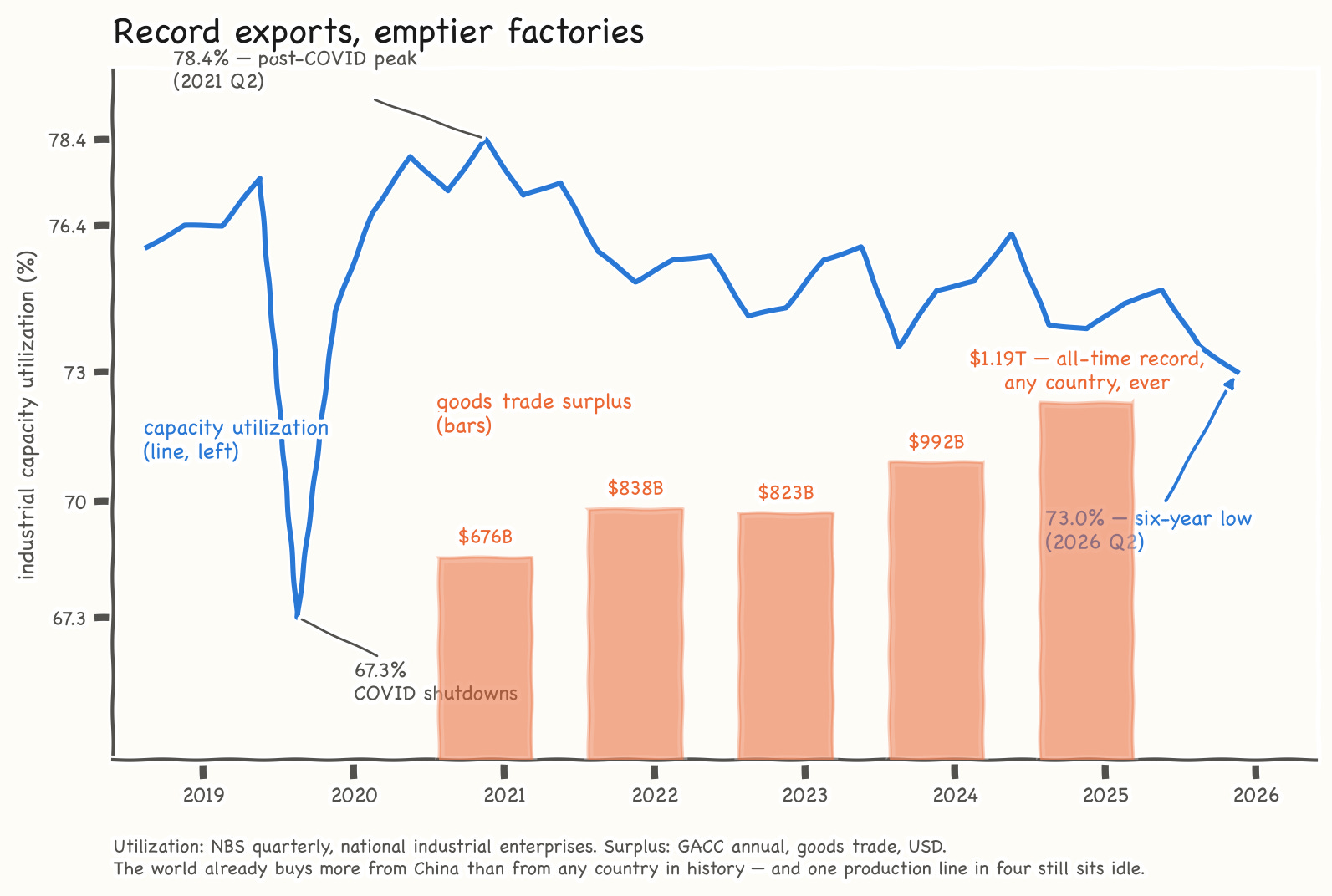
The first number: $1.19 trillion. China's goods trade surplus for 2025, customs data, the largest any country has ever recorded — $3.77 trillion out, $2.58 trillion in. Meaning: Chinese factories make more than China buys back by roughly the GDP of the Netherlands, and all of it has to find buyers abroad.
The second number: 73.0%. National industrial capacity utilization for the second quarter of 2026, per the National Bureau of Statistics — a six-year low, with manufacturing at 73.5%. Put crudely: of every four production lines, one sits idle. And this in a record export year — external buyers are already absorbing more than at any point in history, and capacity still isn't full.
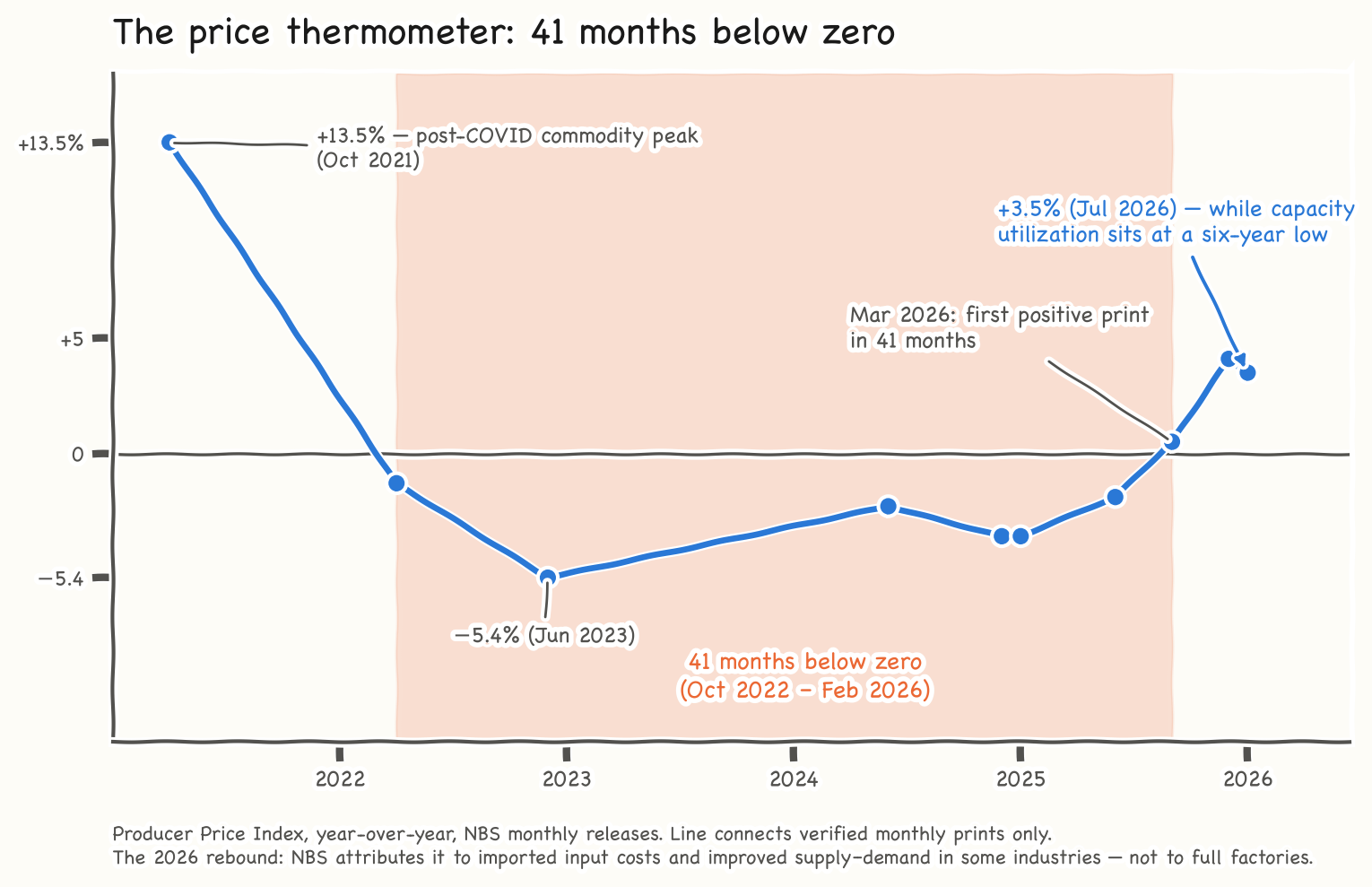
The third number: 41 months. That is how long PPI — factory-gate prices — stayed below zero year over year: negative from October 2022, bottoming at −5.4% in June 2023, and not positive again until March 2026. Price is overcapacity's most honest thermometer. When a quarter of the lines sit idle, the marginal pricing logic on every order changes: if a quote covers variable cost and gets an idle line turning, it is worth quoting.
As for the 2026 turn — +3.5% in July — the statistics bureau credits imported input costs and improved supply–demand balance in some industries. Note what the combination implies: the same quarter prices turned positive, capacity utilization was still setting a six-year low. The price ruler moved; the clearing of quantity did not finish — one line in four is still dark. Keep that divergence in your pocket. The second half of this piece will need it.
String the three numbers together and you have the cause of "Chinese finished parts cheaper than American raw materials." Not subsidy, not corner-cutting, not a dumping conspiracy — at least not mainly. It is a flow problem: capacity has grown faster than domestic demand for years, and exports absorbed the difference. Once exports hit the tariff wall and the ceiling of global demand, the excess has exactly one place left to go — price.
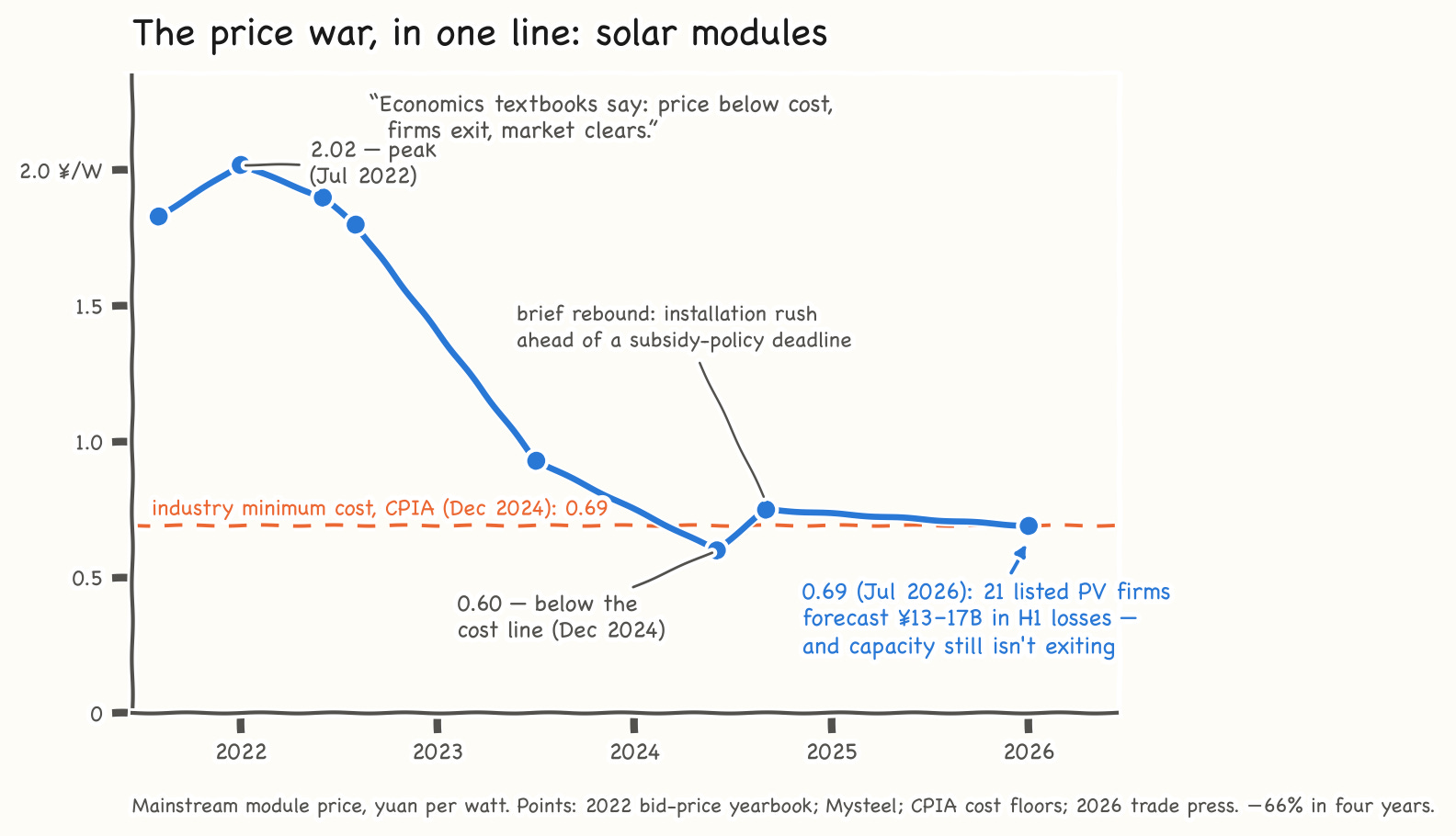
To watch the chain run to its limit, look at solar. Module prices fell from about 2 yuan per watt in 2022 to under 0.7 by mid-2026, through the industry association's estimated minimum-cost line. The 21 listed solar companies that have issued first-half 2026 guidance forecast combined losses of ¥13.0–16.8 billion, with LONGi, Tongwei and TCL Zhonghuan alone accounting for more than ten billion. Now the counterintuitive fact: the losses did not push capacity out. Everyone is waiting for someone else to die first. That refusal to exit is exactly where the two analytical frameworks split hardest — which is what the second half is about.
Two chains of inference
Now change the question: why do the two shores read the same chain so differently?
Scroll the comments under Destin's videos, then scroll Chinese social media from the same months debating neijuan — "involution," the domestic word for grinding, self-defeating competition — and the official campaign against it. Both sides are discussing the same phenomenon; their vocabularies barely intersect. The answer traces back to schooling. An American engineer or buyer, even one who never studied economics, absorbed a default inference toolkit from basic education and business culture: opportunity cost, supply and demand, price signals, rational actors. A Chinese factory owner, even one who never read Das Kapital, got a different toolkit from middle-school politics class: productive forces and relations of production, accumulation and distribution, surplus and crisis. This is not a question of which toolkit is correct. They are two pairs of glasses: each sees what the other cannot, and each has a blind spot.
Feed one event — manufacturing overcapacity and the price war — through both chains:
The neoclassical chain runs: price falls below cost → rational firms cut losses and exit → supply contracts → price recovers → market clears. Hence: below-cost quotes cannot last, long-term contracts are risky, and government intervention — subsidies, industrial policy — only delays clearing and creates deadweight loss.
The political-economy chain runs: capital accumulation has self-expanding momentum → distribution tilts toward investment while labor's share stays low → domestic demand cannot absorb the output → the surplus exits through exports → when external absorption tops out, competition turns inward and vicious → profits and wages fall together, compressing demand further. In this chain the price war is not a road to equilibrium; it is a symptom of a structural contradiction that price signals alone cannot resolve.
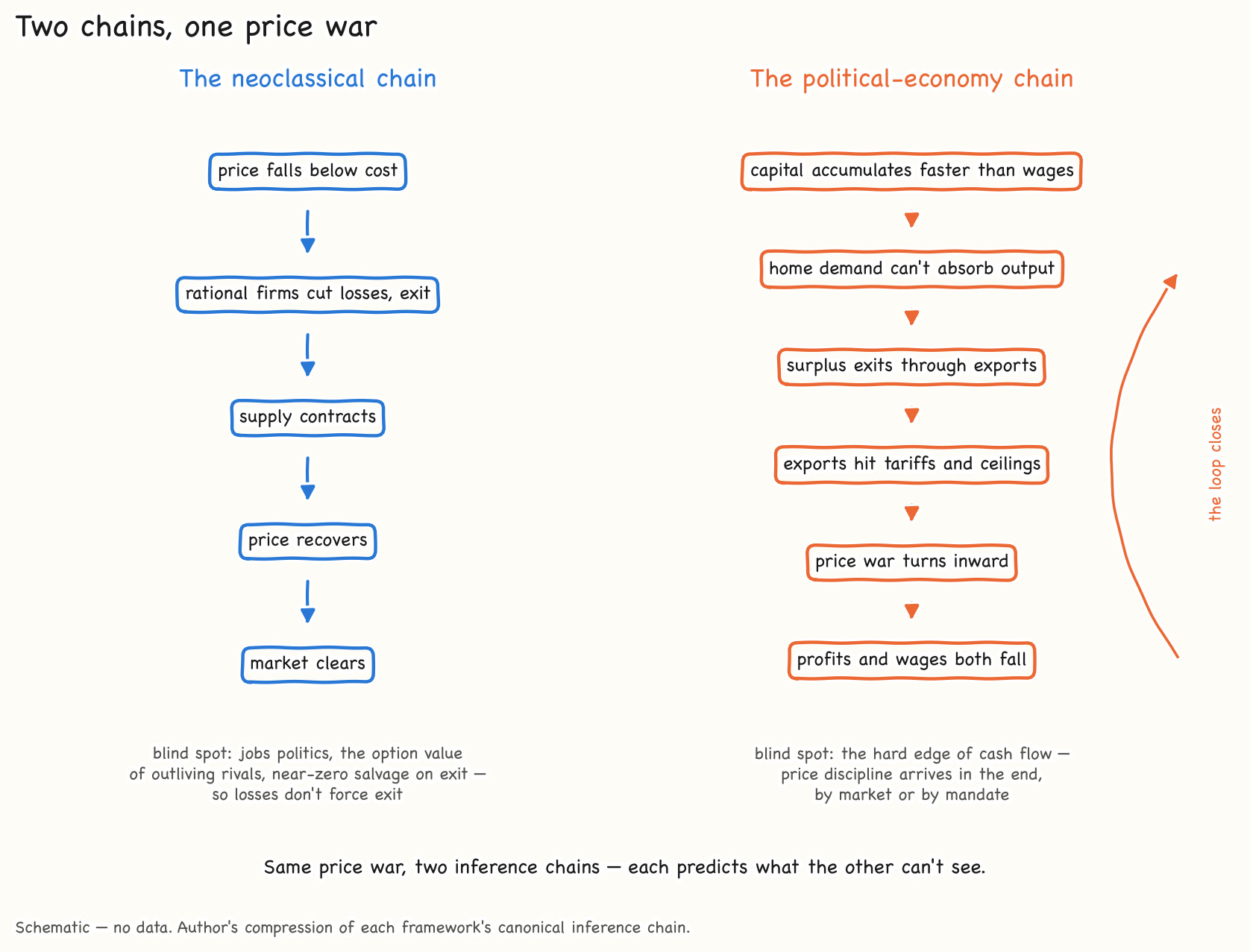
The point is not which chain is more "scientific." It is that each makes testable predictions, and the predictions collide.
The neoclassical chain predicts that loss-making firms exit. In reality, nearly the entire solar main chain is in the red and capacity has barely moved — because the chain leaves out several variables: local governments welded to employment (a closed line is not just the shareholders' loss), the option value of holding a position in the chain (outlive everyone and the market is yours), and exit costs themselves (specialized equipment has almost no salvage value). Use the neoclassical frame to predict a Chinese supplier's behavior and you will systematically underestimate how long they can bleed. A side note: the analyst who has argued this chain hardest in English, Michael Pettis — persistent surpluses reflect suppressed household income, not comparative advantage — spent years as a minority view among Western peers. Chinese readers find him almost familiar. A heresy in one framework is a commonplace in the other. That asymmetry is this essay's thesis, walking around in the wild.
The political-economy chain predicts that without changing the distribution structure, overcapacity has no solution. Its blind spot is symmetric: it underestimates the final coercive power of the price signal. What arrived for Chinese solar in 2026 was not an infinite grind — it was the anti-involution campaign: mandatory efficiency standards led by the Ministry of Industry and Information Technology, in force from 2027, which amount to clearing the market with an administrative ruler where the price ruler failed. The grind has a boundary, and cash flow draws it. On that point the neoclassical frame has never once been wrong.
Remember the divergence from the first half? In March 2026, PPI printed positive after 41 straight negative months — while capacity utilization was still probing lows. Read that scene through each pair of glasses. Neoclassical: the price signal is finally back. Political economy: the price was hauled up by imported costs and administrative clearing, and the quantity contradiction has not moved. Which reading is right? Most likely each is half right — and that is exactly where someone wearing only one pair of glasses puts the position on wrong.
So, back to the quote sheet. It is neither "clearing is imminent" (the neoclassical optimism) nor "it can fall forever" (a straight-line extrapolation of surplus). It is a process with a clear mechanism and a clear boundary — and judging where your supplier sits inside that process takes both pairs of glasses at once.
How to read the quote
A checklist for each side of the table.
If you are an American buyer holding a too-good-to-be-true quote, don't reach for "subsidy" or "corner-cutting" first. Check three things:
Capacity utilization in that specific sub-industry, not the national average. 73% is a mean. Your category might run 85% — the quote is near true cost — or 60%, where the quote is marginal pricing: there is room to negotiate, and the supplier list will be reshuffled within two years.
Which way concentration is moving. In an industry deep into clearing (concentration rising), the low price is a survivor's scale efficiency — sign the long contract. In an industry where clearing hasn't started (everyone losing, no one leaving), the low price is a grinding posture — put a supplier-exit clause in the contract.
Their cash-flow signals. Payment terms are more honest than quotes: a supplier that starts stretching its own vendors and asking you for prepayment is near the edge of its grind, however low the number on the page.
If you are a Chinese supplier selling to American customers, the symmetric warning: price carries less weight in their decision function than you think. Compliance risk, continuity risk, switching cost — each carries a posted premium in their ledger. That is why the order didn't move after you cut 15%. In language closer to home: they are not buying the part, they are buying certainty across the whole supply relationship — and in their framework, certainty has a price.
Back to Destin's question — how can American raw materials come to cost less than Chinese finished parts? Once you have seen the other half of the picture, the question turns out to have a time axis. Today's 0.7-yuan solar module and below-raw-material molded part are snapshots from the middle of a clearing process, not a steady state. Through the neoclassical chain, those prices eventually return to cost. Through the political-economy chain, the road back will be far longer and far more painful than the textbook predicts. Both chains are half right — and no one making cross-border supply decisions can afford to believe only half. The most expensive mistake in this business has never been miscalculating a cost. It is using your own chain of inference to predict a counterparty who thinks in the other one. Learn to read both ledgers. That skill only gets more valuable from here.
If you buy from — or sell to — the other side of the Pacific, forward this to the person across the table. It reads differently from each chair, which is the point.
First Principles Manufacturing — Dispatches from a Novi robotics lab.