

Last week I argued that the office work in a factory, quoting, work orders, aligning with customers, rework, will converge on one harness and a set of skills. I left one thread hanging: the checks around a harness have to come down to real measurement, and a factory with no in-line inspection has no way to know whether the agent got it right.
This piece takes that one step further, out of the factory. Once sellers have agents, buyers will too. When two agents strike a deal, the measurement is the piece that's missing.
On April 29, 2025, Mastercard announced Agent Pay. The next day Visa announced Intelligent Commerce. On September 16, Google and more than 60 partners announced AP2, which uses cryptographically signed "mandates" to prove that a user really did authorize an agent to make a specific payment. On September 29, OpenAI and Stripe open-sourced the Agentic Commerce Protocol, and ChatGPT users could buy from Etsy sellers without leaving the chat.
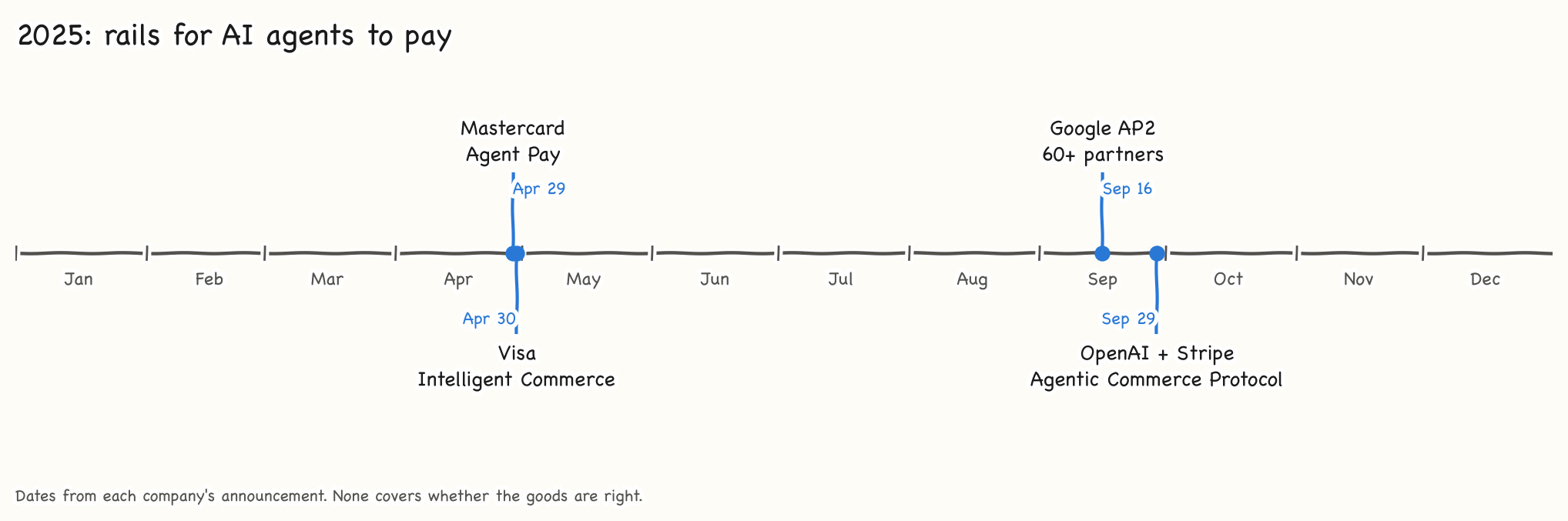
Within a year, the biggest payment companies in the world solved the same problem: an agent pays on someone's behalf, and the money arrives safely.
None of these protocols touches the other problem: once the money has moved, is the thing that arrives right? A buyer opens a silk scarf and knows. A buyer opens a custom food truck and still can't tell whether it was built with a defect.
That defect is what this piece is about.
1. The seller's side is already an agent
Take the food-truck factory in Tai'an from last week. Its trucks go into a container, cross the Pacific, and end up selling snacks in a city the owner may never see. Its bottleneck is rarely the shop floor. The welders can keep up. The people who quote, revise drawings and answer English emails at midnight can't, and the number of salespeople sets the ceiling on how many orders the factory can take.
This round of agents removes that ceiling. Give today's models the factory's material prices, labor standards and past orders, and they can take a customer's email all the way to a quote, answer in English, and answer at midnight.
Then the problem shows up. Say a customer in Texas spends half an hour with the factory's agent and settles the configuration and the price. They still have to ask: why wire $20,000 to a Shandong factory they've never heard of, when what they've been talking to is a program?
2. The buyer's side will be an agent too
Suppose a few hundred Chinese food-truck makers all have sales agents that never sleep. Someone in Austin who wants to start a food truck used to get three quotes because three was all one person could chase. Now three hundred cost nothing extra. Nobody can read three hundred quotes, so the buyer gets an agent too. ChatGPT can already place orders inside a conversation. This step isn't far.
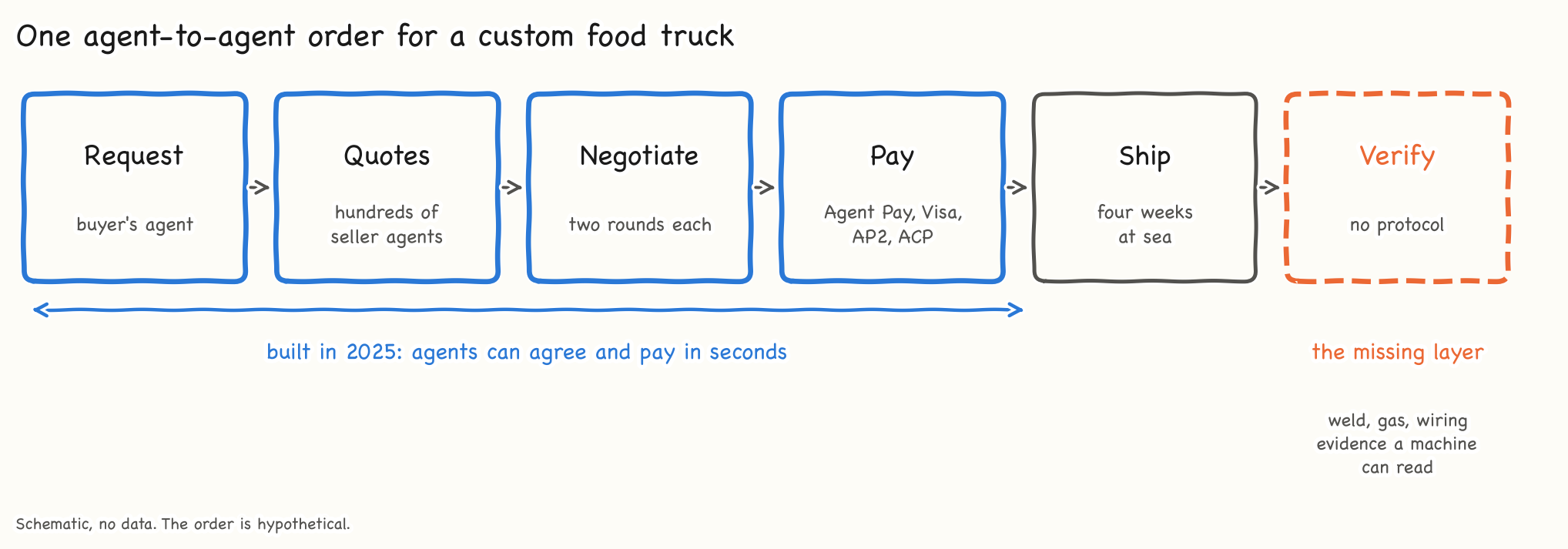
So both ends of the deal are programs. The buyer's agent sends out the request. Hundreds of seller agents reply within minutes. The buyer's agent filters to five on price, lead time and track record, negotiates two rounds with each, and puts one recommendation in front of a person. The person taps confirm, and Visa or AP2 moves the money safely.
Programmatic advertising and stock trading have run this way for years. But ad slots and shares are standard goods, so both sides only need to agree on price. A custom food truck needs agreement on two things: what is being bought, and whether what arrives is that thing. Two agents can settle the first, since drawings, bills of materials and spec sheets are all text. No protocol today covers the second.
3. Stuck at the receiving dock
A food truck loaded in Qingdao spends four weeks at sea before it's unloaded in Los Angeles or Houston. The money was paid before it was loaded. The customer opens the door and sees the paint, the lights and the sign. What the buyer can't see is whether the weld under the counter has full penetration, whether the gas fittings were pressure-tested, or whether the wiring will pass a local inspection. Those problems show up six months into use, or when the local inspector arrives.
The payment protocols cover "the user really authorized this money." They don't cover "the thing is really right." A silk scarf can still rest on the buyer's review. A food truck can't, because the buyer can't see the problem either. If verification still means a person opening a box, the thirty seconds the agents saved get spent again at the receiving dock.
So the missing layer in agent-to-agent custom manufacturing is this: who can turn physical quality into evidence a machine can read and a buyer can trust? Nondestructive test records for the welds, pressure-test curves for the gas lines, material certificates for the stainless steel, insulation tests for the wiring, all traveling with the order, read, checked and signed off by the buyer's agent before the truck is loaded. A seller's reputation would then be built from the inspection data of order after order, rather than from stars a buyer clicked.
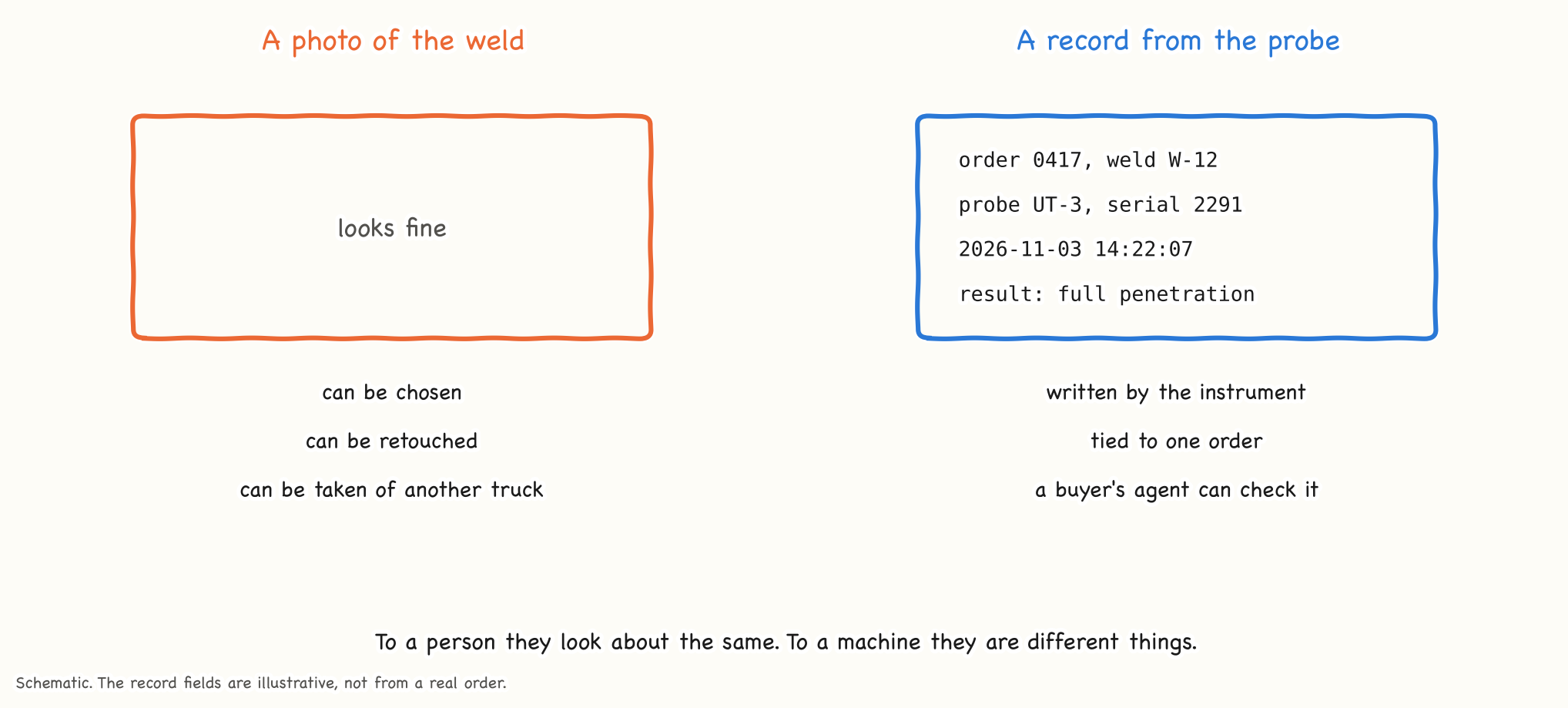
Why this is hard, from my own trade: inspection comes down to picking a signal out of background. A nice photo of a weld and a test record written straight from the probe, with a timestamp and an instrument serial number, look about the same to a person. To a machine they're different things. The photo can be chosen, retouched, or taken of another truck. The record can't.
And verification differs by trade. A food truck needs welding, gas, electrical and local health codes. A machined part needs a CMM report and a material cert. Wood products need moisture content. Evidence doesn't carry from one trade to the next, so this layer won't start as one big platform. It will grow first in the categories where the evidence is easiest to standardize.
4. Why Alibaba or Xometry won't just add it
People in the industry will object here: this already exists. Alibaba.com has Trade Assurance. Xometry's Instant Quoting Engine already uses models to price parts from their geometry and predict lead times, and in the first quarter of 2026 its marketplace revenue was $191 million, up 40% from a year earlier, with more than 85,000 active buyers. Why not add an agent interface and be done?
I think they will add one, and it won't be the layer from section 3. Two reasons.
Their trust is built for people to read. Product photos, reviews, chat logs and "verified supplier" badges are either unreadable to a buyer's agent or unverifiable by it. Xometry's answer is to stand behind quality itself. Under its service agreement, Xometry either makes the parts or subcontracts them to its partners, and it warrants to the buyer that parts are free from defects in material and workmanship and conform to the specifications. The buyer's counterparty is Xometry, not the shop underneath. So the trust stays locked inside the platform, and the seller can't take it along.
And they are counterparties themselves. A platform earns from commissions, ranking and ad slots, and its goal is to keep the deal on the platform. A buyer's agent wants the best seller for the buyer, wherever that seller is. Agents don't look at ad slots. The payment layer already shows the answer: Visa doesn't run a store, and AP2 is an open protocol. Verification has to be neutral too, and a platform that makes its money as a counterparty will find it hard to turn itself into that.
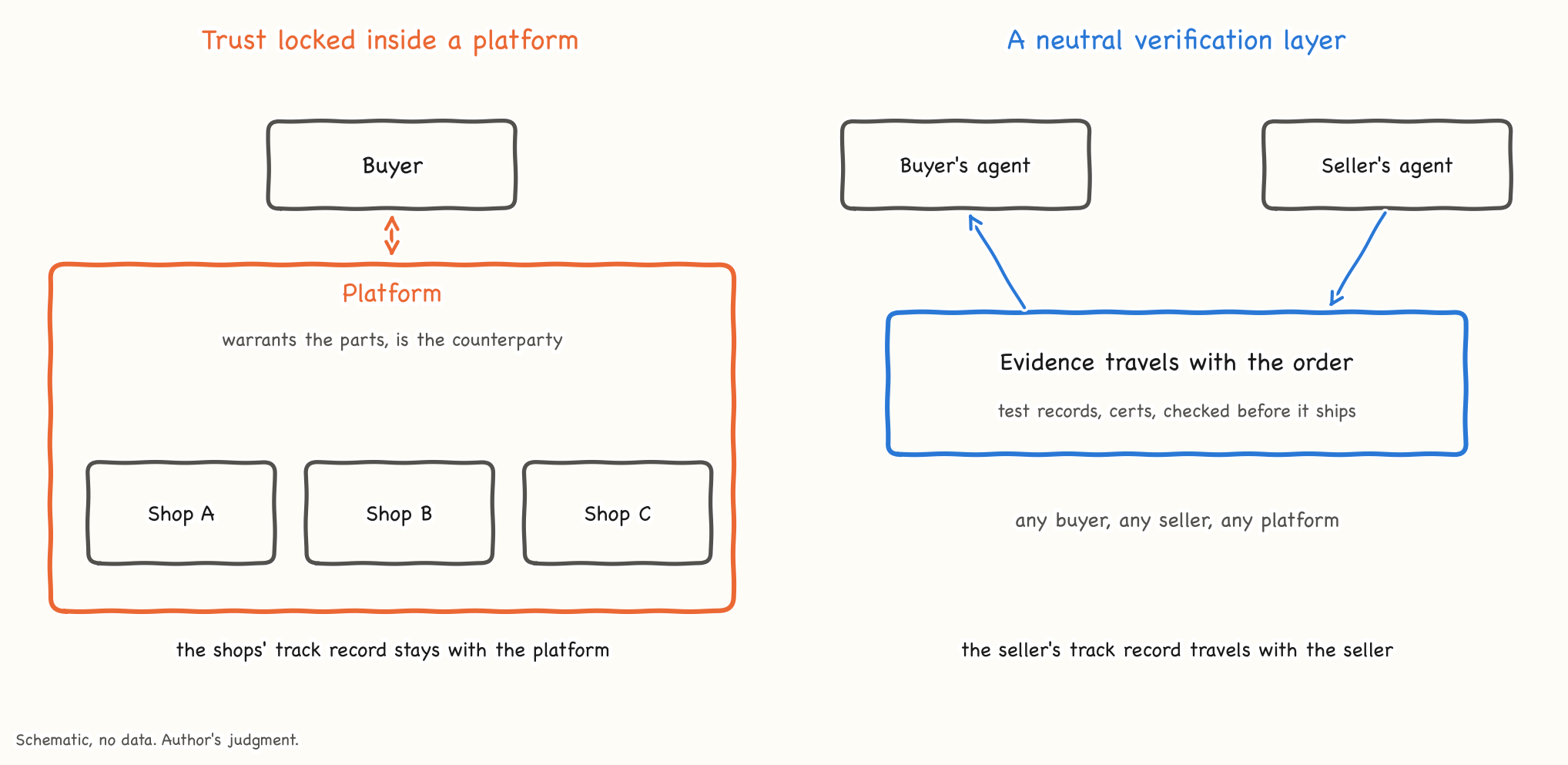
So here is my guess at the shape of the next few years. Existing platforms build "let agents come shop in my store." Letting any two agents inspect the goods and release the money is a different position. Everyone has the capability layer, and model prices fall every year. Trust has to be earned one deal at a time, and wherever it accumulates is where the platform will be. In the gap before that, the first to arrive could be the next platform, or a scam.
Disclosure: The author leads R&D at an industrial AI and robotics company, and inspection is part of that industry. This judgment favors that industry, so weigh it accordingly.
5. The bets
As usual, here they are in a form that can prove me wrong, logged in my prediction ledger and settled in public when due.
P27. At least one custom manufacturing marketplace has agents handle both sides by default, from request to deal. I win if escrowed volume is publicly visible at 1,000 or more deals a month. Due December 31, 2027. My probability: 55%.
P28. At least one mainstream agent payment or commerce protocol (AP2, ACP or a successor) adds a standard "release on verified delivery" field that can carry third-party inspection evidence. I win if the field appears in the protocol's official documentation or spec. Due June 30, 2028. My probability: 50%.
P29. None of Alibaba.com, 1688, Amazon Business or Xometry launches an open agent-to-agent escrow and reputation protocol. "Open" means sellers outside the platform can use its escrow and reputation; any one of them launching it means I lose. Due December 31, 2028. My probability: 65%.
P29 is a pit I dug for myself: if it loses, section 4 is wrong. If P27 wins and P28 loses, someone has built verification as a private feature, and trust is still locked inside a platform.
If you know someone wiring an AI agent into purchasing, send them this before the first order ships.
Sources:
Mastercard Agent Pay: Mastercard press release, April 29, 2025
Visa Intelligent Commerce: Visa press release, April 30, 2025
Agentic Commerce Protocol: Stripe, September 29, 2025
Xometry Q1 2026: results release, May 12, 2026 (CIMdata copy); warranty and subcontracting: Xometry service agreement
The photo and the probe record are the heart of it for me. A photo depends on someone choosing to take the right one; a record written by the instrument does not depend on anyone's goodwill. I see the same split inside Japanese plants long before any buyer's agent shows up: the numbers people type in at the end of a shift drift, and the ones captured straight from the machine hold. Which trade do you think will standardize its evidence first, welding or machining?