

A note before you start. This post opens a new series, Invisible Things. For ten years I measured radiation, something you can't see, smell, or feel. Then I moved into manufacturing and kept running into things no instrument measures: structure, management, myself. The series starts with radiation and ends with organizations. The usual technical posts keep coming alongside it. This first piece is the frame.
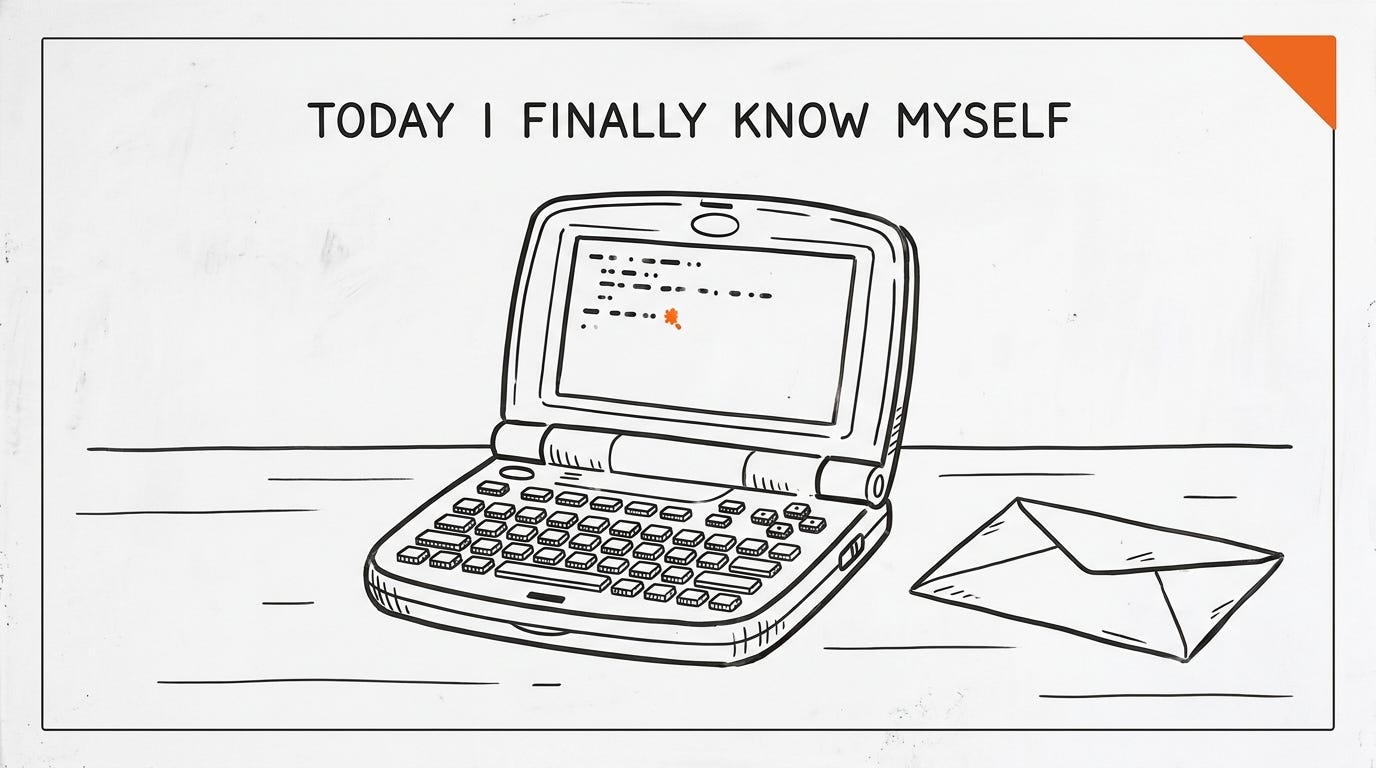
In 1996, at eleven, I got my first computer — a BuBu Gao study machine. The man who built it was Duan Yongping. Only many years later did I understand what that name would come to mean.
I didn't buy it for homework. I wanted to write games.
No one taught me. I chewed through BASIC, guessing at its grammar line by line, and worked every exercise that came with the machine — memory, variables, pointers — from front to back, over and over, all of them. BBK ran something like a correspondence course back then: finish the exercises, mail them to the editorial office, get a certificate. I sent mine in, with one question attached: I want to write games — how do I start?
They wrote back, a warm letter. First they were surprised — it was rare, they said, for an eleven-year-old to finish the whole course. Then they answered my question: keep studying, truly master programming, and you'll be able to begin.
They were right. But the me of that year filed the letter away with the certificate and turned, full of enthusiasm, to something else.
Later I went to Shanghai Jiao Tong University. Choosing a major, I wavered between computer science and mechanical engineering; I even considered the programming olympiad. In the end I chose mechanical. The reason sounds absurd now: I thought computing was just a skill everyone ought to have, not worth studying as a discipline of its own — I treated it as a tool to carry around, not a road to walk. I was, honestly, a little too sure of myself.
And so I went on, blindly, upward. Bachelor's, master's, doctorate, then a post at the university. Most people of my era were like this, groping forward. I was born in Tai'an. I went from a small city to a big one, and from a big city to a bigger one. I learned everything on instinct. No one guided me.
In 2020, I decided to break out of Jiao Tong and join Microintelligence. The me of that time was green, unformed — my judgment about technology, my grasp of the whole field, all still at a very primitive stage. The only thing I had to show was a decent top-tier logic and the nerve to believe I could solve any problem the moment it landed in front of me.
But that self was willing to explore, and had the strength to take on everything in front of him.
To get a project right, I could settle down, lock myself alone in a small dark room for days on end, labeling one point at a time, then doing the segmentation bit by bit, hunting for the key that unlocked the problem. I met every difficulty with all the good heart and patience I had. When I hit a wall, I didn't blame anyone — I only thought I hadn't disciplined myself enough.
Now bring the clock back to 2026.
After all of it, I've changed. These days I want to see structure. I want to know how things actually work: what is right and what is wrong; what should be done and what shouldn't; what is priority and what should be set aside; what is atmosphere, what is management, when you should step up and take point and when you shouldn't.
I calculate far more precisely than before.
But honestly — I am more in pain than I was then.
Because the self I used to be didn't need to calculate. He only needed to know: I'm going to do it.
The self I am now weighs success and failure, weighs what is worth doing against what isn't, sees the eddies turning around him. Sometimes I laugh — if you dropped that self from a few years ago into the position I'm in now, the matter would end right there; he wouldn't need to think this much, he'd just lift his foot and charge. And the self I am now stands here and has to observe, carefully, and settle the plan before he dares to move.
Sometimes I wonder: purely on the odds of getting things done, which of these two selves is better?
There's a character I love in Water Margin — Lu Zhishen.
Lu Da was only a garrison major. He killed the butcher Zheng with three punches, and by a chain of accidents fell into a monastery. The abbot took one look at him and said: this man has the root of wisdom. No one could say what the root of wisdom was, and no one understood why a coarse man who killed and burned should have it. Then he lived a magnificent, tumultuous life.
His master, the abbot Zhizhen, had once given him four lines of prophecy that he never understood:
逢夏而擒,遇腊而执,听潮而圆,见信而寂。
Seize at summer, take at winter's end; hear the tide, and be complete; see its coming, and be still.
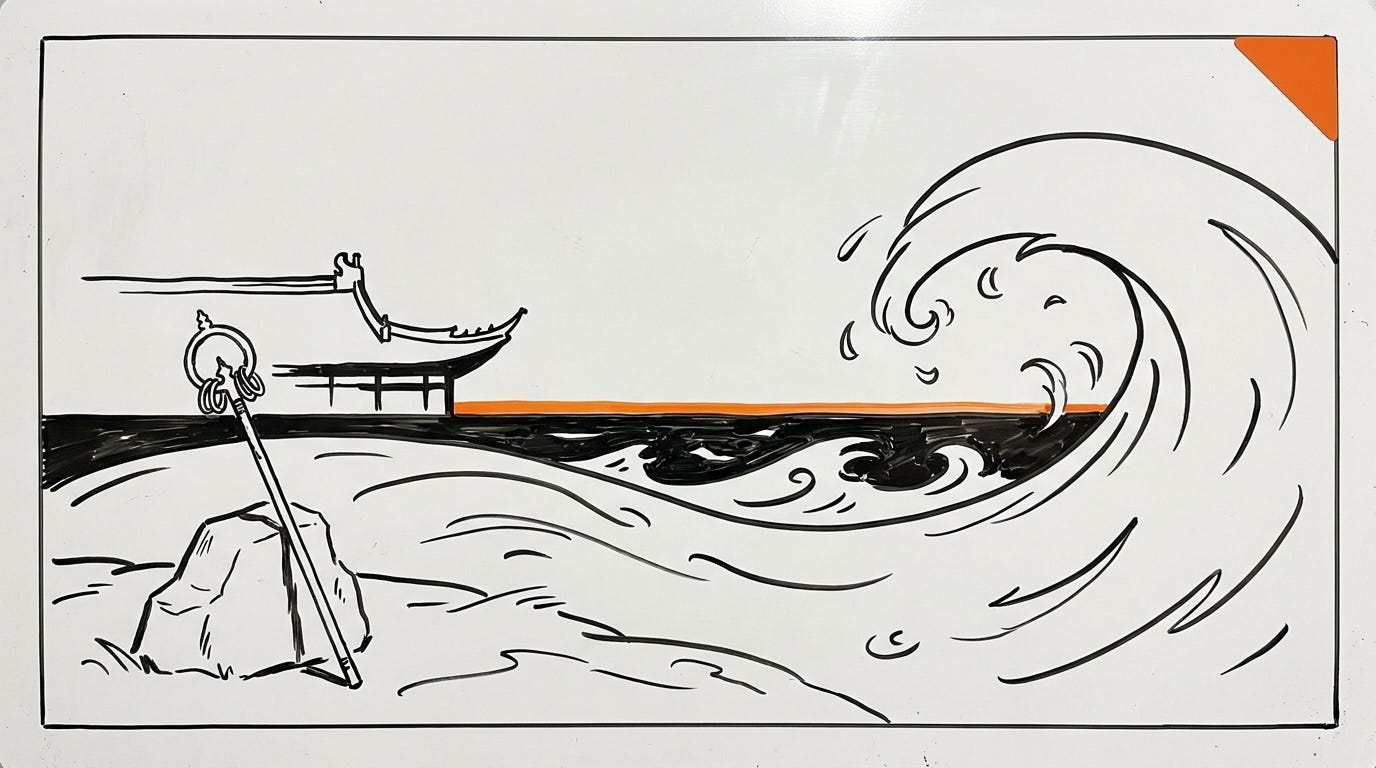
At the last, in the Liuhe Temple, he woke in the night to the roar of the tidal bore on the Qiantang River. He took it for war drums, seized his staff, and made to charge out and fight. The monks stopped him and told him: this is the tide. Only then did he remember his master's four lines. He asked what "be still" meant. To be still, they said, is to die.
So he laughed, called for brush and paper, and wrote a verse:
平生不修善果,只爱杀人放火。
忽地顿开金枷,这里扯断玉锁。
咦!钱塘江上潮信来,今日方知我是我。All my life I worked no virtue; I loved only killing and fire.
All at once the golden cangue swings open, here the jade lock is torn apart.
Ah! On the Qiantang River the tide comes in —
today I finally know that I am I.
He set down the brush, sat on the meditation chair, and passed into stillness.
Lu Da had, at last, found himself.
But here is what I want to ask: that "I" he found — was it still the same Lu Da?
This is the self I was and the self I am. I believe there is also a self to come. I want to talk once more with the me of ten years from now, have him look back at me, and tell me what the me of today looks like.
His answer will be wonderful. I really believe that.
If you know someone who has gotten very good at calculating, and sometimes misses the version of themselves who didn't need to — send them this.