

A joke
When the conversation turns to Ukraine building millions of drones a year, the engineers I know in China all react the same way: so what. Then comes the joke: "Let me build planes. Who cares if they break, they're consumables. I could make them do tricks."
It isn't bragging. An FPV drone costs a few hundred dollars, and its core parts, motors and battery cells, are still largely bought from China. Ukraine only started making its own flight controllers and video links in the last couple of years (RUSI, RFE/RL). Making an electromechanical product cheap, making it do new things, shipping a new version every week: any decent team in China can do that.
But the joke is looking in the wrong place. Nothing that makes those few hundred Ukrainian workshops valuable is in the airframe. This piece tries to explain two things: where this "grab anyone and they can build it" capability came from, and what is still worth something once it is everywhere.
What changed in five years
In China, motors and flight controllers no longer count as technology. Undergraduates build robot arms with force control as side projects. People on Bilibili, a Chinese video platform popular with hobbyists and students, build rocket engines from scratch. You can copy a working FOC (field-oriented control) motor driver from open source in a weekend. Five years ago these things took a company. Now they take one person and a workbench.
Several things matured at once:
The supply chain opened up down to retail scale. PCB fabrication, assembly, components, 3D printing, small-batch machining: an individual orders online, gets it in a few days, and the cost hardly matters.
Open-source designs met cheap Chinese chips. The chip shortage years forced out a crop of good-enough MCUs and power devices, and reference designs are a click away.
Bilibili became a de facto engineering school. Schematics, code, the mistakes people made, all public.
Spillover from industry. After a few rounds of drones, EVs and humanoid robots, motors, joint modules, batteries and sensors have been driven down to commodity prices, and the people who left those companies brought what they learned into the community.
AI. What one ordinary engineer can finish alone has been multiplied several times over.
The result is that the technical baseline of the whole society went up a notch. Things you would need funding and a team to attempt elsewhere are beginner projects here.
The water level didn't rise. The ground got flatter.
Engineering skill used to travel with people. Someone leaves DJI to start a company, or moves from Huawei to a smaller firm in its supply chain, and the skill flows somewhere new. So it only reached two kinds of places: industries that could pay the salaries, and cities where people change jobs often.
China is not actually a very mobile society. A state research institute, a parts maker in an inland county, a niche product category worth a few hundred million yuan (tens of millions of dollars) a year: they could not afford these people, and these people would not go there. For decades the water simply did not reach them.
What has changed is that skill no longer needs people to carry it. It arrives in the hands of people who never moved: a small farm-machinery parts shop in a third-tier city, a research group inside an institute, a five-person company making obscure instruments. Each can now build what used to take a full R&D department. And because a project needs fewer people and less money, small markets that never penciled out are now worth going after.
So I don't think the water rose. There are as many engineers as before. What changed is the terrain. The ridges and ditches got planed down, and the water spread over them on its own.
There is one sample of what the flood does inside China and another outside it.
The sample inside China: AI short drama, run to the end in one year
If you want to see an industry completely flooded, Chinese short drama, the vertical-video series with episodes often just a minute or two long, is a ready-made experiment. The cycle is short and the data is complete.
In the first quarter of this year, about 128,000 micro-dramas went online across the industry, and more than 95% of them were made with AI, according to the China Netcasting Services Association (People's Daily Online).
DataEye, a Chinese industry data firm, estimates that a premium live-action short drama costs about ¥1.5 million (roughly $210,000) on average to make, and an AI drama with realistic human characters can come in under ¥200,000 (about $28,000) (TMTPost).
Hengdian, China's largest film studio town, hosted more than 4,000 short-drama crews last year. In the first five months of this year the number was down by at least half from a year earlier, and by the third quarter new productions were down more than 80% (Jiefang Daily, Qilu Evening News).
In the first half of the year, 221,900 new AI dramas and animated dramas appeared on Douyin, the Chinese version of TikTok. Taking 50 million plays as the break-even line, only 2,886 of them, about 1.3%, made it, according to DataEye (DataEye).
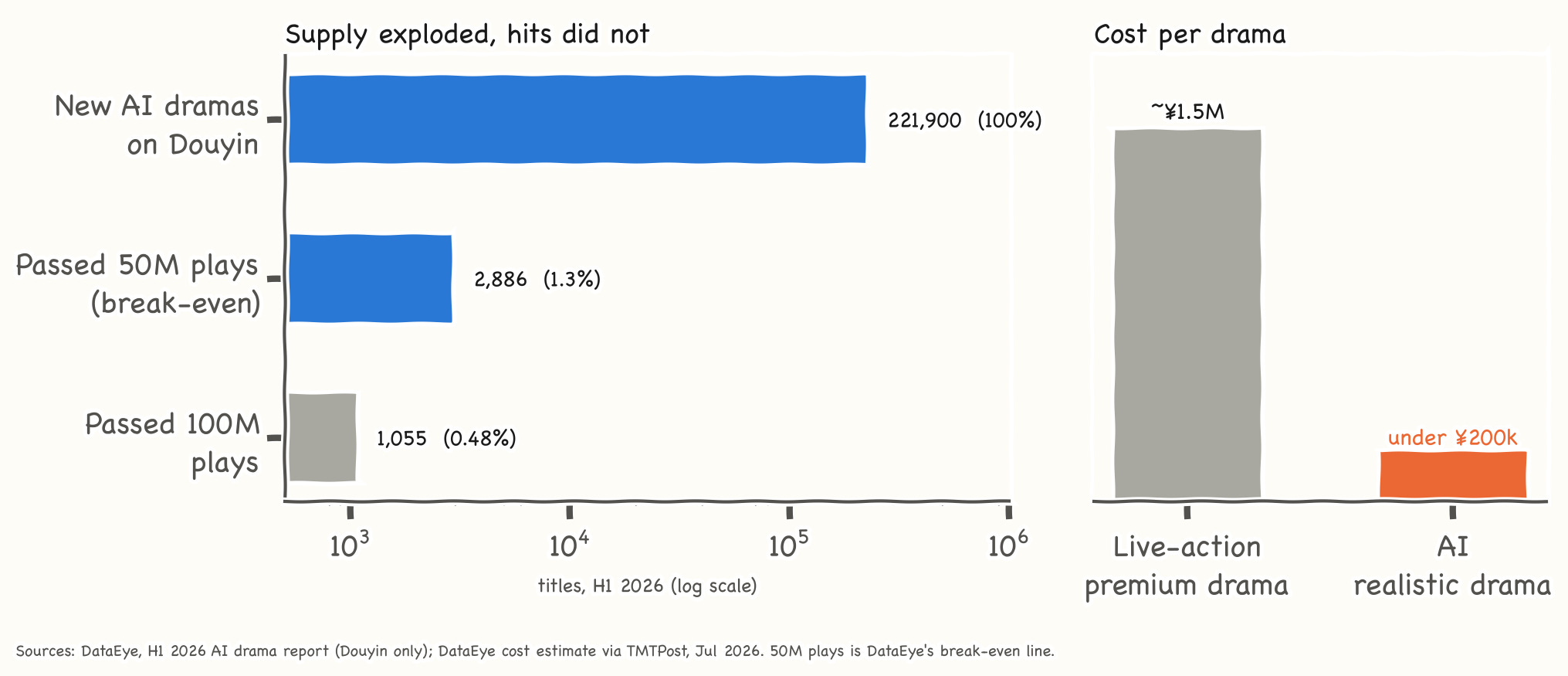
Read together, these make one complete chain. The barrier disappears, supply explodes, prices fall below cost, the people making content can't make money, and the value sinks to the platforms that own the traffic and the IP holders who own the stories. The value of the production step itself goes to roughly zero.
Live-action short drama isn't completely dead. A few premium titles still get far more plays than the average AI drama. But as a business that lived on volume, it was largely replaced by AI drama within a year.
Other industries won't move this fast, but I think the order will be the same. Being able to build things is the first layer to get flattened.
The sample outside China: hidden champions and the new walls
Once the flood crosses the border, the first to be swamped are not big American companies. They are the German and Japanese small and mid-sized firms that have made one kind of valve, one kind of sensor or one kind of special-purpose machine tool for decades. Their moat was mostly not how deep their technology went. It was that the market was too small for anyone else to bother. Now someone is willing to come in, and coming in is cheap.
German industry lost about 124,000 jobs in 2025, according to an EY analysis (dpa via Yahoo Finance). At the end of last year, Peter Leibinger, president of the Federation of German Industries, said German industry was in its deepest crisis since the Federal Republic was founded (Tagesspiegel). There is more than one cause. But in my view the heaviest one is that China went from one of Germany's biggest trading partners to its strongest competitor.
The response is to build walls, and the walls have changed shape.
In July the US did not agree to renew the USMCA as written, and the agreement moved to annual reviews. The US conditions include tighter rules of origin, less "third-country content" and investment screening aligned with America's. It's not hard to guess who that is aimed at (USTR, USTR report to Congress).
Since January, Mexico has charged tariffs of up to 50% on cars from countries it has no trade agreement with, China first among them (Mexico News Daily).
In March the EU proposed a draft Industrial Accelerator Act. Public procurement and subsidies would require "Made in EU." In industries dominated by a single country, large foreign investments would have to meet four of six conditions, including foreign ownership of no more than 49%, licensing technology to a European partner, and at least half the workforce in the EU (European Commission, Skadden).
Look at what these check. A tariff checks where the goods come from. The new rules check where the parts come from and who owns the plant. Moving the plant to a third country is a route that dedicated clauses are now closing. In 2024 the EU put countervailing duties on Chinese battery-electric cars. In 2025 China's car exports to the EU still rose by about 30% in volume and passed one million for the first time, with the increase coming mostly from plug-in hybrids and gasoline cars that the duties don't cover (ACEA). That is why the rules keep getting more specific. In October the EU set a quota of 350,000 hybrids a year (Borderlex).
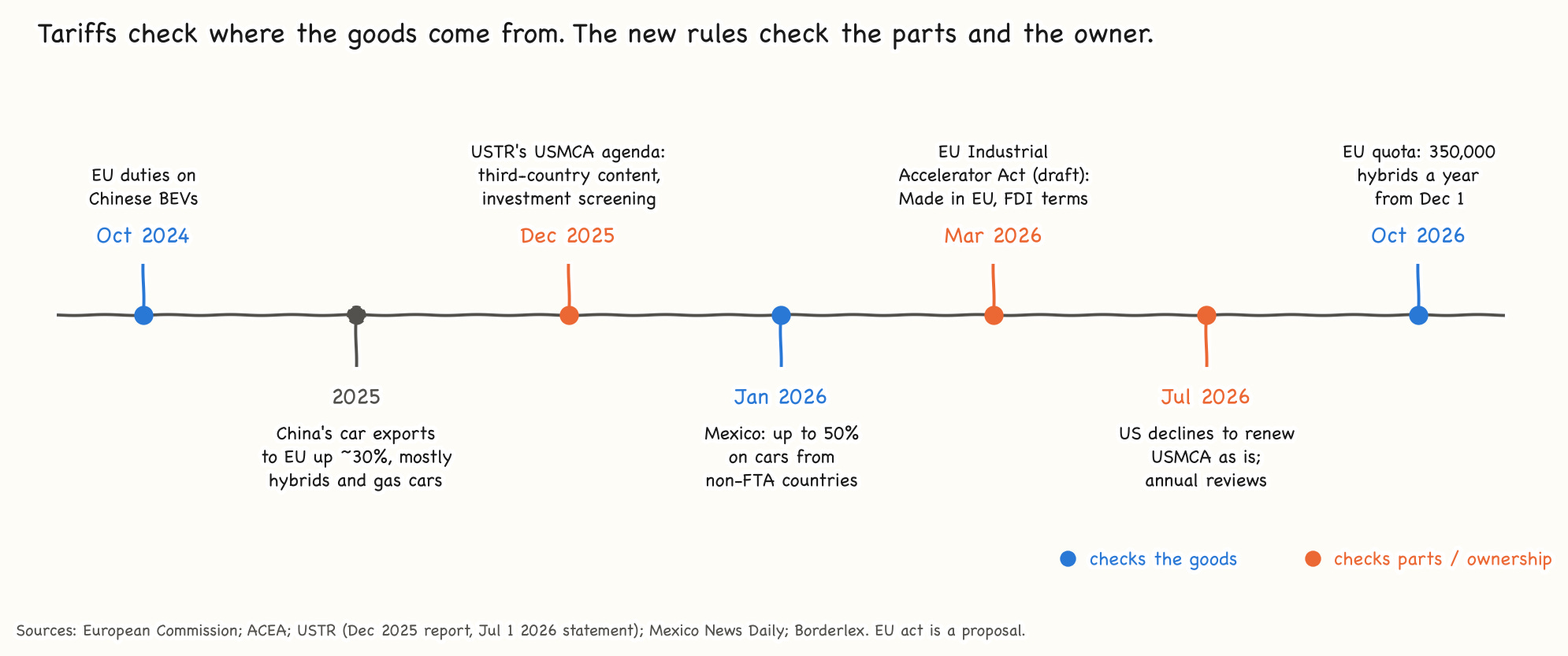
The more the flood succeeds, the higher the walls. The two are linked.
Three things the flood can't reach
Back to the joke. Ukraine went from 7 drone makers before the full-scale invasion to more than 500 (Ukraine's Ministry of Defence). In the first half of this year, 413 new drone systems were approved for service, more than two a day on average (Ukrainska Pravda). Through a manufacturing lens, the output and the workmanship are nothing special. Their advantage is in three places, and those happen to be exactly where the water can't reach.
The first is a feedback loop in the real environment. Which jamming frequencies the other side switched to this week, which payload works over which terrain, how pilots actually fly: only the front has that, and it changes every week. An engineer in Shenzhen can make a better, cheaper airframe but doesn't know which way to change it. Anyone can put a factory together. What's scarce is the environment that tells you whether this version works. In civilian terms, that is acceptance data. Whoever holds enough real examples of pass and fail gets to define what "right" means.
The second is an accountable, trusted identity. When a customer hands over drawings, data or a production line, what they look at is whether they can find someone when something goes wrong, and whether they can sue. The new walls check ownership, and they are checking the same thing. That identity is built from time and records. No amount of engineering skill buys it.
The third is being physically present. Someone has to install the equipment, someone has to answer for the cycle time, someone has to show up when the line stops at 3 a.m. The parts that can be done remotely are getting flattened. The parts that need someone on site are worth more.
The three have one thing in common: none can be copied and pasted. They can only be built up in one specific place, for one specific customer, one job at a time.
So what do you sell?
If being able to build things isn't worth much anymore, selling engineering by the head and by the hour is a business that keeps getting thinner. Every step AI takes knocks the unit price down again.
I think the right product looks like a price list based on outcomes. The customer buys a result that can be accepted, in units of their own language: per good part, per station that passes acceptance, per program that runs. Fixed price, fixed delivery date, and someone who signs and takes responsibility.
Behind that price list are three layers.
A front office, where the customer is, that carries the contract and the site.
A verification layer, which turns "was it done right" into criteria a machine can judge. With it in place, the customer doesn't need to care how many people or how much AI sits behind it.
A back factory: the flooded-in engineering capacity, turning out designs, programs and tools at speed.
The price is anchored to the customer's alternative: the local integrator's quote, and the skilled workers they can't hire. The back factory's costs keep falling with AI, and the difference stays in the middle.
One hard constraint shapes the back factory. Customers' drawings and process data increasingly can't cross borders. So the back factory can't be people remotely processing customer data. It has to be a factory that builds tools: capability locked into software, models, process libraries and equipment, shipped over and run on the customer's data locally. Selling engineers' time turns into using engineers' time to build capital goods.
Disclosure: I run a cross-border manufacturing delivery business myself, and this section describes the model I'm betting on. Please factor that in as you read.
Where I could be wrong
The flood could also wash the soil away. For a niche to produce something truly good, someone has to make money in it and then spend ten years going deeper. If every small market instantly fills with dozens of firms undercutting each other, nobody keeps any profit, and the result could be good-enough products everywhere and nothing top-tier. Short drama and solar panels have both played this out. Whether more volume turns into better quality depends on whether anyone survives a round of price war and digs in.
In some fields, engineering isn't what's missing. In materials, processes and aircraft engines, the bottleneck is time and failure data: one furnace run after another, one year of testing after another. More people and stronger AI can only compress that cycle so much. The stretch between "we can build one" and "a hundred thousand units without a problem" is still out of the flood's reach.
How high the walls go is a political decision. Court rulings, transactional deal-making and inflation pressure could all bring a stretch of wall down suddenly, or raise it. I'm confident about the direction, not the timing.
The verification layer may not hold. If AI becomes strong enough to generate realistic enough test environments on its own, real-world feedback will be less scarce. I don't currently think that will happen soon in the physical world, but it is the point I am least sure of.
The joke was half right. Capability really has reached the point where you can grab anyone and they can make it do tricks, which was unimaginable five years ago. The half it left out is the question that matters next: where the tricks get done, and who signs off that they work.
If you know a German or Japanese niche manufacturer being undercut by Chinese quotes, send them this.