

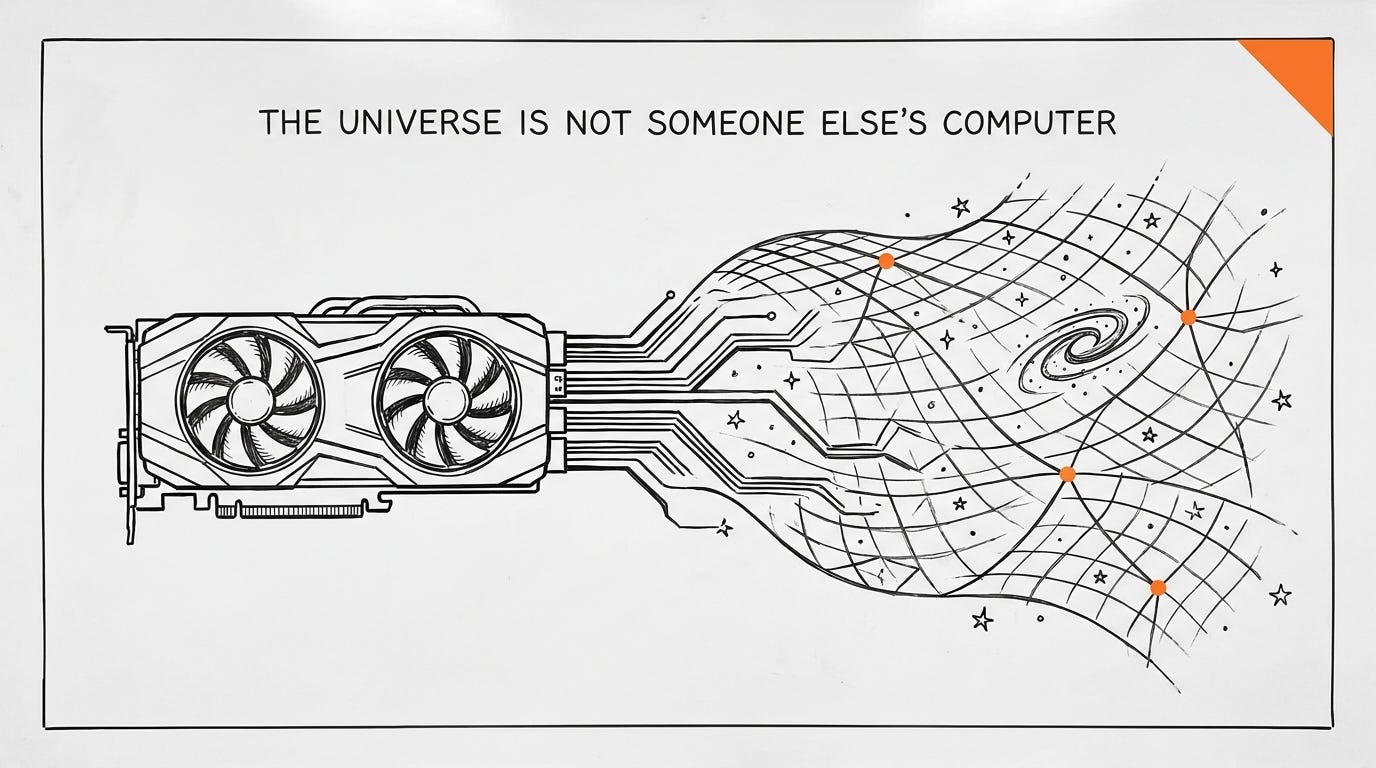
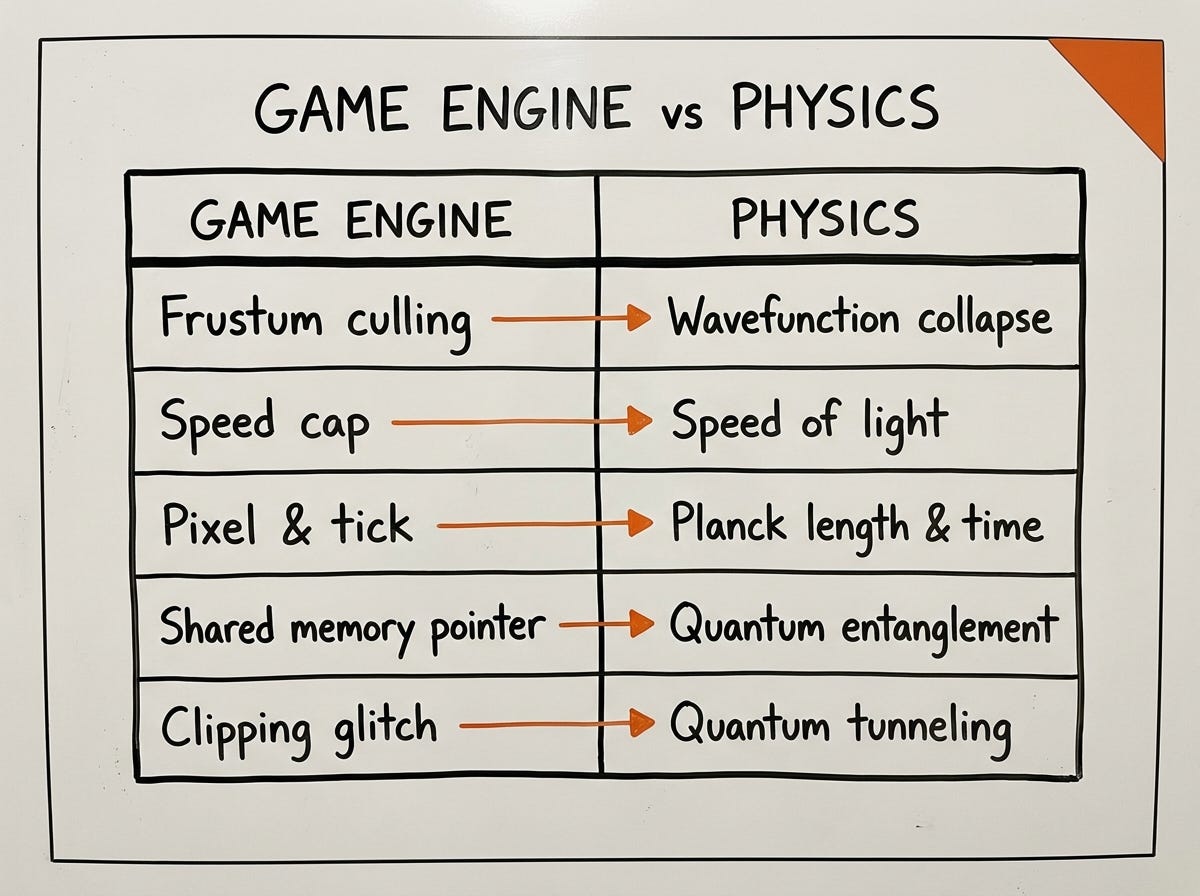
My RTX 3080 can run Battlefield only because it never renders the whole battlefield. The explosion behind you, the collapsing building, your teammate’s body — none of it gets drawn until the instant you turn your head. This is called frustum culling, and no player ever catches it in the act, because “catching it” is itself a head turn.
Anyone who has written a game engine knows a few more tricks from the same family. Cap the speed at which information travels, so no local region overloads the compute budget. Let two NPCs a thousand miles apart share one memory address — change one, and the other changes with it.
And of course, tricks sometimes fail. Every gamer has seen clipping: collision detection only runs a few checks per frame, so with enough speed and a nasty enough angle, half your body sinks into a wall and a bullet kills you through solid cover.
The trouble is that every one of these — the glitch included — has a counterpart in physics. And not the hand-wavy kind.
The engine tricks, found in nature
Leave a particle unobserved and it exists as a superposition of probability waves, as if the system can’t be bothered to assign it a definite position. Put a detector in place and the wavefunction collapses; the particle instantly acquires a trajectory. This is not a metaphor — it is what double-slit and delayed-choice experiments have confirmed, over and over.
The speed of light is hard-capped: 3×10⁸ m/s, and no information gets past it. Space and time aren’t infinitely divisible either — below the Planck length (1.6×10⁻³⁵ m) and the Planck time (5.4×10⁻⁴⁴ s), current physics simply stops working. Pixels and refresh rate: check.
The shared memory pointer? That’s quantum entanglement: measure one of two distant particles, and the other’s state is fixed at once. Einstein called it “spooky action at a distance” and refused to believe it. The 2022 Nobel Prize in Physics went to the three people who proved it with Bell tests.
And clipping? Physics calls it quantum tunneling. A particle facing a barrier that classical mechanics says it can never cross has a definite probability of simply appearing on the other side. This is no laboratory curiosity: the Sun has burned for 4.6 billion years because protons tunnel through the Coulomb barrier — classically, it couldn’t ignite at all — and the flash memory in your phone writes every byte by letting electrons clip through a wall.
Reality’s collision detection drops frames too — and it does so unapologetically.
Culling, a frame-rate cap, a minimum resolution, state sync across any distance, even clipping. The engineering fingerprints are all there. At this point, “we live in some advanced civilization’s game console” starts to look hard to refute.
Do Physicists Themselves Buy It?
Which raises a better question. Nobody knows this evidence better than physicists — they ran the double-slit experiments, they computed the Planck scale, they awarded the Nobel for the Bell tests. Do the people who handle these “engineering fingerprints” every day believe the simulation hypothesis?
In 2016, the American Museum of Natural History devoted its Asimov Memorial Debate to exactly this question, moderated by Neil deGrasse Tyson. The disagreement on stage was startling.
Tyson himself put the odds at roughly even. String theorist James Gates told the room something that made it go quiet: inside the equations of supersymmetry, he had found a set of error-correcting codes — the same class of binary codes that keep your browser’s data transfers intact, embedded in the mathematical structure describing elementary particles. In his words, it made it hard for him to laugh off The Matrix. Sharing the stage, Lisa Randall put the probability at “effectively zero.” Sabine Hossenfelder later went further and flatly called the hypothesis pseudoscience.
The interesting part isn’t how hard they argued. It’s that when you press the skeptics on why they don’t believe, their reasons converge. Not philosophical taste. Compute.
That Server Cannot Be Built
Suppose there really were an external server running our universe. How much memory would it need?
The state space of a quantum system grows exponentially with particle count. Three hundred entangled electrons span a state space of dimension 2³⁰⁰ — about 10⁹⁰, already more than the number of atoms in the observable universe (about 10⁸⁰). Three hundred electrons. A glass of water holds 10²³ times more.
And that’s just storage. In 2017, Zohar Ringel and Dmitry Kovrizhin showed in Science Advances that for certain quantum systems with gravitational anomalies (electron systems exhibiting a thermal Hall effect, for example), classical simulation slams into the “sign problem”: the cost blows up exponentially, and the obstruction is provably unavoidable. It’s not that our algorithms aren’t clever enough — the classical route itself is closed. The media headlined it as “physicists prove we don’t live in a simulation,” which oversells it. But it did nail one thing down: simulating our universe’s physics on classical hardware fails even in principle.
So to fully simulate our universe by classical means, the world hosting that “server” would have to be vastly more complex than ours. That explains nothing — it just pushes the question out one level: who simulates that world? Occam’s razor swings cleanly here. Adding a “programmer” multiplies entities; it doesn’t reduce them.
It from bit
Physicists offer an answer that is both more economical and much stranger: the universe doesn’t need to run on any server, because it is the machine. What look like “optimization artifacts” aren’t anyone cutting corners — information processing is simply how this world operates at the bottom. John Wheeler compressed the position into three words: it from bit. Matter doesn’t come first with information derived from it; information comes first, and spacetime and matter grow out of it.
That sounds mystical. It isn’t — there are concrete technical threads behind it.
Three Threads
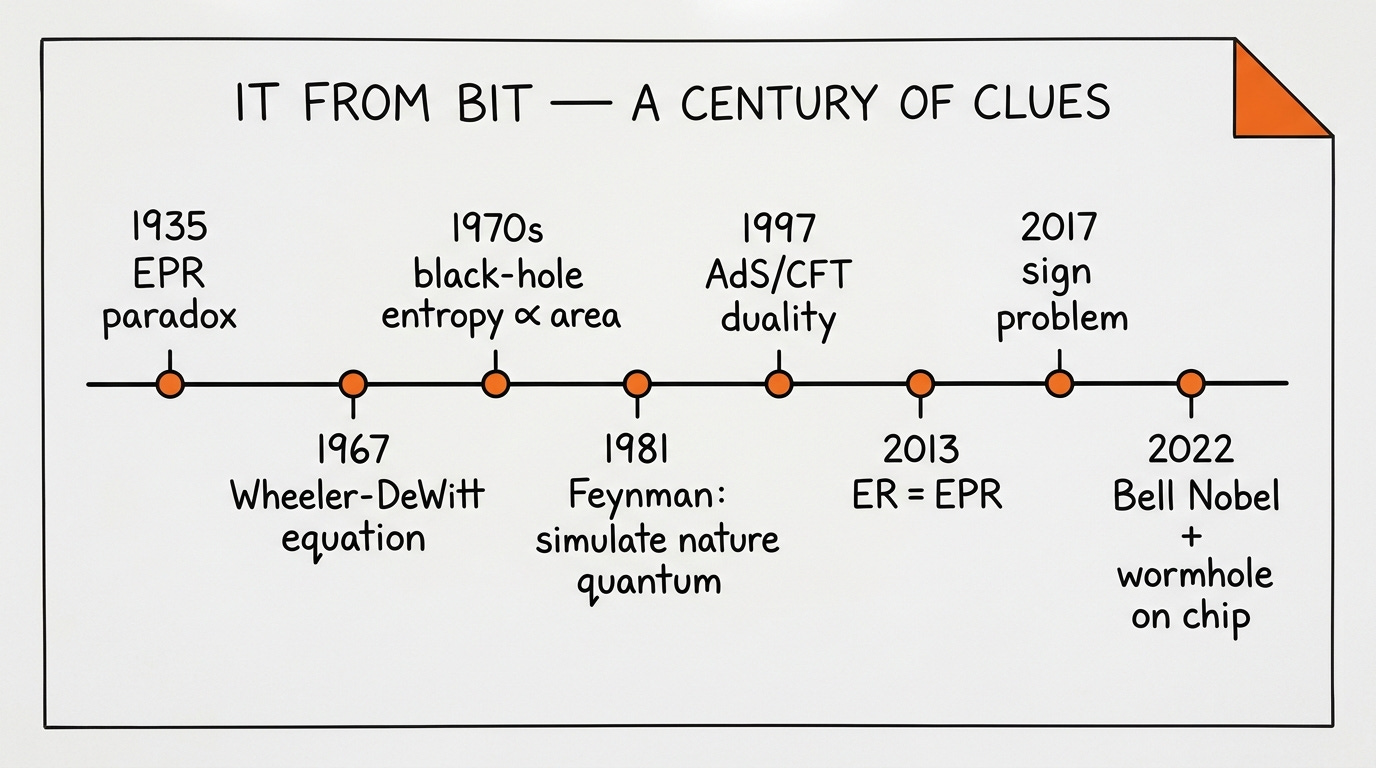
Space may be stitched from entanglement. In 2013, Maldacena and Susskind proposed the ER = EPR conjecture: quantum entanglement between two particles (EPR) is geometrically equivalent to a microscopic wormhole (an ER bridge). If it holds, three-dimensional space is not a box that contains things — it is a mesh woven from the entanglement of vast numbers of qubits. Cut every thread of entanglement in a region, and “space” there falls apart. To be clear: this is still a conjecture, not a theorem. But quantum gravity researchers take it seriously.
Time may be a local illusion. Try to write one quantum state equation for the entire universe and you get the Wheeler–DeWitt equation:
H^∣Ψ⟩=0H^∣Ψ⟩=0
There is no time variable in it. Globally, the universe’s total quantum state just sits there; nothing happens. Then what is the flow of time we experience? Page and Wootters offered an answer in 1983: time is a relation between subsystems. You — one subsystem — read off the experience of “evolution” through your entanglement and decoherence with the environment. No river globally; the sound of running water locally. The approach remains contested, but “time is emergent, not fundamental” is no longer heresy.
Three dimensions may be a projection of two. A black hole’s maximum information content scales not with its volume but with its surface area — Bekenstein and Hawking worked that out in the 1970s, and it is where the holographic principle starts. AdS/CFT duality later gave it an exact mathematical form: a D-dimensional spacetime with gravity is equivalent to a quantum field theory without gravity on its (D−1)-dimensional boundary. Honestly stated: the duality is rigorous in anti-de Sitter space, and our universe is de Sitter — whether it transfers is an open problem. But the core fact stands: gravity and spacetime geometry can be fully translated into information dynamics on a boundary, and the mathematics checks out.
Three threads, one direction: spacetime is not the stage. It’s the plot — what a quantum information network looks like at coarse grain.
Why Quantum Computers Are a Different Thing
Once you see this layer, the meaning of quantum computing changes.
Most introductions call it “a computer that calculates faster,” which misses the point. A classical computer uses transistor 0s and 1s to approximate the equations of physics — doing physics with math. A quantum computer uses the superposition and entanglement of its own qubits to evolve isomorphically with a physical system — doing physics with physics. Feynman said it plainly in 1981: nature isn’t classical, and if you want to simulate nature, you’d better make your machine quantum mechanical.
Three hundred electrons break classical simulation. For a quantum computer, 300 logical qubits against 300 electrons is a 1:1 mapping — no exponential blowup. That’s why in 2022 a Google team used a quantum processor to simulate the dynamics of a traversable wormhole (yes, the ER = EPR thread). A quantum computer isn’t just a tool. It is, so far, the only machine that speaks the universe’s native language.
The Ending
So where does the simulation hypothesis go wrong? Not in its observations — in its conclusion. It sees the right phenomenon — reality’s foundations really are saturated with information processing — and then bolts on a redundant explanation: a computer outside.
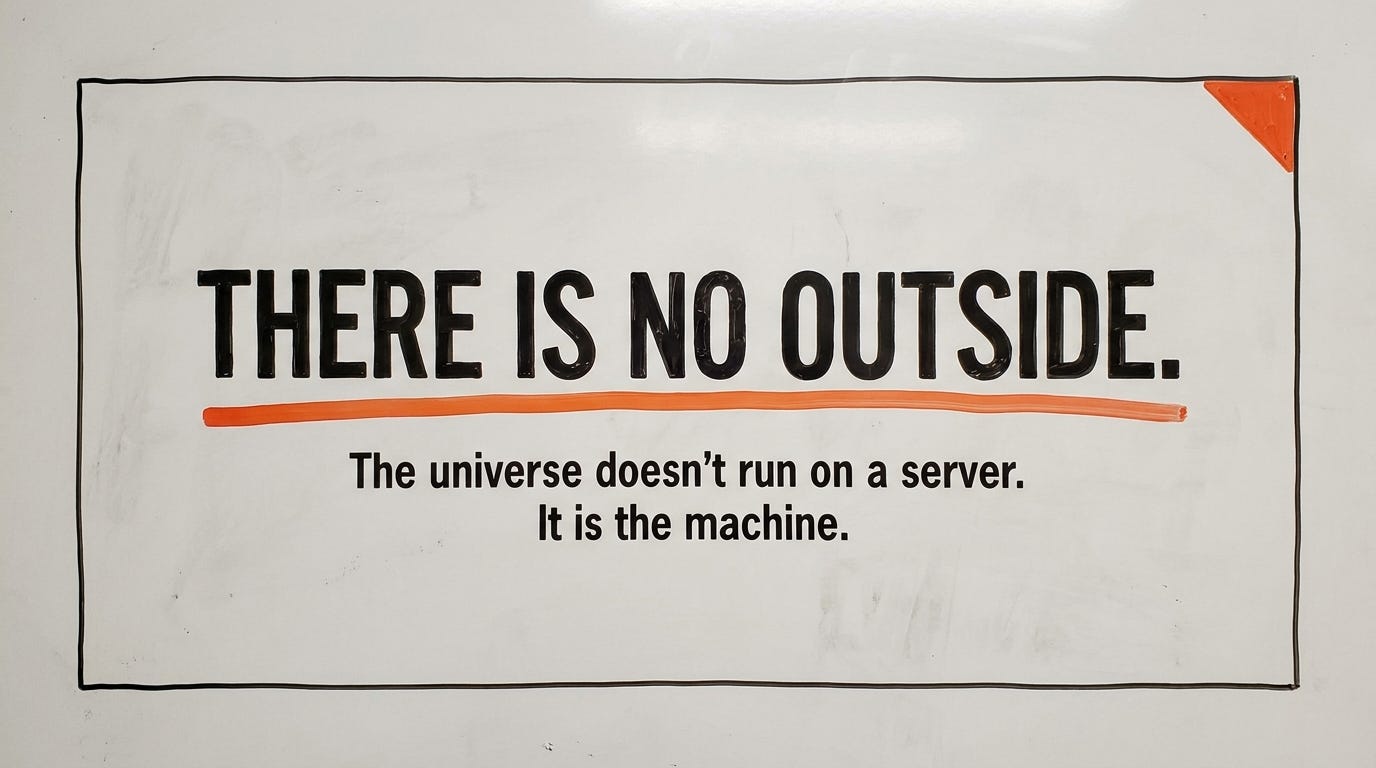
Physics offers a cleaner picture: there is no outside.
The universe weaves space from entanglement, manufactures time’s direction from decoherence and entropy, and freezes probability into fact through measurement. We are not NPCs being rendered. We are part of the computation itself — every observation is one step in this machine’s evolution.
It’s less romantic than the game-console story. But it has one enormous advantage: it might be true.
First Principles Manufacturing — Dispatches from a Novi robotics lab.
interesting thoughts