

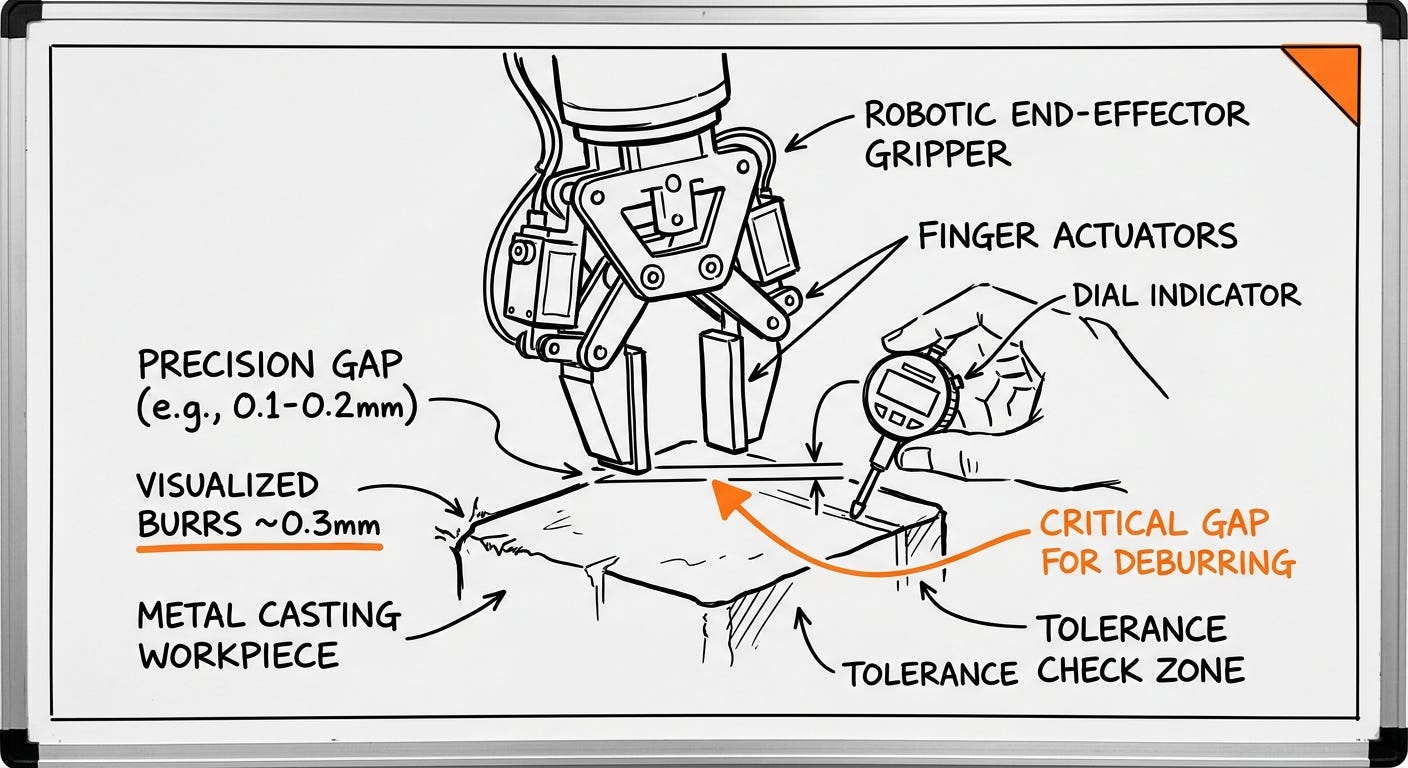
I. The Demo Was Impressive. But Can It Deburr?
The demo was impressive. A humanoid robot walks to a cabinet, opens the door, takes out a cup, and places it on the dining table. The whole sequence flows like a skilled housekeeper. The presenter’s face says “this is the future.”
I waited for him to finish, then asked one question: can this robot deburr?
The air went quiet for two seconds. He said: deburr what?
I explained: a workpiece comes out of the die-casting mold with 0.3mm burrs along the edge. You need a rotary cutter to trace the edge and shave them flat. The requirement: don’t cut into the workpiece body, and don’t miss any burr. Precision ±0.3mm.
He said: it should… probably work? Train it some more.
That “should work” isn’t a few training runs short. It’s a full order of magnitude of physical reality short.
II. Industrial Robots Have Two Precisions — And They Differ by an Order of Magnitude
Most people don’t know that an industrial robot’s datasheet lists two precisions, but most only ever see one.
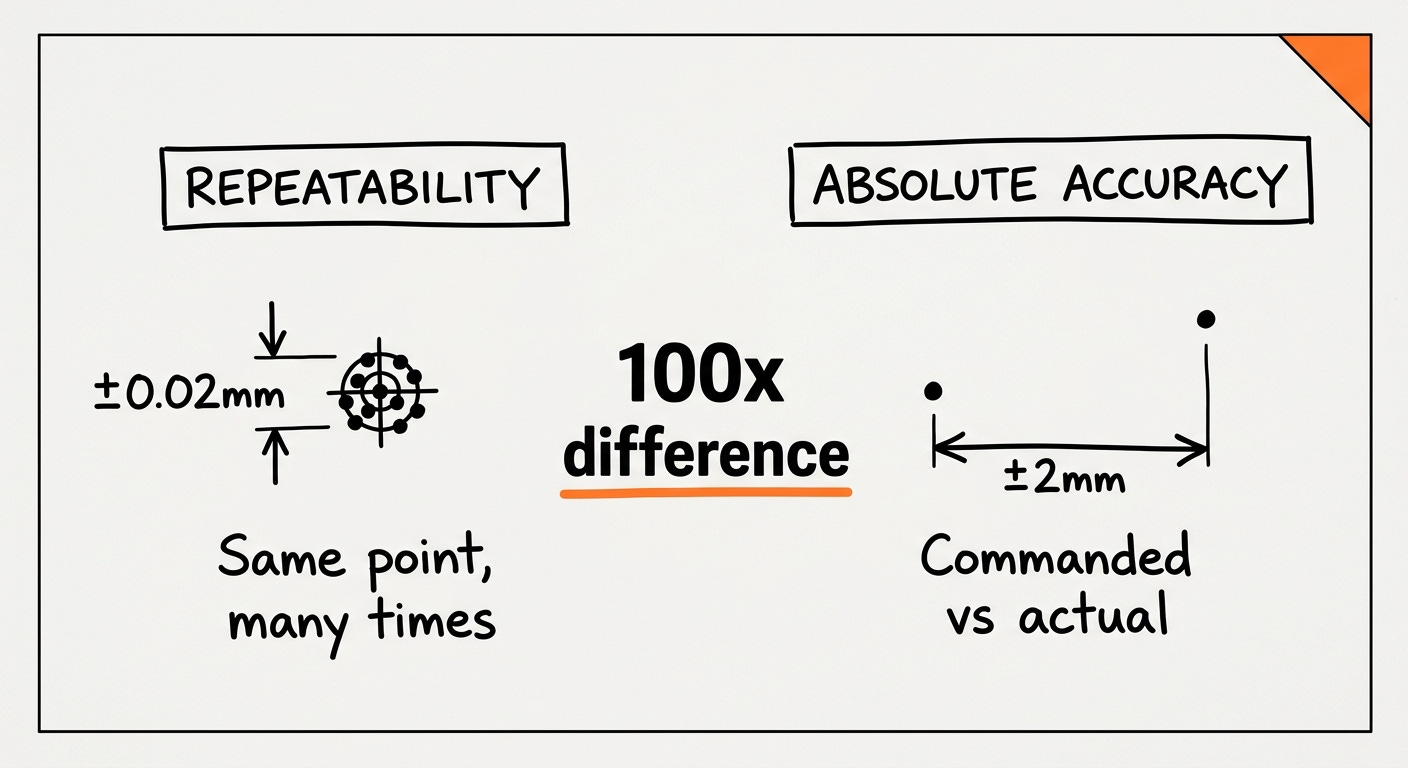
Precision Type Definition Typical Value Determining Factors Repeatability Deviation when reaching the same target multiple times ±0.02–0.05mm Encoder resolution, servo response Absolute Accuracy Commanded pose vs. actual reached pose ±0.5–0.8mm, poor ones ±2–6mm DH calibration, link thermal deformation, gear backlash, base rigidity
No need for an abstract example — take one of the most common mid-range arms on the shop floor: the ABB IRB 1200. Its official datasheet lists repeatability as 0.025mm — printed right where you’ll see it. But scroll down the same page, and the ISO 9283 linear path accuracy (AT) is 0.53mm.
Same robot, same datasheet, two numbers that differ by 20×.
Why such a gap? Because absolute accuracy is full-chain error accumulation. DH calibration error, link thermal deformation, gear backlash, base rigidity — every link injects error into absolute accuracy. Repeatability only cares about “returning to the same place”; absolute accuracy demands “going to the place the command names.” Completely different difficulty. There’s a rule of thumb in the field: a robot’s absolute accuracy is typically 20× or more worse than its repeatability. For large arms, or uncalibrated ones, ±2–6mm is common — one calibration study pulled absolute error down from 6.3mm to 0.5mm, which tells you how large the raw error was.
And here’s the more damning fact: most manufacturers only publish repeatability — they never disclose absolute accuracy. That pretty “±0.02mm” on the spec sheet is almost always repeatability. Absolute accuracy is the number they’d rather not print.
III. The “Secret” of Existing Industrial Solutions: Using Repeatability for Precision Processes
So how is industrial grinding actually done? The answer: absolute accuracy is never used.
Teaching (jogging): A person drags the arm to the point and records the joint angles. During execution it plays back perfectly — error only ±0.05mm. The human is the “precision sensor,” feeling and seeing to set the trajectory exactly.
CAD offline programming + visual guidance: First use vision to locate the workpiece (establish a workpiece coordinate frame), then “paste” the pre-programmed trajectory onto that frame. Absolute accuracy only handles “rough approach”; precision relies on “relative positioning + repeatability” as the safety net.
Both methods share one core sentence: make the robot return to a place it has been, not travel to a coordinate it has never visited. This approach has run for forty years. Not because it’s outdated, but because physically, it’s the only path that works.
IV. The Blind Spot of Embodied AI Paradigms: All “Absolute Positioning” Thinking
Now look at the mainstream embodied AI paradigms:
VLA models (RT-2, OpenVLA, π0): End-to-end regression of end-effector pose or joint angles — the output is an absolute target.
LLM planners: Output spatial coordinate sequences — absolute coordinates.
Vision-action models: Look at the target object directly, output the action to reach it — no concept of “workpiece coordinate frame + relative trajectory.”
All these paradigms share one implicit assumption: that the robot can precisely reach the target pose the model gives.
One detail says it all: search through these models’ papers and you won’t find a single mm-level positioning-accuracy metric. OpenVLA, π0, and RT-2 all report task success rates — π0 hits 80–95% on trained tasks, RT-2 hits 62% on novel objects. The recent VLA benchmark surveys evaluate success rate, generalization, instruction-following. Not one uses “end-effector landed within ±0.x mm” as an acceptance threshold.
This isn’t an oversight — it’s the paradigm blind spot: the entire academic evaluation framework has no “submillimeter accuracy” dimension at all. Yet for industrial precision processes, that’s the very first gate. ±0.5–2mm absolute accuracy against a ±0.3mm process requirement is physically impossible.
V. Then Why Does the Demo Look Flawless?
Because the tolerance of household scenarios and that of precision processes differ by two orders of magnitude.
Opening a cabinet, grabbing a cup, folding laundry, putting a plate in the sink — these have tolerances around ±2–5cm. A robot’s ±2mm absolute accuracy has a full two orders of magnitude of margin here; it can’t go wrong. Of course the demo flows.
But nobody deburrs in a demo. Not because they didn’t think of it — because it’s physically impossible. The moment the process requirement drops to ±0.3mm, those two orders of magnitude of margin flip into two orders of magnitude of deficit.
So every stunning embodied-AI demo you see lands in a high-tolerance scenario: flexible grasping, assembly pre-positioning, logistics sorting. Which is exactly the reverse proof that the precision wall exists — what can be demoed doesn’t need submillimeter; what needs submillimeter never gets demoed.
VI. Where the Conflict Happens
Put the two lines side by side:
Grinding, deburring, weld-seam tracking, precision assembly — process precision is all in the 0.1–0.5mm range
Embodied AI runs on ±0.5–2mm absolute accuracy
The precision magnitude overlaps with — or is worse than — the process requirement. This isn’t solved by “training a bit more.” It’s the physical boundary of mechanical structure: gear backlash doesn’t shrink because the model got bigger, link thermal deformation doesn’t vanish because the dataset grew.
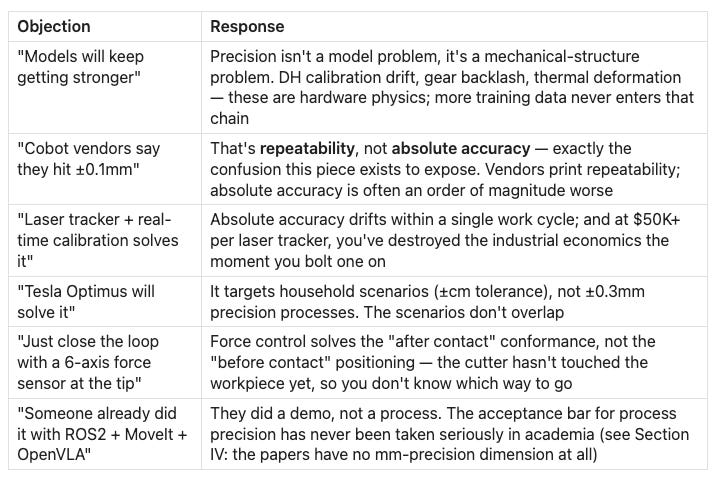
VII. You’ll Probably Push Back Like This
I’ve voiced this argument enough to have heard nearly every objection. Point by point:
VIII. The Solution: Hierarchy of Accuracy
I’m not against embodied AI. I’m against using it at the wrong level.
The correct architecture is a three-layer relay, letting each layer do only what it can physically do:
Layer Capability Responsible Party Precision Upper (Semantic Decision) Identify workpiece, judge defects, select process Embodied AI / VLA Precision not required Middle (Visual Re-localization) Sub-pixel template matching, establish workpiece frame Industrial vision ±0.01mm Lower (Physical Execution) Replay pre-calibrated trajectory in local frame Industrial robot ±0.02mm (repeatability)
This is isomorphic to nuclear engineering’s “defense in depth”: each layer’s capability boundary is clearly drawn, never expecting a single system to do it all. A reactor doesn’t rely on one barrier to catch every risk, and a precision process shouldn’t rely on one end-to-end model to catch every micron.
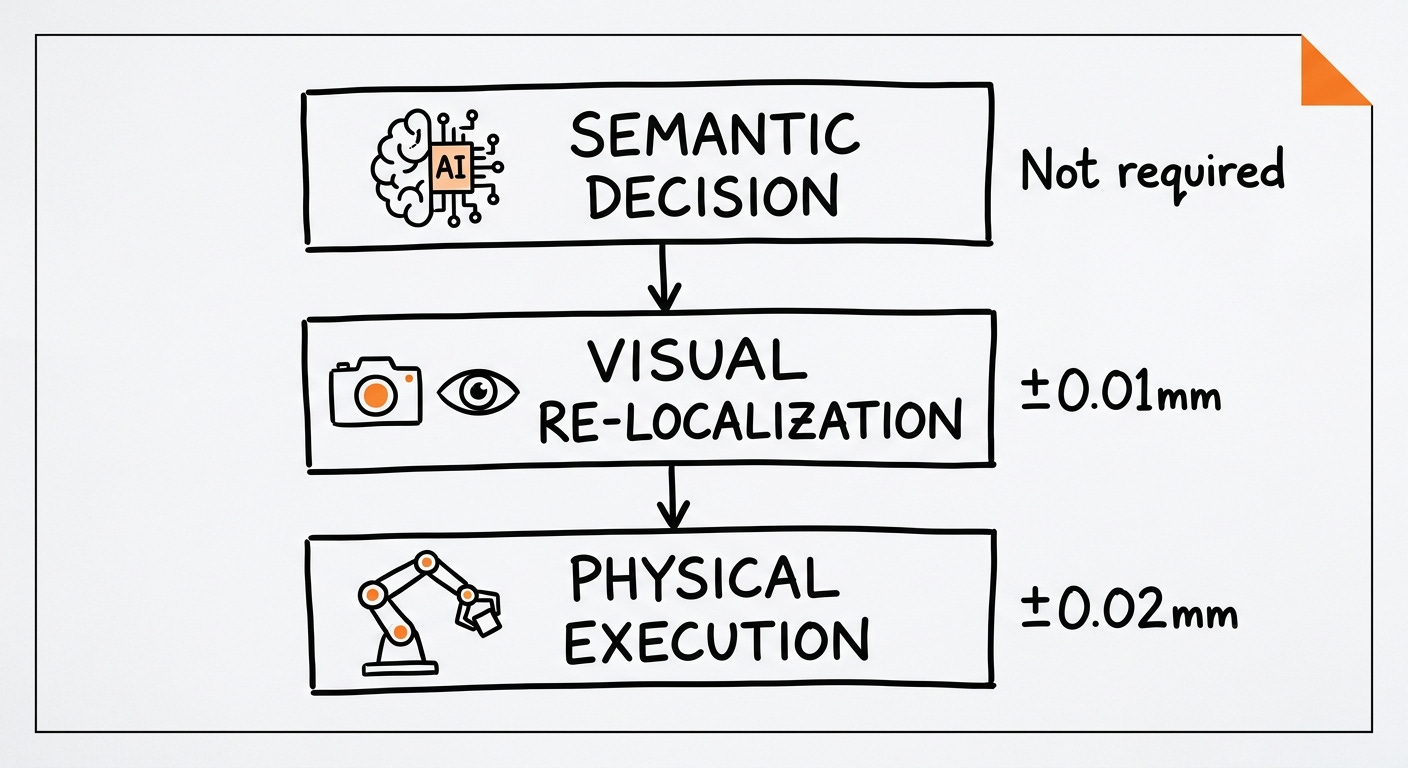
Embodied AI is right at the decision layer. Embodied AI is wrong at the precision layer. Put it at the right level and it’s the smartest layer in the stack; put it at the wrong level and it can’t shave a single 0.3mm burr.
(Whether that middle-layer sub-pixel visual loop can stably reach sub-pixel accuracy, our lab is still validating — no final answer yet. But the layering logic itself is settled.)
IX. Advice for Practitioners
For embodied AI entrepreneurs:
Don’t pick precision processes. Pick high-tolerance scenarios: flexible grasping, assembly pre-positioning, logistics sorting.
Your edge is understanding and decision-making, not physical precision. Leave the precision layer to the industrial methods proven over forty years.
For industrial practitioners:
Don’t be intimidated by demos. Your “teaching + visual re-localization” stack is still correct — the physics hasn’t changed.
Embodied AI isn’t here to replace your execution layer; it’s here to add a decision layer. See that clearly and you’ll know what to buy and what to skip.
First Principles Manufacturing — Observations on physics, economics, and cross-cultural engineering from a nuclear engineering PhD on a Michigan shop floor. Subscribe: