

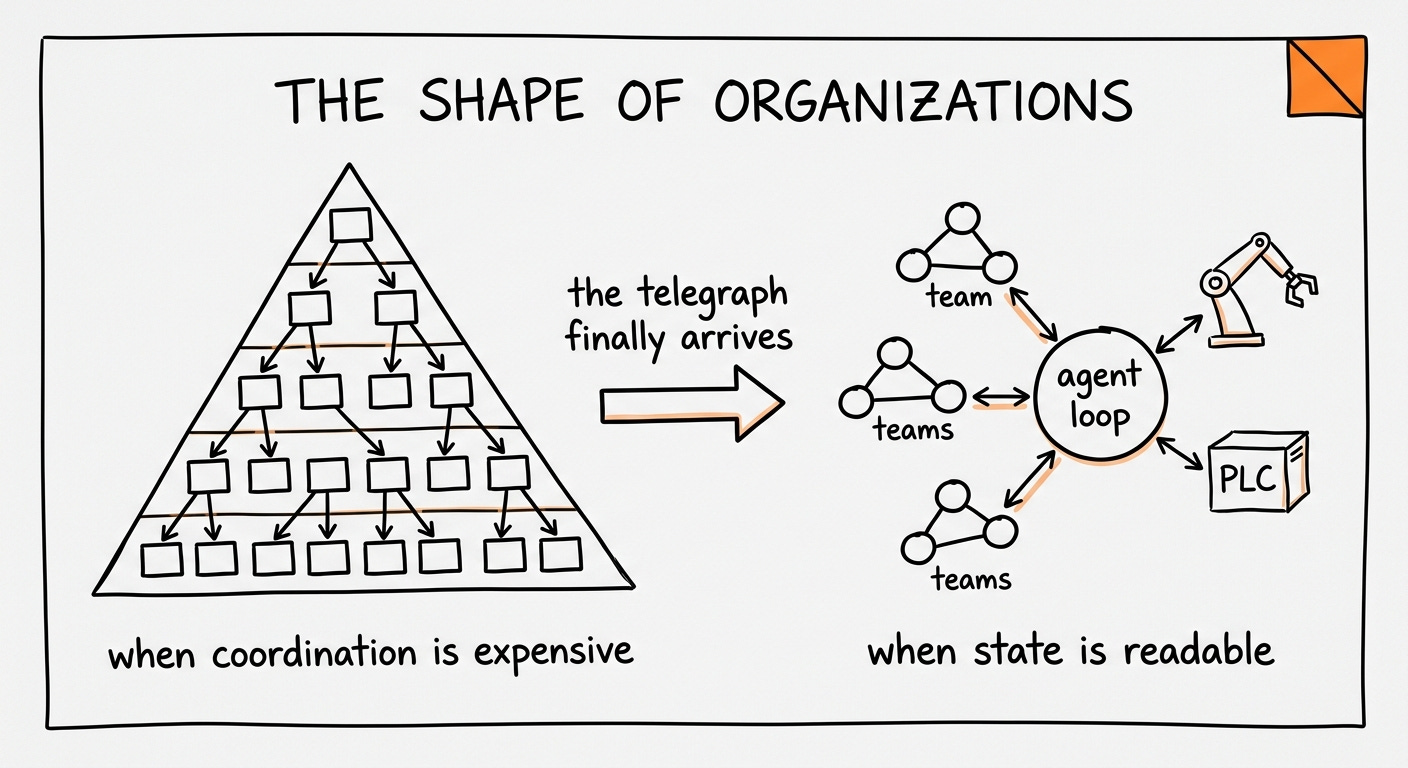
Manufacturing is not hard because it is backward. The way it looks today — the hierarchy, the crews, the shift handovers, the old hands — is a solution, optimized over decades. The real question is what happens when the constraints that solution was built for start to move.
1. One wall apart
Earlier this month, Hardware FYI ran a good piece called Why is Manufacturing Difficult? The list is accurate: cycles are long — qualification, ramp, and production all run in parallel; complexity is high — a design has to become a repeatable process; decisions cast long shadows — cut the tool once and the mistake follows you for three years. Nothing on that list is wrong. But a list describes the difficulty. It doesn't explain it.
To compress the list into one question, walk into any car plant and stand at the wall between the body shop and final assembly.
On one side of the wall: Mercedes' Alabama plant runs more than 1,650 robots, and about 1,250 of them are in the body shop — sparks everywhere, hardly a person in sight. On the other side: final assembly is full of people. ABB's managing director for automotive OEMs put a number on it in 2020: less than 5% of final trim and assembly is robotic — worldwide. The production chief of Volkswagen's Trinity plant said it plainer still: "Assembly is still 90 percent manual work."
Same company. Same capital. Same engineers. Same purchasing department. One wall apart, the automation rate drops by an order of magnitude.
Is it for lack of trying? Tesla tried. After the Model 3 ramp, Musk wrote it himself: "Yes, excessive automation at Tesla was a mistake. To be precise, my mistake. Humans are underrated."
So the question is not "why is manufacturing difficult." It is: what decides whether a task lands on the machines' side of the wall, or on the humans' side?
2. Automation is not a function of technology
Widen the frame from one car plant to all of manufacturing and the answer surfaces on its own.
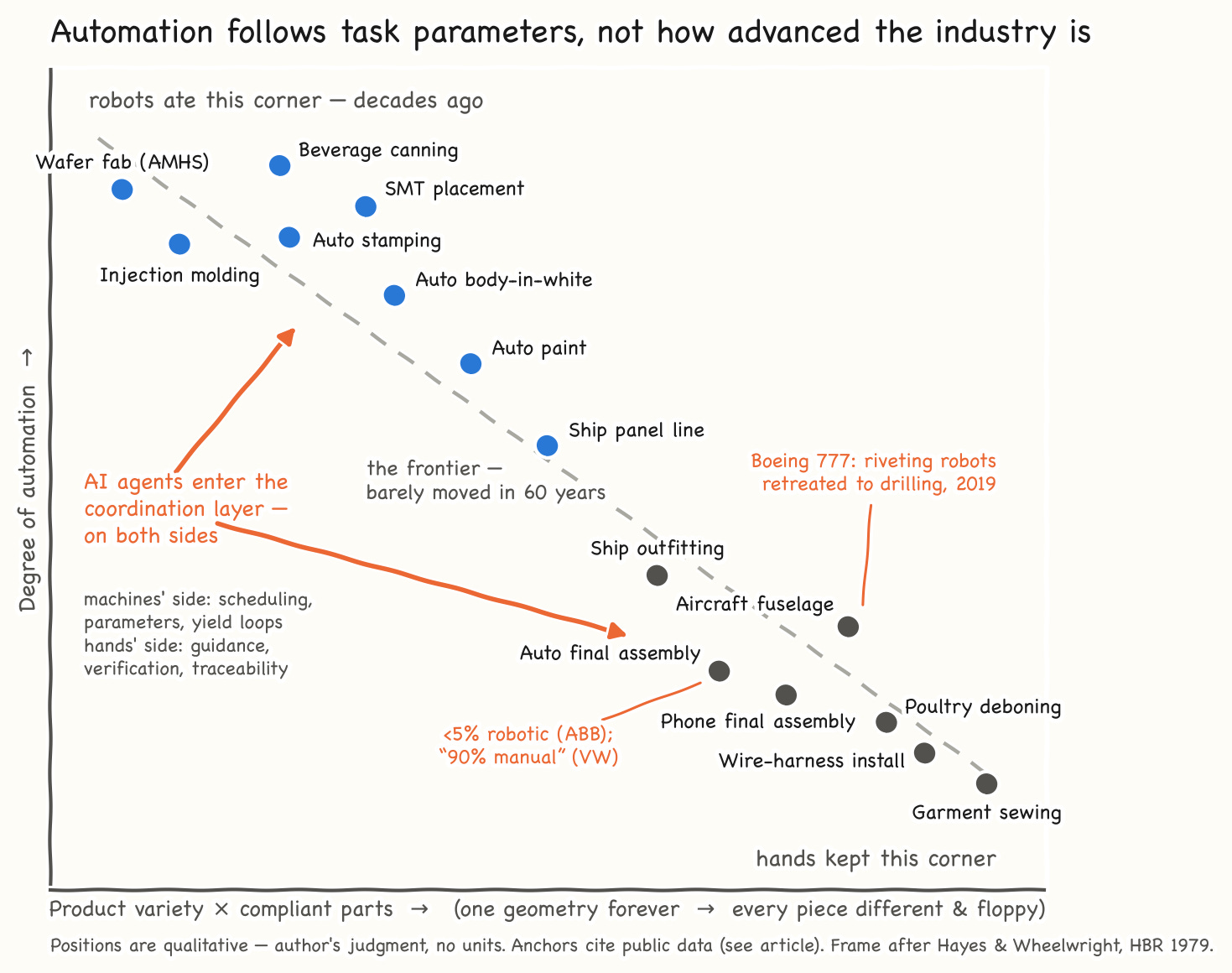
A qualitative map — no units, positions are author's judgment, anchors cite public data. The frame follows Hayes & Wheelwright's product–process matrix (HBR, 1979).
In a semiconductor fab, wafers ride overhead rails in sealed FOUP pods and no human hand touches them. In apparel, nearly two hundred years after the sewing machine, robots still have a "limited presence". Inside a single phone: an SMT machine places 20,000 to 150,000 components per hour, while the final-assembly halls next door hire two hundred thousand people for peak season. Inside a single food plant: a canning line runs two thousand cans a minute with almost nobody watching, while poultry deboning remains "primarily manual". Aerospace is the summit of advanced manufacturing, and Boeing's 777 fuselages are still fastened by machinists.
Put these on one chart — product variety times the share of compliant, floppy parts on the x-axis, degree of automation on the y — and every industry falls near the same downward line. What sets the automation rate is not how advanced or how rich an industry is. It is two parameters of the task itself: is the geometry certain, and is this piece the same as the last one.
The companies that charged the line head-on left records:
Apple ran a secret lab in Sunnyvale from 2012 to 2018 to automate iPhone and MacBook assembly. Robots couldn't drive tiny screws — they can't feel torque. The automated insertion of the 88 keyboard screws on the 12-inch MacBook kept failing and delayed the product by six months. The lab closed in 2018.
Boeing's FAUB program put KUKA robots on 777 fuselage riveting — roughly 60,000 fasteners per aircraft. Rework piled up from 2015 on, and in 2019 Boeing pulled the robots, keeping automated drilling and handing the fastening back to machinists. Note the detail: automation didn't leave. It retreated to the sub-task with certain geometry.
SoftWear's sewing robots were announced in 2017 to make 800,000 Adidas T-shirts a day in Arkansas, with 400 jobs promised. A few years later the plant's registered headcount was nine.
Foxconn promised one million robots in three years in 2011. By late 2012 it had installed about 30,000 — and hired roughly 100,000 more workers in the same period.
The most extreme point on the chart is the wire harness. A car carries more than 3,000 individual wires, around 4 kilometers of them, roughly 60 kilograms — and the number keeps growing: by Volvo's own like-for-like count, wire length per car went from 1,000 meters in 2000 to 2,800 meters in 2020. As for installing it, engineers from Chalmers, Volvo and Scania put it bluntly in a 2024 review: the job "has been performed entirely manually by skilled human operators," and to date "no practical automated solutions have yet to be witnessed in actual production." For the machinist's version of why: harness installation is five steps — soften, transport, untangle, route, connect. Machines can do the first two. Each of the last three means handling an object that deforms under its own weight and differs batch to batch.
This line has barely moved in sixty years. Industrial robots entered the factory in 1961; today the car industry's robot density is nine to ten times the manufacturing average — and every one of those robots is piled into the upper-left corner of the chart.
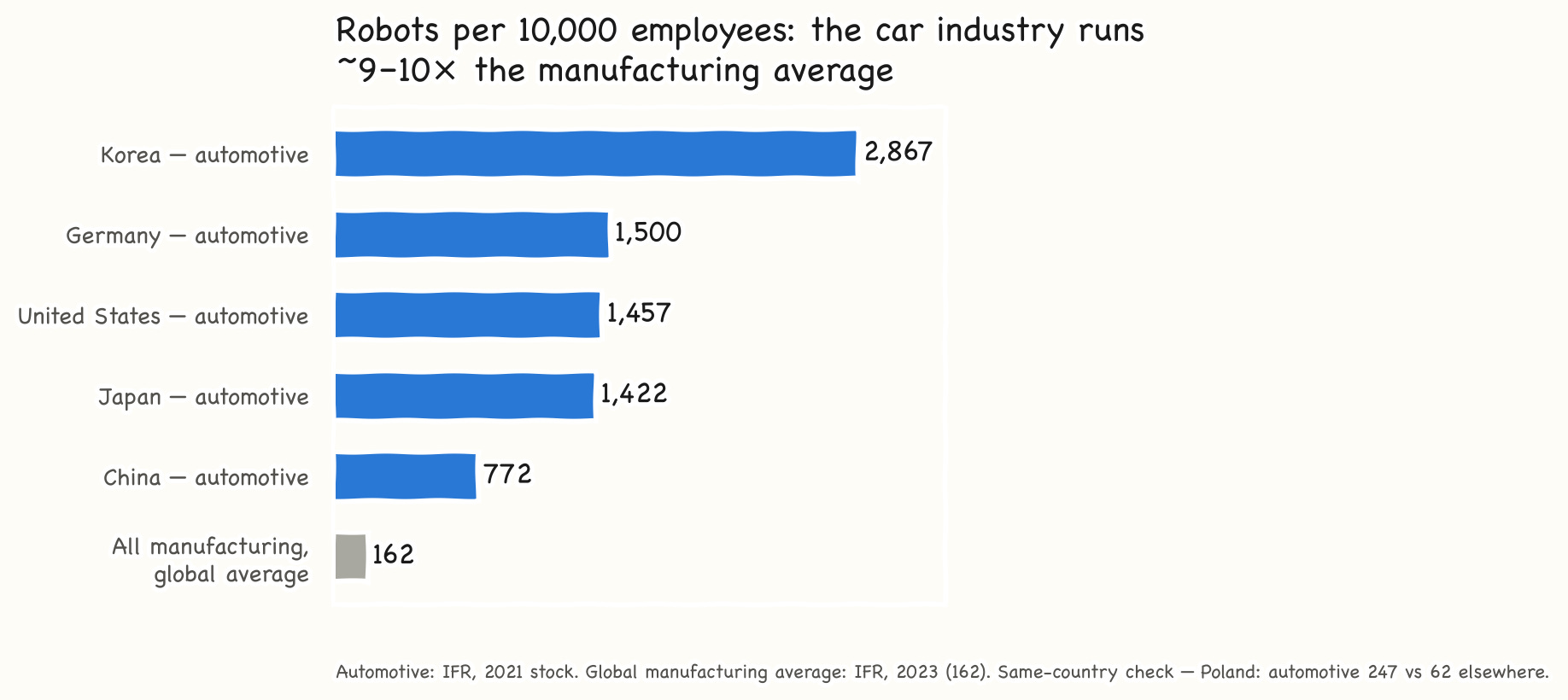
It holds within a single country too: Poland runs 247 robots per 10,000 employees in automotive and 62 everywhere else. Robots did not flow to where labor is scarcest. They flowed to where geometry is most certain.
3. The org chart is a solution
Now look at the lower-right corner — the corner machines couldn't enter and hands kept. What does the organization look like down there?
Deep hierarchy, orders passed level by level. Crews of a few people, an old hand training the new one. Three shifts, with a meeting at every handover. A traveler document that follows the workpiece, signed at every step. When something goes wrong: escalate, investigate, assign a name.
Plenty of people read this as backwardness — legacy structure waiting to be cleaned up by digitization. Put on a different pair of glasses: this is a structure that has been optimized, repeatedly, under a specific set of constraints. Every feature answers a specific cost:
Hierarchy, level-by-level reporting — Moving information is expensive: remote readers can't see floor state
Crews + apprenticeship — Knowledge won't encode: feel and experience don't fit in documents
Shift-handover meetings — State won't transfer: the machine's and the workpiece's state live in someone's head
Paper travelers, signatures — Verification is expensive: traceability runs on physical evidence and named people
Approval chains — Errors are costly: one bad decision physically scraps things
None of this is my invention. Coase settled it in 1937: firms exist because using the price mechanism itself has a cost — "the main reason why it is profitable to establish a firm would seem to be that there is a cost of using the price mechanism." Chandler gave manufacturing its version in The Visible Hand: modern business enterprise first appeared when the volume of activity made administrative coordination more efficient than market coordination — the management hierarchy is not bureaucratic inertia; it is itself a technology, the best engineering answer of the railroad-and-telegraph era to the coordination problem. And Conway's law, usually quoted forward — systems copy the structure of the organizations that design them — should be read backward on a shop floor: an organization's shape is a copy of its communication structure.
Look back at the Hardware FYI list through these glasses — long cycles, high complexity, hard coordination — and the three items collapse into one: coordination is expensive. And the army-style organization is the best machine humans have ever built for operating under expensive coordination.
Calling it an army is not a figure of speech.
4. Armies change shape when communication does
The army is the most-studied high-coordination-cost organization in history, and its history of shapes is a history of communication technology.
Prussia's Moltke inherited a problem: railroads and the telegraph had made war too large for any single commander's head — van Creveld gives it a full chapter in Command in War, titled "Railroads, Rifles, and Wires." Moltke's answer was not to grip harder. It was two things: the general staff — a corps of uniformly trained officers, in effect one operating system installed across the whole army — and the doctrine later called Auftragstaktik, mission command: the commander states the intent; how to execute is left to the officer on the spot.
A hundred and thirty years later, bandwidth jumped a few more orders of magnitude and the army changed shape again. Afghanistan, 2001: twelve-man special-operations teams on horseback used satellite radios and laser designators to call B-52 strikes in real time — the official U.S. Army history records these detachments wielding the striking power that used to take an entire corps-level chain of command. McChrystal later compressed that whole organizational lesson into one line: it takes a network to defeat a network.
The rule is clean: every time the cost of communication and verification steps down, the organization gets one level flatter, its units one size smaller, its authority one notch lower. The army got its telegraph, and then its satellites. Manufacturing's hierarchy and crews still hold the shape of the previous era — not out of stubbornness. Its telegraph never arrived.
5. Plug in the new variable
Now plug in the AI agent. First, clear away a distractor: the robot was never the variable. Sixty years of robotics did not change the shape of the manufacturing organization — it took over the muscle work in the upper-left corner and swapped operators for maintenance engineers. The hierarchy stayed. The handover meeting stayed. Muscle was never what set the organization's shape. Coordination was.
Agents hit exactly that layer: reading state, carrying intent, running verification — the cost in every row of the table above. Link by link:
Design → process. Today: throw drawings over the wall, hold reviews. The locked constraint: design intent can't reach the floor. With agents: process constraints computed back at design time.
Production planning. Today: planners + Excel + morning meetings. The locked constraint: line state can't be read out. With agents: state readable live; replanning in minutes.
Purchasing / supply chain. Today: emails and chase-up calls. The locked constraint: supplier state invisible. With agents: cross-plant state reads (crosses firm boundaries — slowest).
Shop-floor execution. Today: crew chief assigns, briefs verbally. The locked constraint: intent travels through people. With agents: mission command: state the intent, guidance at the station.
Shift handover. Today: a meeting + handwritten notes. The locked constraint: state lives in heads. With agents: state transfers, and replays.
Quality. Today: dedicated inspectors + stacked reports. The locked constraint: verification expensive, delayed. With agents: verification embedded at the station, closed loop.
Maintenance. Today: the old hand's memory + escalation. The locked constraint: knowledge won't encode. With agents: fault history queryable, diagnoses accumulate.
This is the organizational meaning of the agent loop I wrote about in Is Manufacturing at Dusk or Dawn? That piece was about the machine layer: interfaces that can't enter the loop get squeezed out. This piece is the same judgment one level up: once the interfaces are in the loop, the organization wrapped around them changes shape.
Look at the two arrows on the chart. Agents don't push against the sixty-year-old line — they enter the coordination layer on both sides of it. Upper left: take over the scheduling, parameters and yield loops of machines already automated. Lower right: don't replace the hands — give them eyes and memory. Work instructions, live verification, variant data delivered to the station. The curve doesn't move. The organization around the curve does.
6. The shape of the endgame
Follow the constraints and the endgame is not the lights-out factory. Lights-out assumes the bottleneck is muscle — but where muscle could be automated, automation started sixty years ago, and where it couldn't, four companies just re-verified the fact with real money (the list is in section 2).
The endgame looks more like the army after Moltke:
Flatter. Hierarchy exists because moving information is expensive; once state is readable, the relay function of middle layers hollows out.
Smaller units. Crew size is set by coordination overhead; with handover and traceability carried by agents, two or three people run a section of line — the shape drifts toward the special-operations team.
Authority sinks; command becomes mission command. Humans state intent and accept the result; the carrying, checking and recording travel in the loop. This is the organizational version of the wall I drew in The Builder Cannot Be the Verifier: the human stands on the verification side.
Humans don't exit. The lower-right half of the chart will belong to human hands for a long time. What changes is how large an organization stands behind each pair of hands. An Iron Man suit, not an empty factory: one technician wearing an agent calls on the whole chain's capability — the way twelve men on horseback called on a B-52.
Three falsifiable markers, on the record:
If, five years after mainstream industrial agent products reach general availability, the plants that adopted them show no statistically visible change in management depth or crew size — the law "organizational shape is a solution to coordination constraints" is wrong.
If products that replace muscle head-on (humanoids swapping whole lines of people) reach meaningful revenue at scale before coordination-layer products do — this piece's test for where to enter is wrong.
If wire-harness installation gets fully automated in volume production — the sixty-year line in section 2 has moved, and this whole piece needs rewriting.
7. One question
If you are evaluating a manufacturing AI product — one you might build, or one you might buy — ask one question:
Does it attack the muscle constraint, or the coordination constraint?
Attack muscle, and you are fighting sixty years of robotics for the hardest bone on the chart, standing in line behind Apple, Boeing, SoftWear and Foxconn. Attack coordination, and your competition is Excel, whiteboards and the shift-handover meeting — sixty years without a serious challenger, with the whole shape of the organization pressing on exactly those costs, waiting to move.
How to build a system that enters the loop and takes over the coordination layer — I'm building one, episode by episode, on another line. This piece is why the entry point is there. That line is how.
If you know someone who still runs three shift-handover meetings a day — send them this. They’re living in the chart above.
First Principles Manufacturing — Dispatches from a Novi robotics lab.
The factory wall transfers cleanly to AI rollouts: the question is never how advanced the model is, but which side of the wall a task lands on. Your product-variety axis maps onto judgment variance - the more the correct output depends on context that is not in the spec, the longer the task stays with humans. Tesla's 'humans are underrated' reads less as failed ambition than as a mispricing: the floppy parts were never going to be machine work at any level of trying. The organizations getting AI employment right are the ones that draw the wall before they buy the machines.
The coordination point is the strongest part. If hierarchy, handovers and approval chains are solutions to expensive information transfer, then faster machines alone do not change the organization. Lower the cost of coordination and the shape of the factory can change with it.