

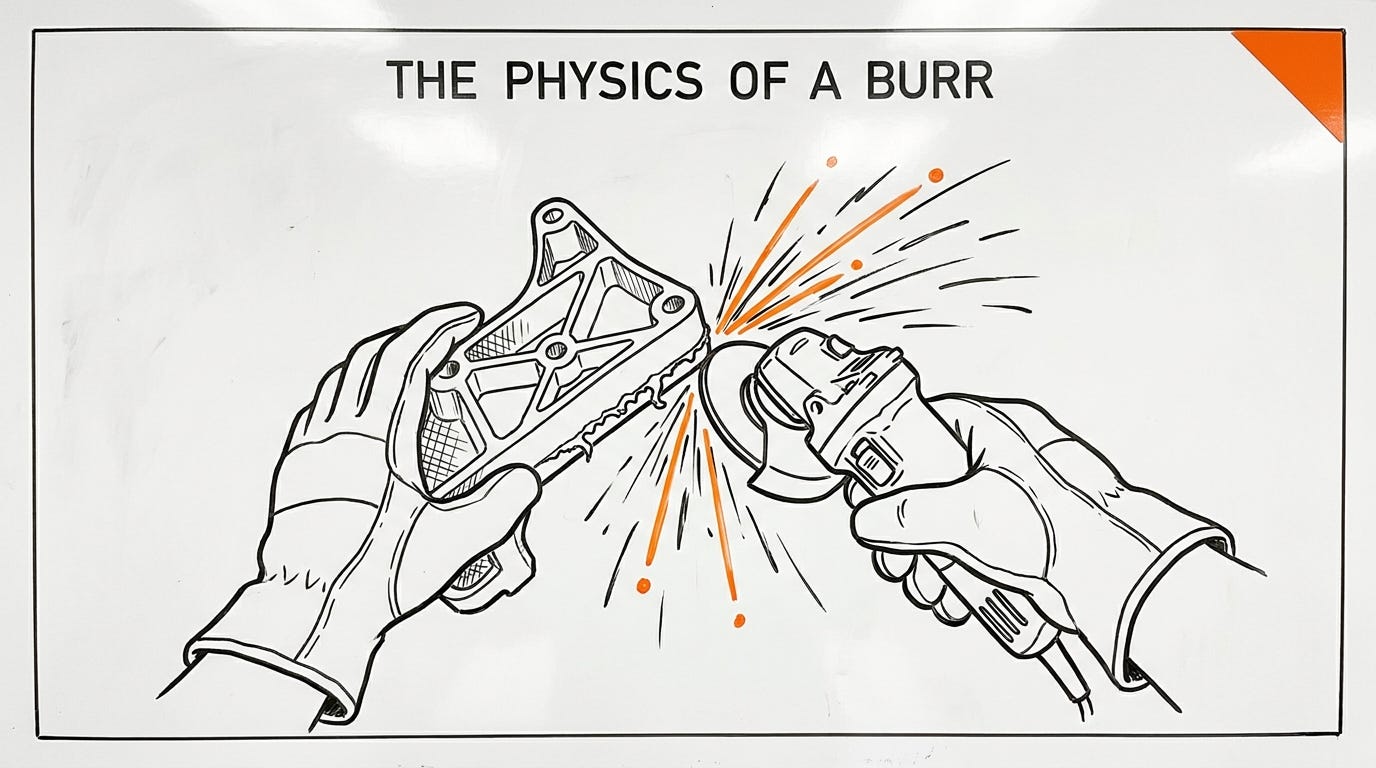
Walk into any die casting plant and the loudest corner isn’t the casting machines. It’s the deburring benches. Sparks, dust, anti-vibration gloves — a row of workers hunched over, running the edge of every single casting by hand.
And the bench is never just the bench. It adds a material-handling loop, a line-side buffer, a haze of dust over half the shop — and, less visibly, it ties up working capital in parts that sit waiting for hands.
Three numbers from that corner are worth remembering: annual turnover at the deburring station, 35%. Time for a skilled worker to finish one structural casting, about 60 seconds. And zero — the number of times, in the past thirty years, this station has been fully automated away.
A plant manager once pointed at one of his veterans and told me: “He’s worth three men. The others are no use.” I looked at the man’s weathered face and felt something I couldn’t quite name.
Robot welding is everywhere. Robot painting is everywhere. Robot palletizing is a commodity. So why is the dirtiest, most injury-prone, least wanted job in the shop the last one still done by hand?
The answer isn’t that robots aren’t good enough. The answer is in the physics of the burr.
A Burr Is the Casting Process’s Fingerprint
Start with where burrs come from. In high-pressure die casting (HPDC), molten aluminum fills the cavity in tens of milliseconds at tens of megapascals. That pressure slams the metal into every gap the die offers — parting line, ejector pin clearances, vent channels. The thin layer that squeezes in and freezes there is flash.
Which means the thickness of the flash is essentially a photocopy of the die’s clearances. And those clearances are not constants: the die wears under thermal cycling and high-pressure scouring, clamping force drifts, gaps grow.
Today’s flash distribution is not the flash distribution three months from now. A burr is not a feature. It is a statistical distribution — and the distribution drifts.
Low-pressure die casting (LPDC) is a different world. Wheels are the classic case: slow fill, low pressure, and the parting-line flash is far milder. But the burrs don’t disappear — they change battlefield. Now they live on the cut faces where gates and risers come off, and at the exits of machined holes. Machining burrs form differently, too: at the instant a cutter exits an edge, the material isn’t sheared off — it’s pushed out. That rolled-over rim is the residue of plastic flow.
One word, “burr,” and on high-pressure versus low-pressure parts it means two different physics, two morphologies, two distributions. Don’t let the single word fool you — the same way “crack” is one word for many different animals.
The Human Hand Is an Underrated Machine
Why is the veteran so good? Take the skill apart and the hand is doing three things at once: fingertips sensing force in real time (more stock, more pressure), eyes inspecting in real time (clean or not — one glance), wrist re-planning online (this part’s flash sits two millimeters left of usual, so the path shifts with it).
A single machine with force control, vision, and online re-planning, closed at millisecond rates — in robotics that’s a frontier research topic. At the deburring bench it’s the first week of onboarding.
But the human cost lives in those same three things. Every worker’s definition of “clean” is different, and one worker’s definition differs between morning and afternoon. Eight hours of vibration and dust treats the body as a consumable. And 35% turnover means that just when you’ve finally taught everyone the standard, they leave.
The hand wins on adaptability and loses on consistency — the goal of automation was never to imitate the former, but to keep it while buying the latter.
Three Walls: Why Robots Still Can’t Deburr
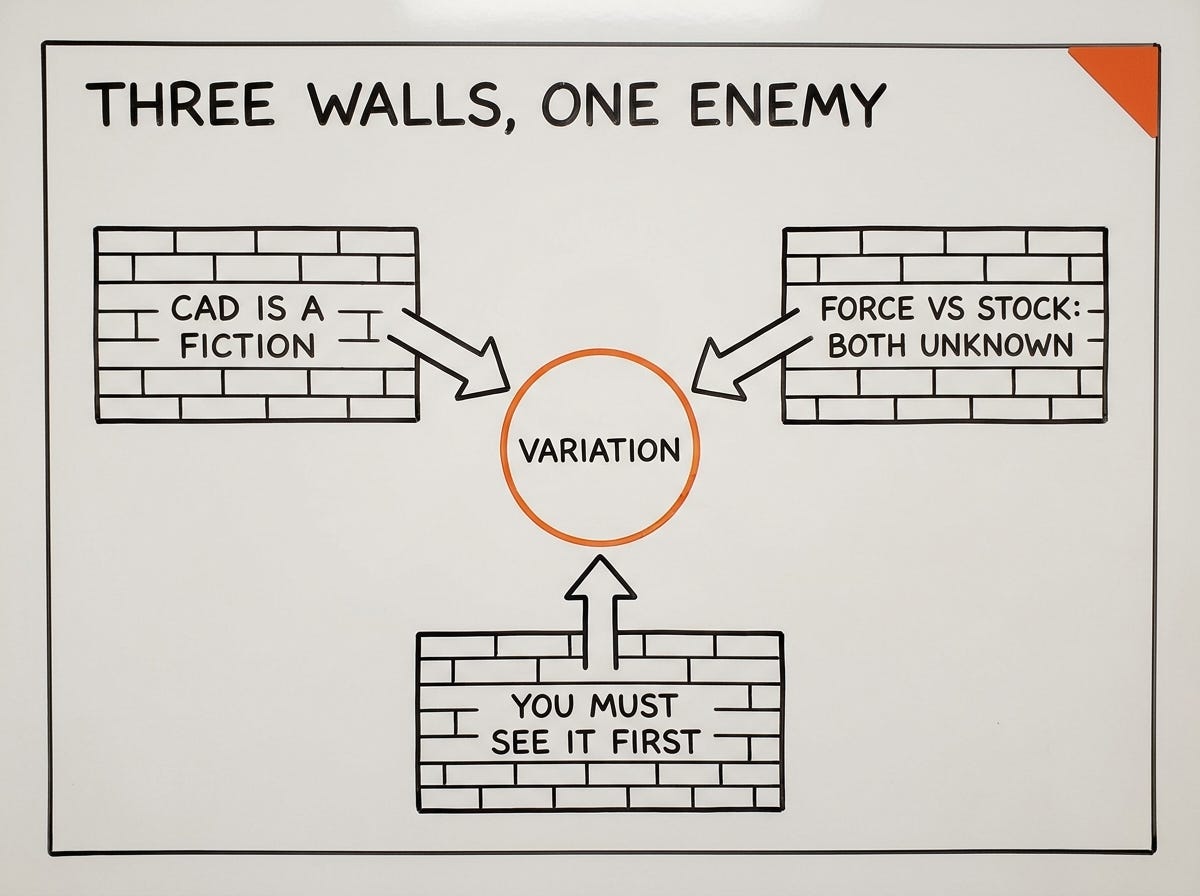
Wall One: CAD Is a Fiction Everyone Agrees to Believe
Where does a robot’s path come from? From CAD. But a casting is not its CAD model. Solidification shrinkage pulls the dimensions in, uneven cooling warps the part, and die wear makes every batch drift slowly in shape. Between the physical part and the nominal model runs a gap — and the width of that gap changes on its own.
Cutting to the model gives you exactly two outcomes: grinding air, or gouging parent metal.
The direction of the way out isn’t hard to point at: measure the part in your hand, not the one you designed. What’s hard is doing that inside a production takt — which is a topic for another article.
Wall Two: Force and Stock Are Each Other’s Unknowns
Grinding is a game of force: heavy pressure for thick stock, light touch for thin, and getting it wrong either leaves the burr or eats the part. But each part’s stock distribution is unknown before you grind it — it is the drifting statistical distribution itself.
Whether the spindle is compliant or rigid, the traditional approach can only aim at the average: never over-cutting, but guaranteed to leave residue somewhere. That’s not a tuning problem. It’s the built-in strategy of conventional robotics.
Fix the force and the stock won’t cooperate; fix the path and the part won’t cooperate. That’s why teach-pendant deburring robots look great at trade shows and get sent back to manual within three months on a real line: they assume a world that doesn’t drift.
Wall Three: You Have to See It First
You can’t remove a burr you can’t find. And “seeing a burr” is not optically trivial: on matte aluminum, a flash root microns deep and millimeters long sits tangled in the same image with texture, oil stains, and shadows. What a human eye separates in one glance, a camera often can’t — there’s an entire discipline in that sentence, which I’ll leave closed today.
The three walls are three faces of the same enemy: variation. Position varies, stock varies, appearance varies — and the entire estate of classical automation is built on things not varying.
The Shop Floor Produces a Health Report Nobody Reads
Here’s something most plants haven’t noticed they own.
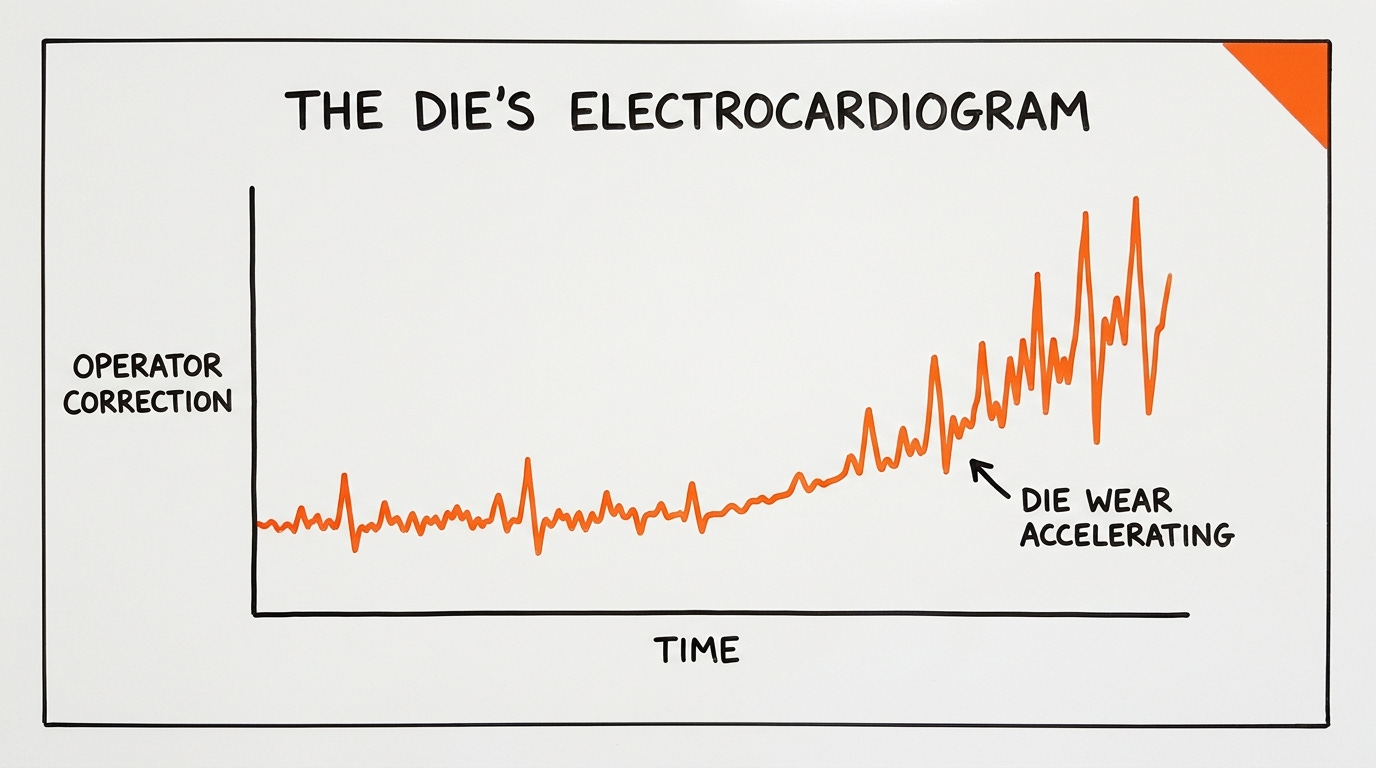
The veteran compensates every single day: this batch’s flash runs thicker than last week’s, so the hand bears down a little more; the left side runs heavier than the right, so the path drifts left. None of these compensations is recorded. They evaporate at the end of the shift.
But record them — each part’s correction relative to the nominal path, laid out over time — and you get a curve. And that curve is narrating the health history of the die: wear accelerating, clamping force decaying, an ejector pin due for replacement.
Corrections are not operator noise. They are the die’s electrocardiogram. The shop floor produces a health report every day — nobody is reading it.
What that observation is worth depends on what you connect it to. Today I’m only putting the observation itself on the table.
What It Would Take to Actually Automate This Station
Turn the three walls around and the conclusion writes itself. A deburring system that deserves the word “automated” must answer three questions for every individual part: Where are this part’s burrs? (Inspection, not assumption.) What force did it use and what path did it take? (Adaptation, not playback.) And after grinding — is it clean? (Re-inspection, not prayer.)
Inspection and rework have to be two steps of one closed loop, not two machines on a line. The eye tells the hand where to grind; the hand finishes and the eye looks again. It sounds like a truism — and most solutions on the market die precisely by splitting that truism into two separate procurement packages.
The burr is the smallest part-level problem in the shop, and the most everyday incarnation of the monster called variation. Whoever tames that drifting distribution understands half of manufacturing automation — the other half is making the taming cheap enough to be worth doing.
That’s the next article.
First Principles Manufacturing — Dispatches from a Novi robotics lab.