

The first time was at Inbolt's own booth. A robot was bin picking automotive parts out of a jumbled bin, and picking them accurately. The person at the booth told me: 1 mm accuracy, 60 frames per second.
I was impressed. The first thing that went through my head was: could this do deburring?
The second time was at FANUC's booth. I didn't expect it there. FANUC, one of the biggest robot makers in the world, on its own stand, running vision from a startup. (FANUC's show release describes a CRX-20iA/L tightening bolts on moving parts.) That's when I started to get suspicious. Is it really that good?
The third time was at a booth doing CNC machine tending. Inbolt again.
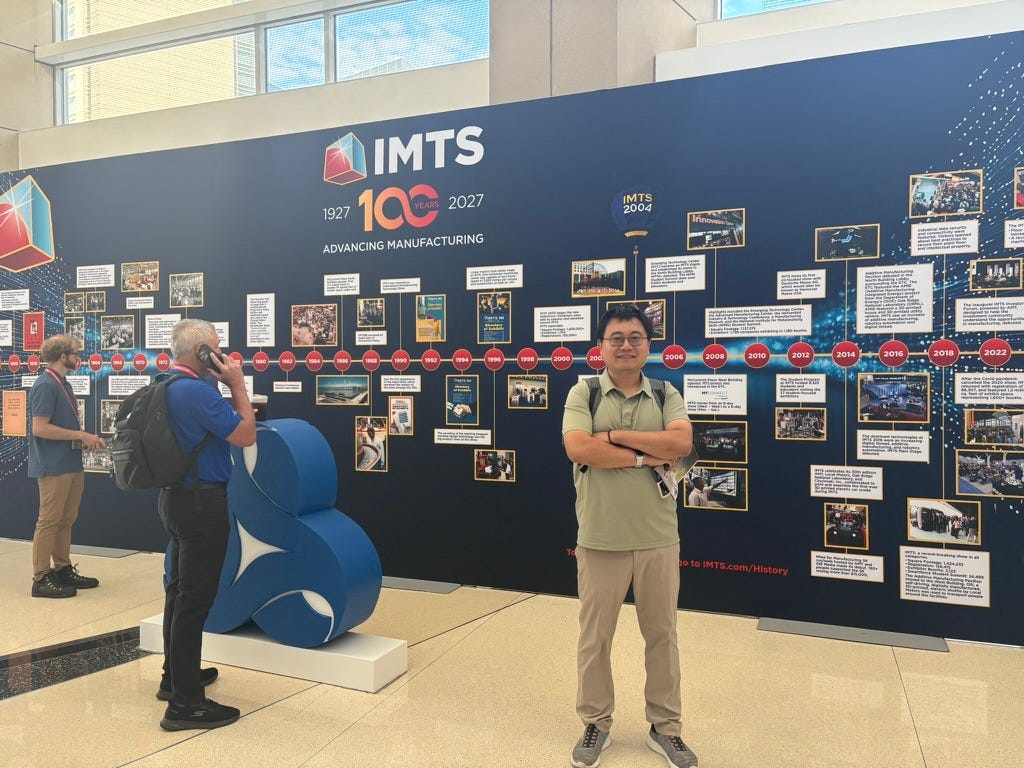
IMTS 2026 in Chicago, in front of the show's 100-year timeline, 1927 to 2027.
That was last week at IMTS in Chicago. After the third encounter I had two questions. How is it that accurate? And how is it everywhere?
How is it that accurate?
When I got home I looked up how it works. Inbolt is a Paris startup that does real-time vision guidance for robots. Its technical overview is plain about the method: the software matches the part's CAD model against the 3D data from the camera, computes the part's position and orientation, and corrects the robot's path in real time. First it finds the part in the scene, which Inbolt says takes 200 ms. Then it switches to tracking, with position updates up to 500 Hz depending on the robot brand. Inbolt also stresses that the software isn't tied to any particular camera.
Then I looked at the camera. At Hannover Messe this April, Inbolt's public demo ran on a RealSense D435. The RealSense online store lists that camera at $314.
Every depth point from a $314 camera is noisy. So where does 1 mm come from? From the drawing. The CAD file already says exactly what the part looks like. Fit the whole shape against a large cloud of noisy points and most of the noise averages out in one fit. Inbolt saves money on the camera by leaning on information the drawing already holds.
That also answered the question I had at the booth. Deburring is about finding exactly the places where the part differs from the CAD. A whole-part matching algorithm treats those small local deviations as noise and throws them away. It can tell the robot where the part is. It can't see where the burr is. Inbolt's own spec sheet agrees: repeatability with the standard camera is 0.5 to 0.7 mm, and to get under 0.3 mm you switch to its separate high-precision structured-light camera. For picking, bolting and dispensing, the standard camera is enough. Deburring needs a different kind of measurement.
How is it everywhere?
The answer to the second question is in what Inbolt doesn't build.
It doesn't build cameras. When it raised its Series A in September 2024, Inbolt already described itself as "software-only," working with "any standard 3D camera."
It doesn't build robots either. It supports six brands: FANUC, ABB, KUKA, Universal Robots, Yaskawa and Comau. The FANUC integration streams trajectory corrections through FANUC's Stream Motion interface, and GM was the first customer on it.
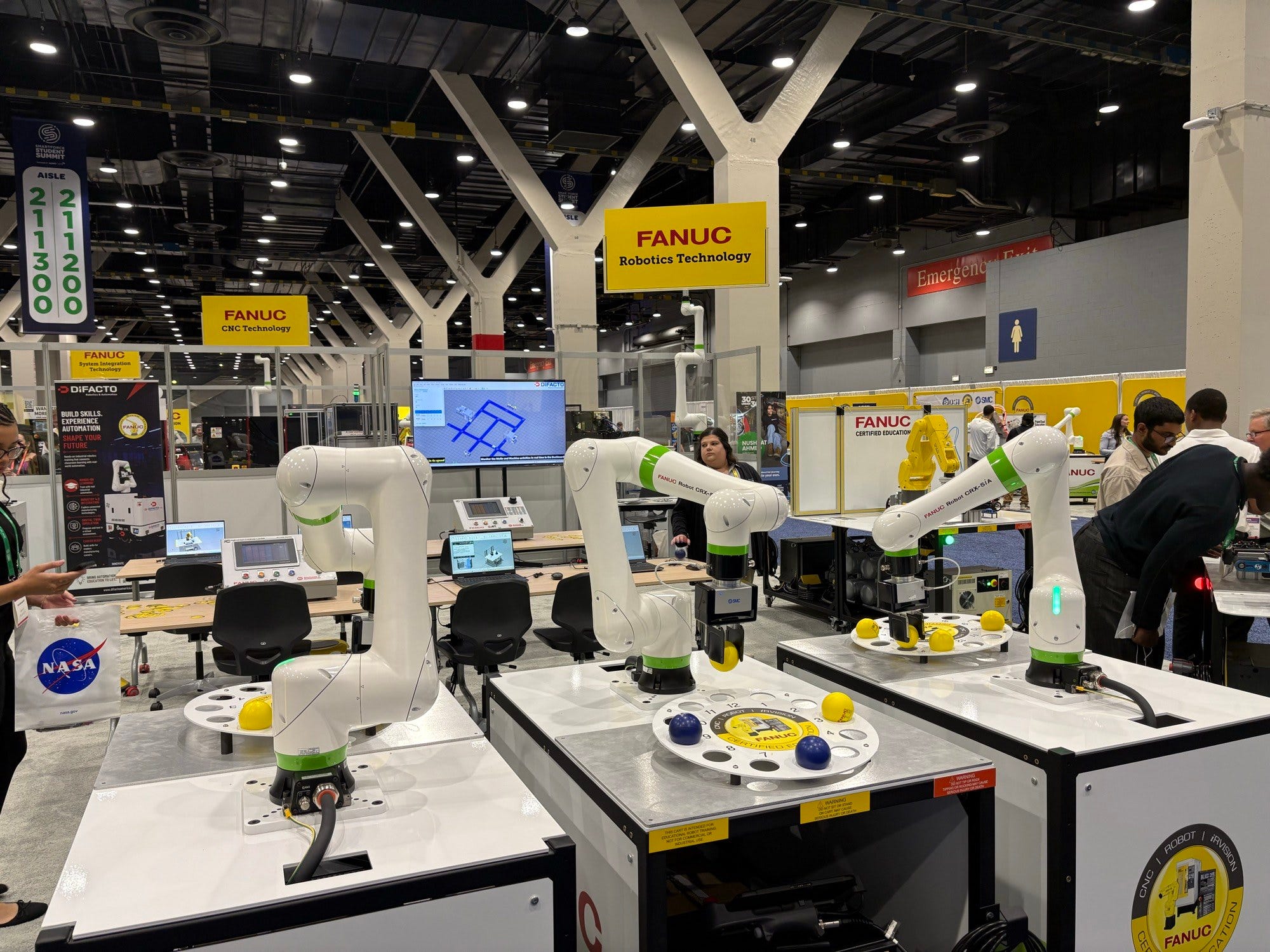
FANUC's education area at IMTS, a row of CRX cobots. The Inbolt integration on FANUC supports the CRX line. (My photo. Inbolt isn't in it.)
On opening day of IMTS, UR launched its Gen 7 platform, and Inbolt's vision now runs directly on the UR controller, sold by UR itself. In UR's release, Inbolt CEO Rudy Cohen put it simply: "available directly through UR."
So that's why I kept running into it. Inbolt builds one layer of software in the middle and uses other companies' hardware on both sides. It gets in the door through the robot makers' booths, controllers and sales teams. By the company's own numbers, it was in 20-plus factories in September 2024, 50-plus in June 2025, and is in 75-plus today, with more than 40 million robot cycles in 2025.
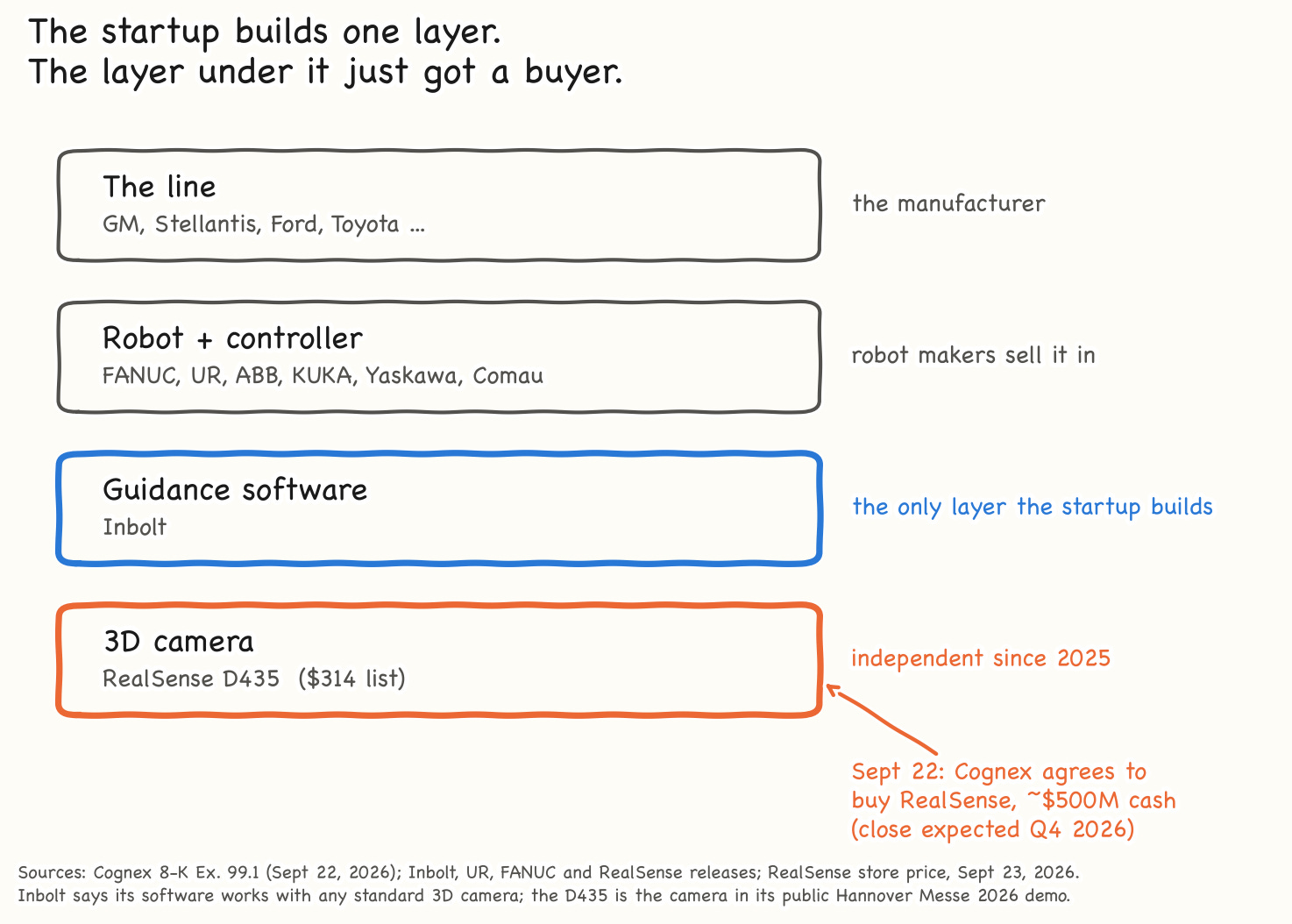
The upside of this path is real. No hardware R&D or inventory to carry. FANUC's and UR's salespeople open doors for you. The customer adds one camera and one software license and keeps the robot they already have. The downside sits in the same place: both ends belong to someone else.
Three days after the show
IMTS closed on September 19. On September 22, Cognex announced it would buy RealSense for about $500 million in cash. RealSense is the company behind the $314 camera in Inbolt's public demo.
There's a small irony here. At the show, UR's list of Gen 7 ecosystem demos had Cognex and Inbolt on the same line. Three days later, one of them announced it was buying the other's camera supplier.
The numbers below come from the release Cognex filed with the SEC. Intel started RealSense in 2014 and spun it out in 2025. RealSense expects $80 to $90 million in revenue this year, up more than 50% from last year, so Cognex is paying roughly 5.6 to 6.3 times revenue. On top of that, Cognex plans a three-year $56.5 million cash retention program for RealSense employees plus about $50 million in restricted stock. Together that's about a fifth of the purchase price. Cognex is clearly buying the team along with the product line.
Cognex CEO Matt Moschner described the goal as a "full-stack visual intelligence platform," running from industrial ID and 2D and 3D measurement all the way to 3D depth perception and robot navigation.
Anyone who has worked in inspection will notice a gap in the middle of that list. Cognex's cameras have always hung over the line, looking at a part and returning a verdict: pass or fail. RealSense cameras ride on a robot's wrist, look at a scene and return a position: where the part is and how to get there. When the first kind is wrong, you get a scrapped part or a missed defect. When the second kind is wrong, the robot moves to the wrong coordinates. Cognex's home ground is the first kind, and this $500 million is its ticket into the second. Cognex's own estimate of that market is about $600 million today and about $1.6 billion by 2030.
What to watch
For a middle-layer company like Inbolt, Cognex could play this three ways. It could be a channel, selling RealSense cameras into factories along with partners' software. RealSense CEO Nadav Orbach said what attracted him was Cognex's "global industrial customer base and go-to-market reach." It could build its own guidance software on top and compete head-on. Or it could buy a middle-layer company outright. The announcement doesn't say which way it leans.
I'm watching two things. First, whether the RealSense developer ecosystem stays as it is: the SDK, the partner program, and supply terms for third parties. Second, whether Cognex ships its own RealSense-based robot guidance software within a year of closing. If it does, the window for the middle-layer path starts to narrow.
If you're evaluating vision guidance for a line, ask one more question when you buy: how many 3D cameras does this software support, and how long does it take to switch? Before September 22, that was a theoretical question.
If you're building a startup, the borrow-both-ends path works. Inbolt going from 20 factories to 75 in two years proves it. But the moat can't be "we integrate with one camera." It has to be something neither end can take: the field data from tens of millions of cycles, and the few minutes it takes to go from a new part's CAD file to running on the line.
As for my deburring question, the answer is no. But chasing it showed me something. Inbolt can borrow its accuracy from the drawing and its sales channel from the robot makers. The camera end isn't up to Inbolt, and as of September 22 it's about to change hands. The deal is expected to close in the fourth quarter.
If you know an engineer who is picking a 3D camera for a line right now, send them this. The camera end is changing owners, and their comparison sheet may need one more column.
Seeing Inbolt on FANUC’s stand is the detail that makes this feel like more than a good demo. For a Japanese factory, the next questions would be less about headline accuracy and more about stability across lots and lighting changes, recovery when something goes wrong, and how long it takes to get a system running. Still, if a $314 camera can get this far, some applications that once needed a custom vision project may be moving toward something teams can actually deploy.
The west can still make kickass deployable components