

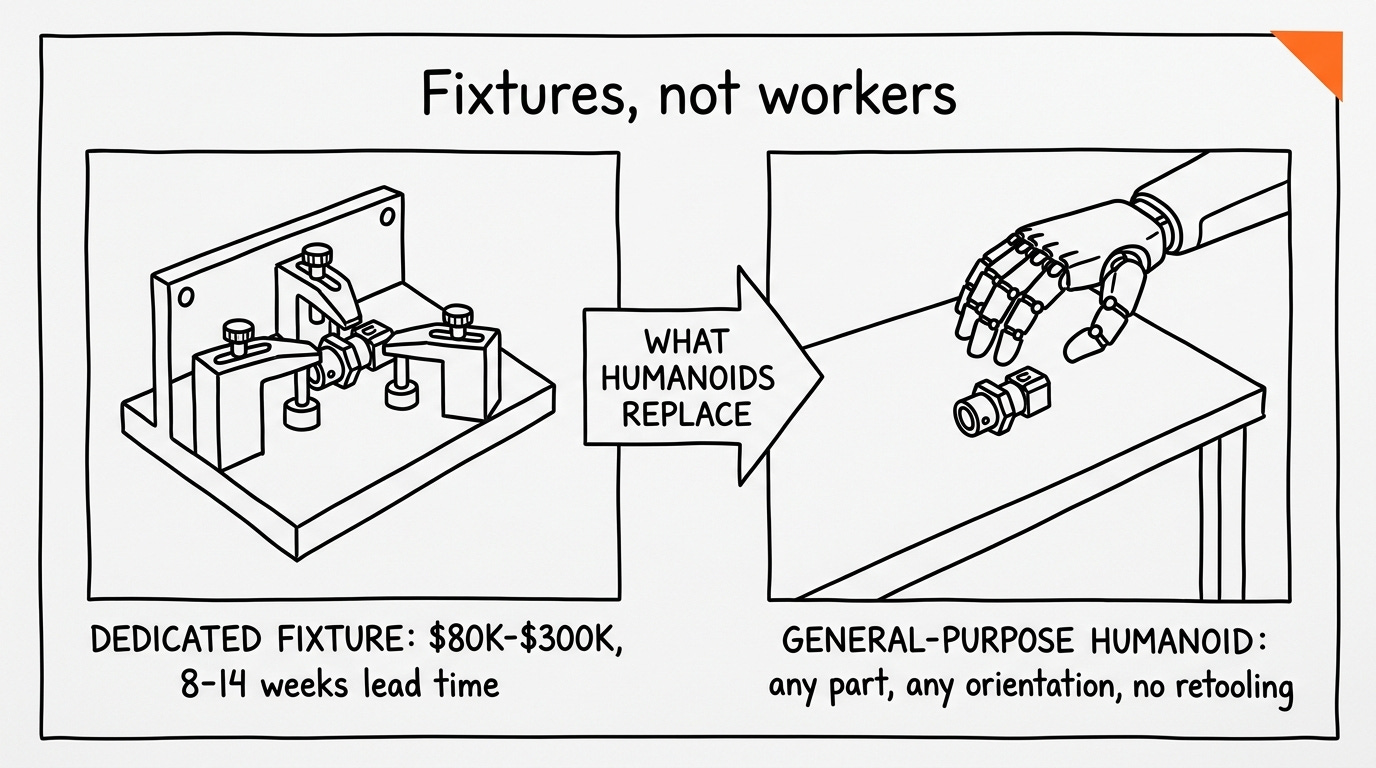
I had a defensible thesis. Humanoid robots in factories are theater. Real production lines run on dedicated automation: SCARA arms, gantries, custom end-effectors, and the unglamorous workhorse most engineers underestimate — the fixture.
A fixture is a piece of tooling that holds a part in exactly the right place so the next operation — a weld, a grind, a torque check, a measurement — happens repeatably. When a CNC station hits 60 parts/hour, it’s the fixture, not the robot, doing the geometric work. The arm just executes pre-programmed motion against a known datum.
For five years I argued: humanoids can’t beat fixtures. Lower precision. Higher cost per minute. Fewer cycles per shift. Show me a process where a humanoid replaces a 5-axis fixture and a Fanuc, and I’ll show you a marketing video.
I was wrong about the comparison.
What fixtures actually cost
Fixtures don’t show up cleanly on a P&L. Tooling capex is a line item; the dynamics are not.
A serious fixture set for a single new part runs $80K–$300K in tooling, plus 8–14 weeks of design, fabrication, debug, and trial-run cycles. That’s before you ship a single unit. It’s why high-mix, low-volume manufacturing in the US has been losing to Chinese contract manufacturers for two decades — Chinese suppliers don’t pay less per fixture; they amortize fixtures faster across more SKUs and absorb thinner tooling-funded margins.
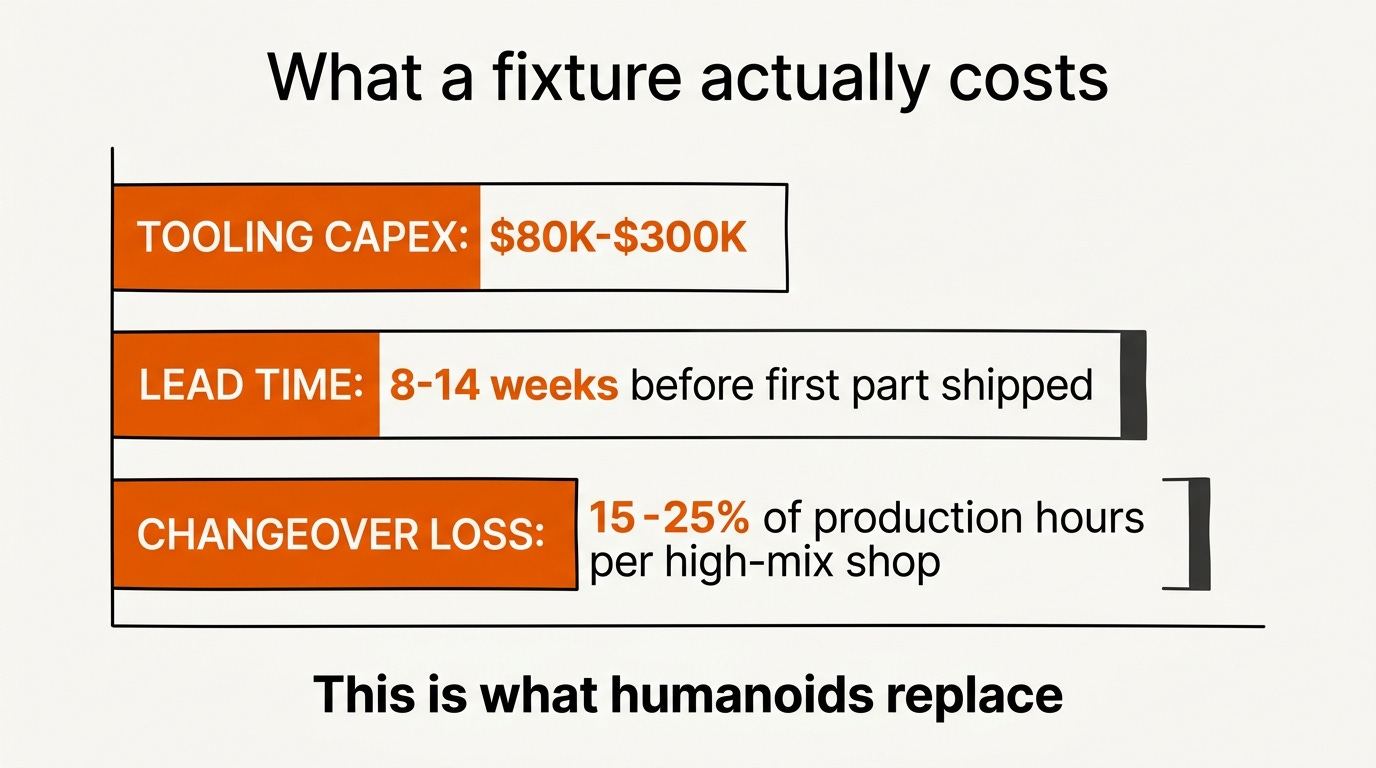
The hidden cost is changeover. Every fixture swap pulls a line down. In a high-mix shop, fixture-driven changeover eats 15–25% of available production hours. That’s the line that bankrupts US contract manufacturers chasing flexible orders.
Now reread the humanoid pitch with that frame:
A general-purpose end-effector that holds, presents, orients, and inspects parts — without dedicated tooling per SKU — is not replacing a worker. It’s replacing the fixture.
That’s the thesis I should have stress-tested in 2021. I didn’t. This week I did.
The week the numbers lined up
Five signals hit my feed in seven days, all pointing the same direction.
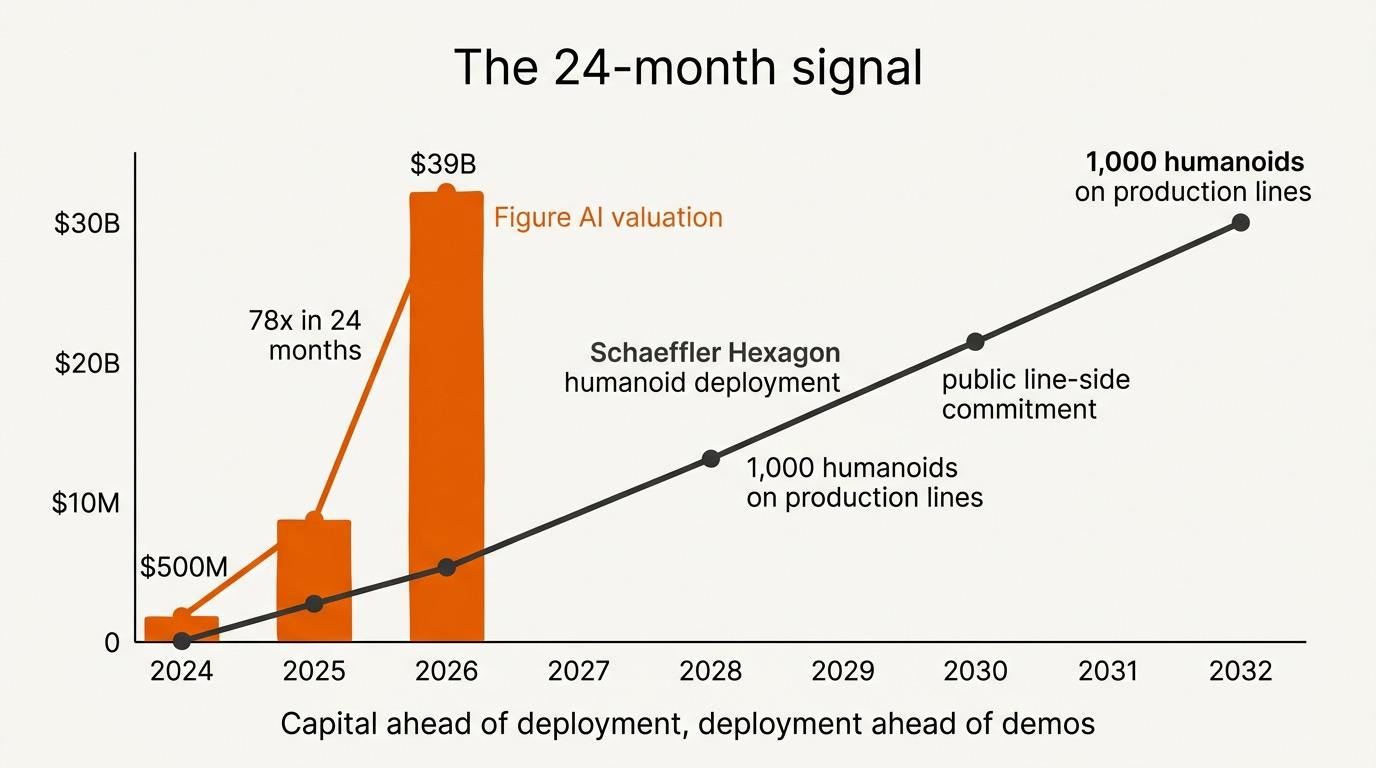
Schaeffler — the German bearings and automotive supplier — committed to 1,000 Hexagon humanoids on production lines by 2032. Not an R&D pilot. A line-side deployment plan with a public number, in partnership with Hexagon and VinDynamics.
1X opened a US factory and announced 10,000 home robots in year one. Set aside whether year-one is hit. The signal is vertical integration on US soil, with Bloomberg confirming the target in writing.
Japan Airlines started humanoid baggage sorting at Haneda. Airports are factories — sorted parts, variable mix, tight cycle. JAL didn’t pick humanoids because they’re fashionable. They picked them because the alternative — a custom sorter for every bag geometry — failed economics.
Figure published stability data: their humanoids now stay balanced after losing single or multiple joints. That’s not a marketing reel. That’s a control-systems claim that, if it survives production hours, narrows the gap with fixed-base arms by an order of magnitude.
And the punchline: Createme’s CEO went on the record this week — deformable-material assembly is the real test for physical AI. Apparel, soft seals, gaskets, harnesses. Exactly the parts fixtures handle worst. He’s right. And he’s saying it because his customers are asking.
Five data points pointing the same direction in seven days isn’t noise. It’s the early phase of a curve where unit economics stop being a theoretical argument.
The American brutality that built this
Here’s the part I want US founders to hear and Chinese policymakers to read.
In 24 months Figure AI moved from a $500M valuation to ~$39B. Meta acquired Assured Robot Intelligence to staff up its humanoid program. Five US companies — Tesla Optimus, Figure, 1X, Boston Dynamics, Apptronik — are independently driving humanoid hardware costs from millions per unit toward $50K–$150K.
Five companies because in the US market, capital is allowed to fund five bets when one will be right.
China sees this and is reacting accordingly. This week the Chinese government blocked Meta’s $2B acquisition of Chinese AI startup Manus. The Frankfurter Allgemeine Zeitung reported it days before an expected Xi-Trump Beijing summit. Beijing is no longer worried primarily about US technology coming in; it’s worried about Chinese AI know-how going out.
The US system isn’t gentle. Most of those five humanoid companies will fold in 36 months. The ones that survive will absorb the survivors’ best engineers and IP for ten cents on the dollar. People who call this “brutal” miss the point: the brutality is the selection mechanism, and the selection mechanism is the moat. China can fund five companies; it cannot, by design, kill four of them with the speed America does.
Both systems will produce humanoid platforms by 2030. The American platform will have stronger unit economics because four other versions of it died first.
VLA: the brain that makes fixture replacement real
Hardware alone never replaces fixtures. The reason 2021 humanoid demos failed is the same reason 2018 and 2014 demos failed: no model could turn “pick this connector and seat it in that harness” into closed-loop motion against an unmodeled object.
That problem now has a name: Vision-Language-Action models (VLA).
This week alone:
Three new VLA architectures hit arXiv (LaST-R1, MotuBrain, PRTS), all targeting closed-loop manipulation under physical uncertainty
An open-weights 1.6B-parameter robot foundation model launched (LDA-1B), trained on 30,000+ hours of heterogeneous human and robot interaction data
PND-0 VLA was demonstrated live on a humanoid at CCMT 2026 doing flexible 3C manufacturing tasks
And — the part that matters most for democratization — a $15K open-source humanoid platform shipped that runs on open-source VLA weights
First principles: capability shows up as the product of body × brain × data. For five years bodies got cheaper while brains stayed dumb. This is the year all three terms moved together.
The fixture replaces faster when the brain understands the part.
What I’d tell 2021-me
If you’re a manufacturing engineer reading this with the same skepticism I had: I don’t need you to believe humanoids will replace your Fanuc cell. I’m not saying that. I’m saying:
Stop comparing humanoids to dedicated automation. Compare them to the fixture you would have built for that next 10K-unit run.
Run the changeover math. If you’re losing 15–25% of production hours to fixture swaps, a $50K–$150K humanoid that handles three SKUs without retooling has a payback window measured in months, not years.
The bottleneck stops being hardware and starts being the data you’re collecting on real parts. Whoever owns the data owns the deployment.
Technology is taking giant strides this week. The strides that matter are the ones where the humanoid stops fighting the fixture and starts replacing it.
First Principles Manufacturing — physics, economics, and shop-floor reality from a nuclear-engineering PhD turned industrial-AI practitioner. Subscribe at firstprinciplesmanufacturing.substack.com.