

On September 16, Siemens and Procter & Gamble announced that they are rolling out AI-based visual quality inspection across P&G's plants worldwide. The product is called Visual Inspection Cockpit. It runs on Siemens Industrial Edge, inspects thousands of products per minute, cuts scrap by 10 to 20 percent depending on the line, and commissions a new line five to ten times faster than a traditional vision system. Those are Siemens's own numbers, from its press center. I'm quoting them as given.
A hundred-year-old industrial giant, taking AI to global scale for the first time, chose inspection. Not welding. Not grinding. Not assembly.
Four weeks ago, in "Is Manufacturing at Dusk or Dawn?", I drew a map. This announcement landed exactly in the corner the map said it would.
1. The map, briefly
Two axes. Horizontal: cost of failure, from "redo it" to "crashed spindle, stopped line." Vertical: cost of verification, from "a glance" to "physical trial." Humanoid demos — cup from a cabinet, folded laundry — cluster in the bottom-left. Manufacturing — welding, deburring, precision assembly — lives in the top-right.
The order in which AI eats tasks is set by those two costs, not by how intelligent a task looks. Palletizing sat in the overlap between the two zones, so it commoditized first. Inspection sits in the cheapest-to-verify corner — when a model mislabels an image, nothing crashes — so it became industrial AI's first beachhead. The P&G rollout is that corner at scale.
That piece used the map as a diagnosis: if your pilot is stuck, find yourself on the map before blaming the model.
This piece uses it as a manual.
2. The claim: the axes are not fixed
Cost of failure and cost of verification sound like intrinsic properties of a process. Welding is just expensive to get wrong. Deburring is just hard to check.
They aren't. They are costs, and costs are engineered, not decreed by physics.
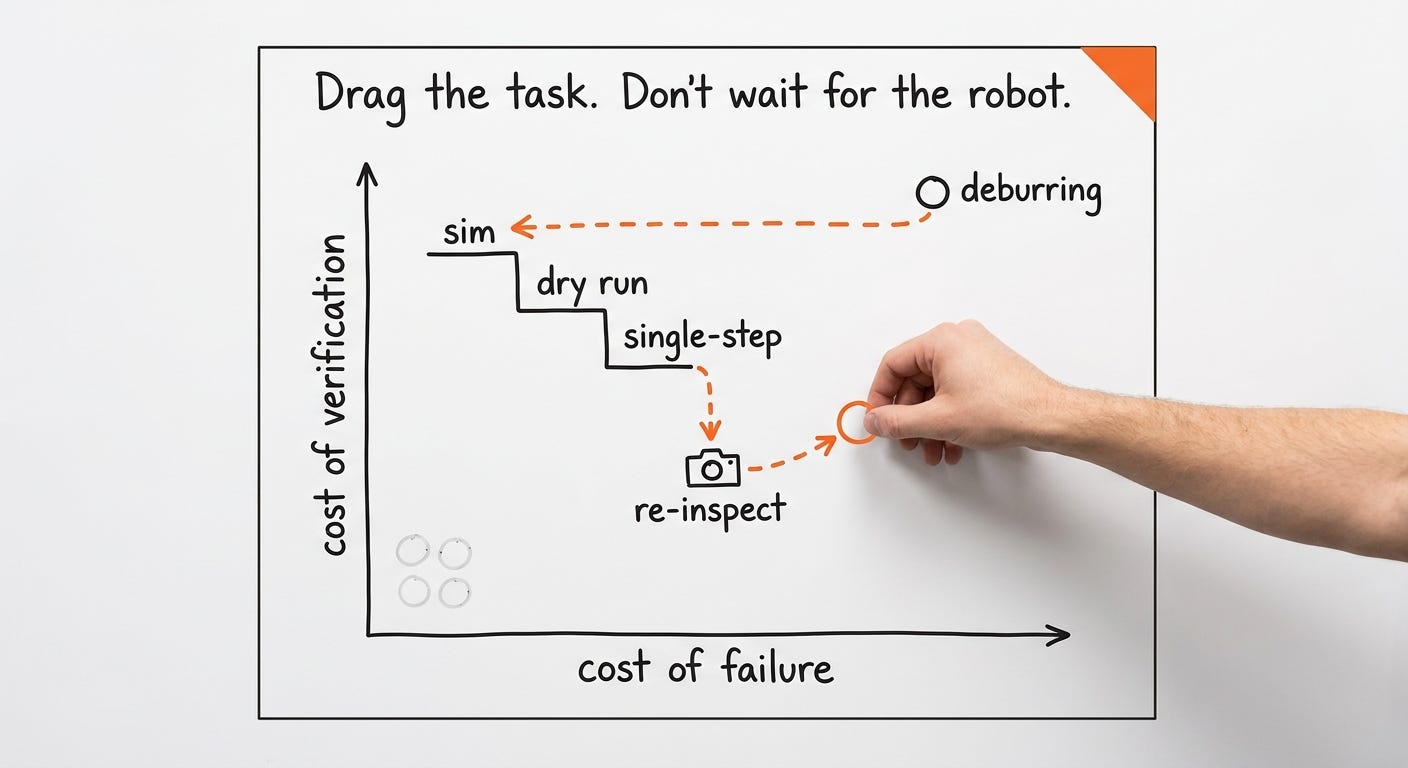
Where a task sits on the map depends on two things: what one failure costs you, and how long it takes you to find out. Both can be changed. Change one, and the task moves a step toward the bottom-left. Move it into the region where automation already works, and it gets automated — without waiting for a smarter robot.
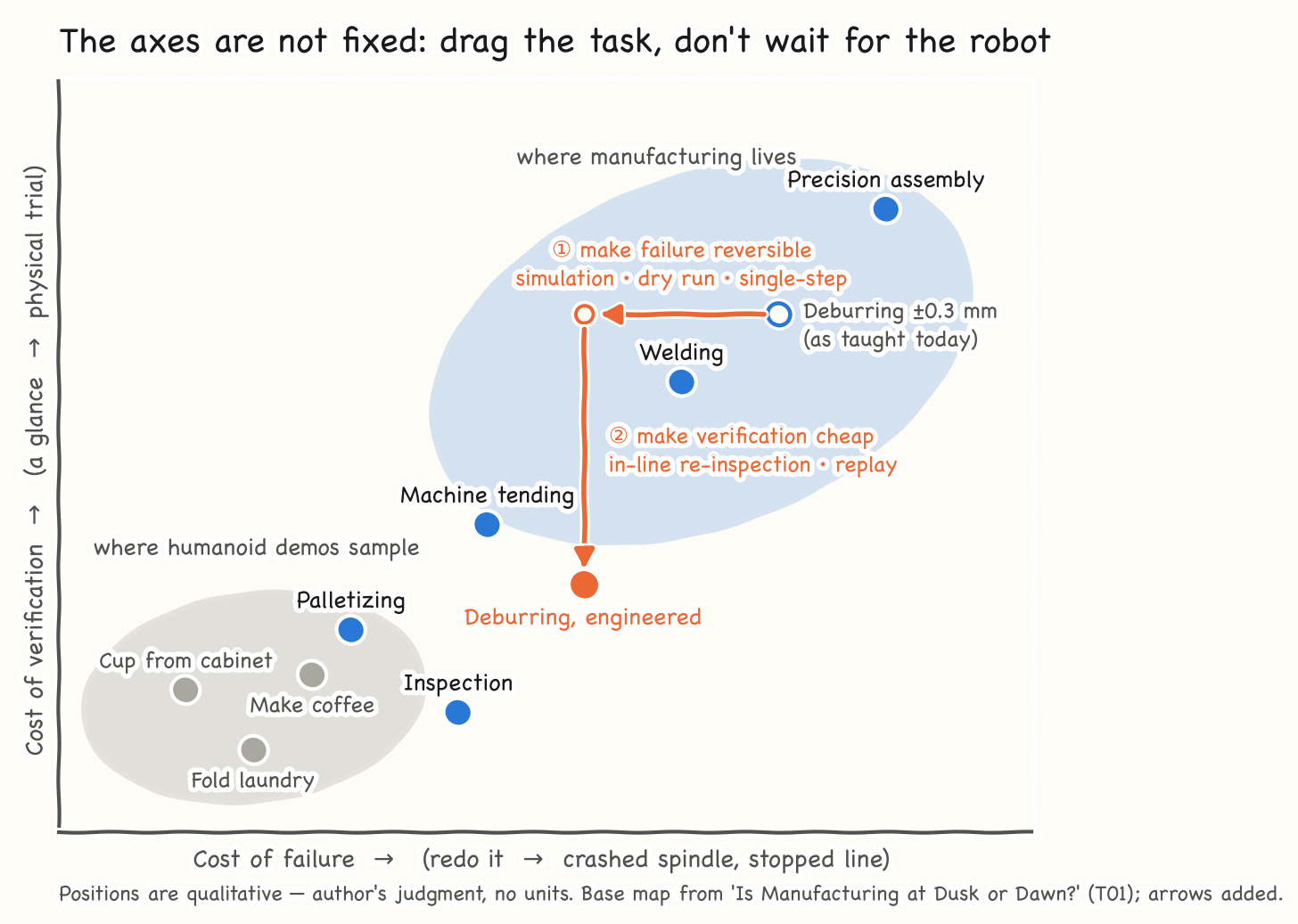
The same map, with two arrows. Positions are qualitative — my judgment, no units. Deburring is dragged from the top-right to the middle: the first leg by making failure reversible, the second by making verification cheap. It lands near machine tending, a region that has been automated for years.
3. Dragging left: make failure reversible
Why is failure expensive? Because it's irreversible and the blast radius is large. A toolpath point that flies a meter off the part is a rerun on screen and a crash on the machine.
The ritual every robot programmer knows — teach, dry run, single-step, low speed, full speed — I wrote about in "The Builder Cannot Be the Verifier" as a stack of checks that don't depend on the brain that wrote the program. Look at it from a different angle today: it is a staircase, and a failure on each step is cheaper than a failure on the next. Crash in simulation: rerun. Drift off in a dry run: you saw it, nothing hit. Touch something in single-step: you touched a point, not a path. Scrape at low speed: you scraped paint, not a fixture.
That staircase is engineering on the horizontal axis. Each step you add drops the cost of failure one notch. Get it down to "redo it," and on this axis the task is roughly where folding laundry is — even though its tolerance is still ±0.3 mm.
In my own offline exploration of a die-cast deburring path, about a dozen real defects surfaced, all on screen: the part was lying upside down, burr directions pointed inward, two arms were handing the path back and forth. Cost: minutes. The same mistakes found on the line would cost a scrapped casting and half an hour of downtime. The error didn't change. What changed is where it was found.
4. Dragging down: make verification cheap
Why is verification expensive? Because you need a physical trial or a destructive sample to know whether it worked. Welds get ultrasonic testing. Assemblies get measured.
Inspection is cheap to verify for a very concrete reason: its output can be checked directly against labeled samples. One image, right or wrong, in a second, at no cost, replayable.
So lend that cheapness to other processes. There is exactly one way: hang an inspection step behind the process. Is it clean after grinding? "The Physics of a Burr" put it as "re-inspection, not prayer." The grinding step itself doesn't change, but its verification cost becomes the cost of one camera frame. Photograph each part after grinding, compare against labeled samples, send failures back, log the result.
There's a trap here. The inspection you hang on must be independent of the system doing the work. If the re-inspection uses the same model's judgment that generated the path, that isn't dragging — it's holding up a mirror. The builder's blind spots get copied verbatim into the builder's own checks. My collision check that passed three rounds and never once put the workpiece into the collision model — that was this trap.
5. Walking deburring through it
A taught deburring robot today: path from CAD, fixed force, verification by a veteran running a gloved hand over the finished part, failure meaning gouged base metal or ground air. Top-right corner.
First leg, left: generate the path offline, run collision checks in simulation, dry-run on the real cell with the spindle off, single-step it, then low speed. A crash goes from "incident" to "rerun."
Second leg, down: one image before grinding to locate this part's burrs, one after to confirm it's clean, both logged with the path. Verification goes from "the veteran's hand" to "the camera's comparison."
Where does it land? On the chart I put it near machine tending. Not the bottom-left — the tolerance is unchanged, the drifting burr distribution is unchanged, the physics hasn't moved. But that region has been automated for years.
The most interesting number in the P&G announcement isn't the scrap rate. It's "five to ten times faster to commission." Inspection was already in the cheapest corner, and they kept dragging it down inside that corner — squeezing the verification cost of every new line one more time. That is what scaling actually looks like: not finding the cheap corner, but engineering the cheapness onto every line.
6. Two questions for a stuck pilot
Whether the model is smart enough is the third question. The first two:
At this step, what does one failure cost? Can you add one stair so the next failure is one notch cheaper?
After grinding, welding, assembling — how long until you know it's right? Can you hang an independent inspection behind it so the answer becomes one image?
Every "yes" moves the task one step toward the corner where automation works. Same robot.
One falsifiable marker, for the record: if a ±0.3 mm process ever enters production on a stronger model alone — no simulation, no dry run, no in-line re-inspection engineered around it — this argument needs revising.
How to build this stack from zero — interface, state, reins — is what I'm doing, one installment at a time, on the other line.
If you know someone who is waiting for a smarter robot before they'll touch the deburring bench — send them this.