

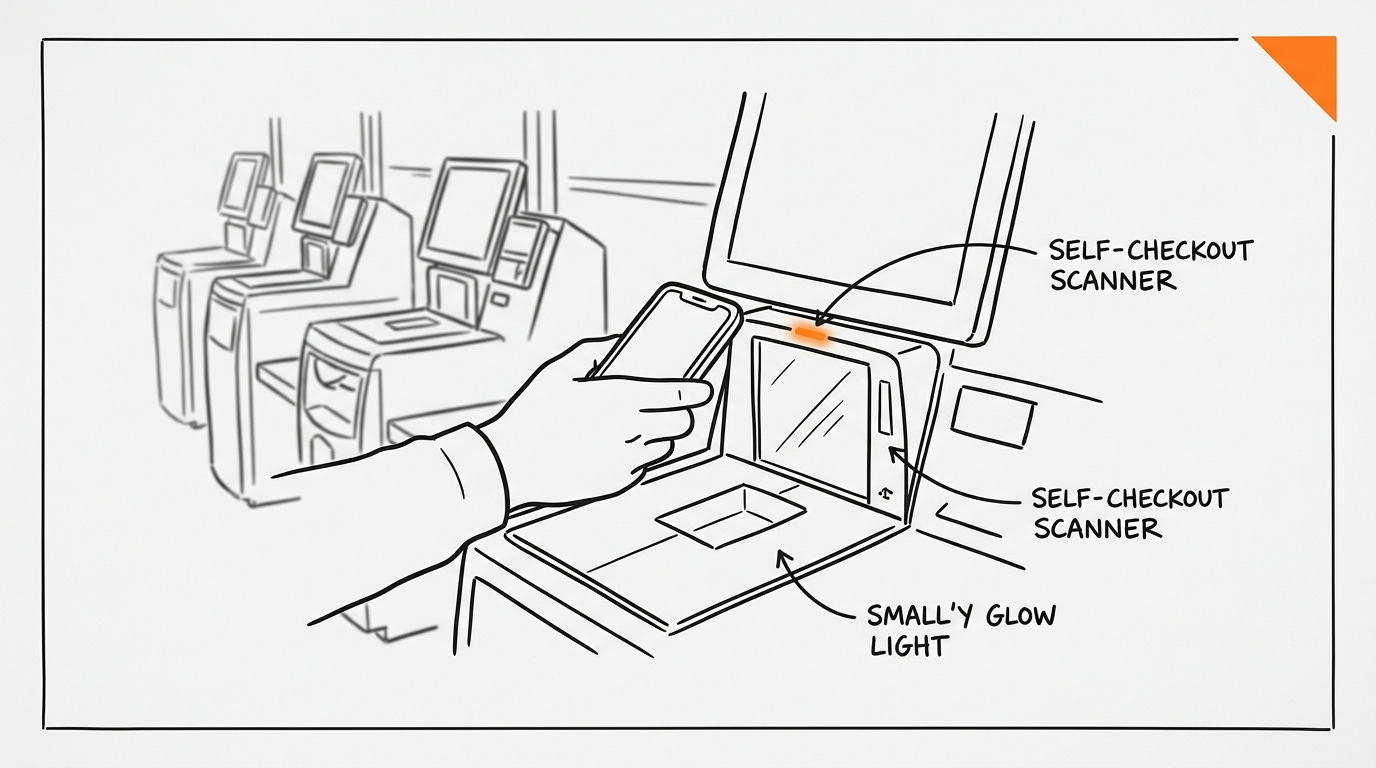
I. The Walmart Self-Checkout: My First Cognitive Crack
Before coming to the US, I had a preconception about electronic payments here: China’s QR-code system is so ubiquitous that America must lag behind.
So when I first walked into a Walmart, I wasn’t asking “Do they have self-checkout?” I was thinking, “They probably don’t have much self-checkout, since electronic payment isn’t as developed.”
The result?
Self-checkout is the default. Not a pilot program. Not a marginal option. The primary option. Target, too. Home Depot, too.
My first reaction: “Americans are pretty advanced too.”
But after living here longer and observing more, I realized this isn’t about “advanced” or “behind.” This is two completely different underlying logics.
II. The One Person at AutoZone: The Extreme of Autonomy
Last week I went to AutoZone to buy a part. One employee in the store, running around: answering phones, checking inventory, giving advice, checking out.
Not understaffed. Designed this way.
This employee isn’t “forced to do three people’s jobs.” He’s designed as “one person who can handle the full process.” The system is built around him, not cutting him into a cog.
The same pattern everywhere:
Burger joint: one person grills the patty, adds veggies, spreads sauce, packs
Pizza shop: one person kneads dough, adds toppings, fires the oven, slices
BBQ place: one person starts the fire, marinates meat, flips on the grill, plates
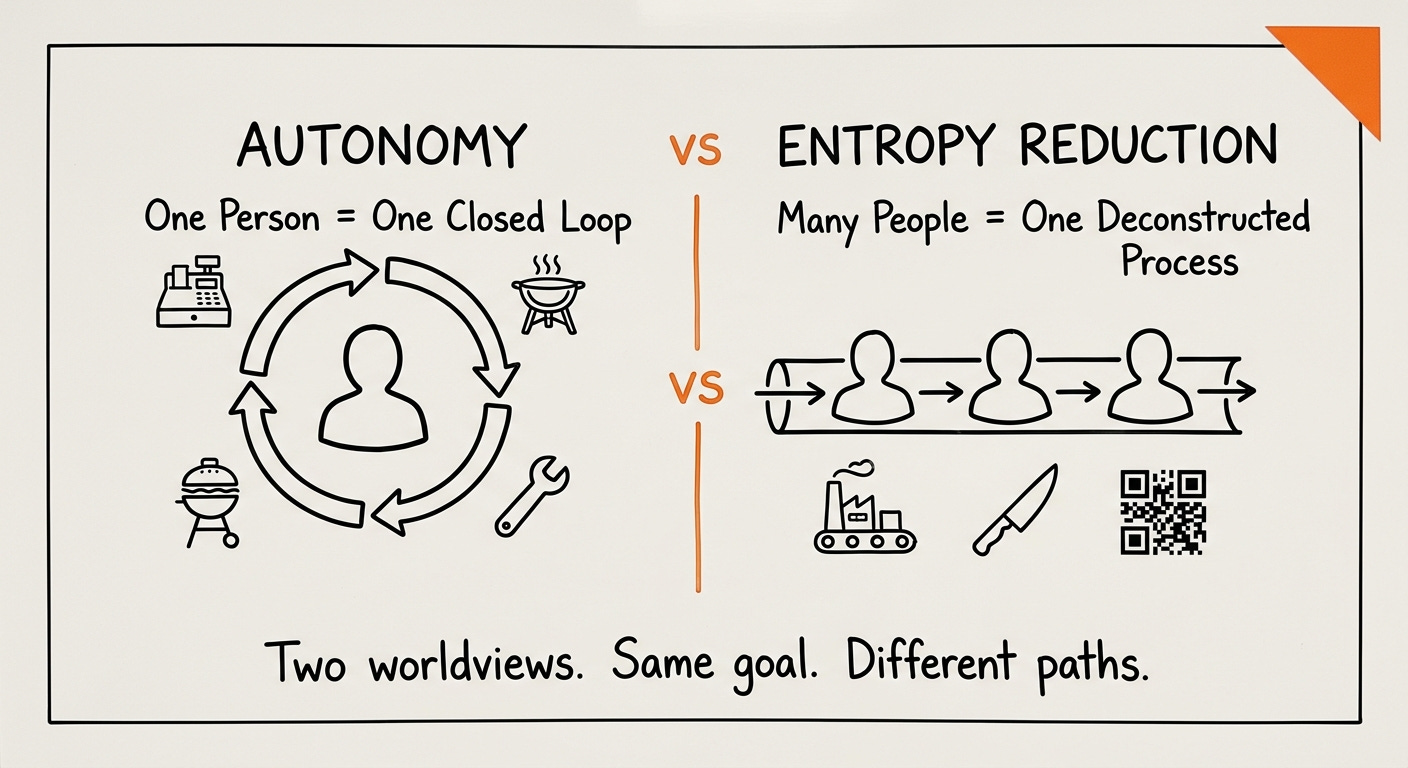
Every position is a closed-loop system: input → process → output. One person is one autonomous unit.
III. Chinese Entropy Reduction: Deconstructing Complexity to the Extreme
Contrast with a Chinese restaurant kitchen:
One station for prep
One station for wok
One station for plating
One station for dishes
A single dish passes through four or five hands. Each person handles only one entropy-reduction step: transforming chaotic raw materials into more orderly semi-finished products, eventually assembled into the final dish.
This isn’t inefficient. This is another underlying logic: through extreme division of labor, reduce the system’s entropy (disorder) to the minimum.
China’s automation follows the same logic:
Foxconn’s production line: each station does one motion
Meituan food delivery: order, pickup, delivery—three people complete one loop
QR-code payment: deconstruct the complex act of “transaction” into three frictionless steps: scan → deduct → notify
What China is doing is entropy reduction.
IV. Two Worldviews: Maintain vs. Reconstruct
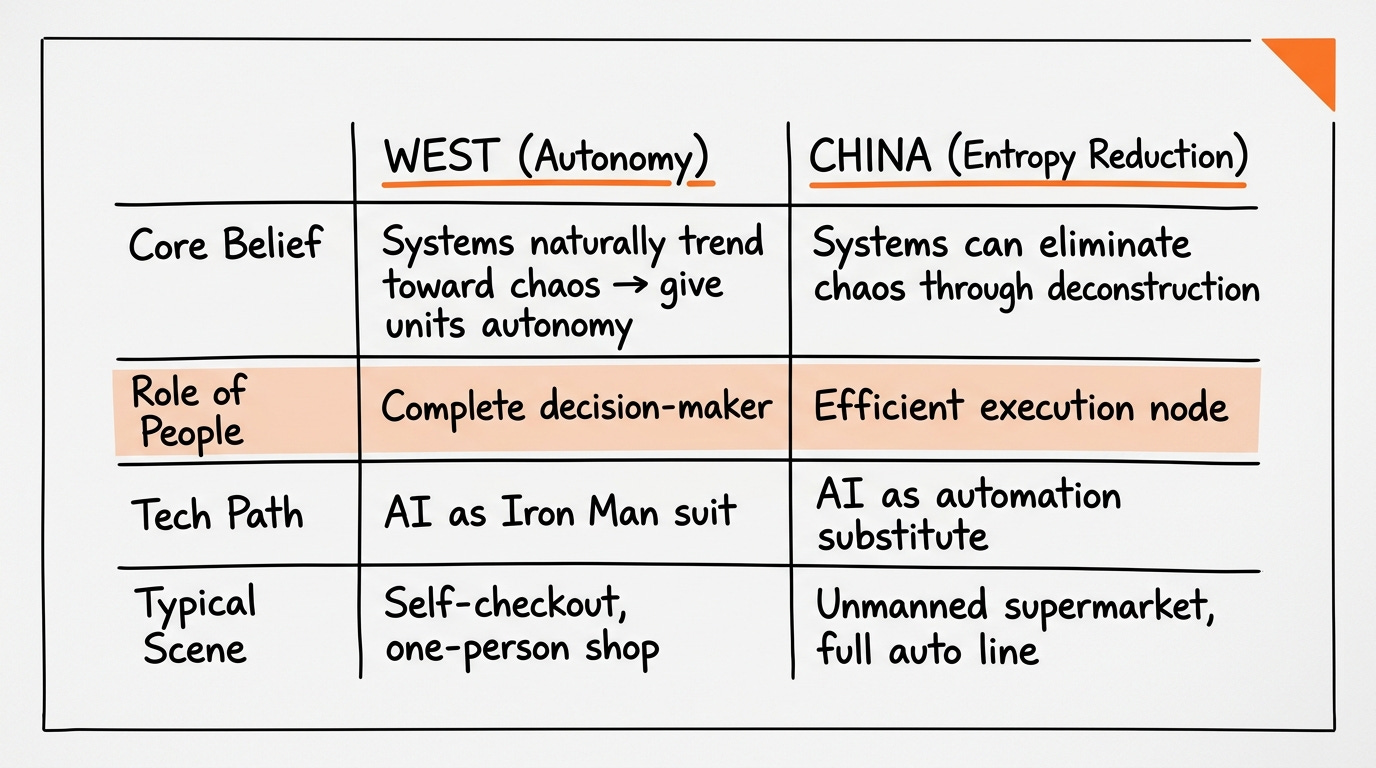
Walmart’s self-checkout isn’t “using machines to replace people.” It’s “returning the decision-making power of checkout to the customer.”
China’s unmanned supermarkets aren’t “giving customers freedom.” They’re “reducing the entropy of the transaction process to zero.”
V. Implications for AI and Automation
This divide directly shapes how we design AI products.
For Western markets, the question AI products must answer:
“How can AI help this person make better decisions?”
Copilot mode: AI assists, human makes final call
Augmentation tools: AI processes information, human handles judgment
Autonomous units: each node has complete decision-making capability
For Chinese markets, the question AI products must answer:
“How can AI eliminate friction in this process?”
Replacement mode: AI completes directly, human only handles exceptions
Process reconstruction: deconstruct human steps into AI-executable ones
Entropy-reduction system: input → AI processing → output, no human decision points in between
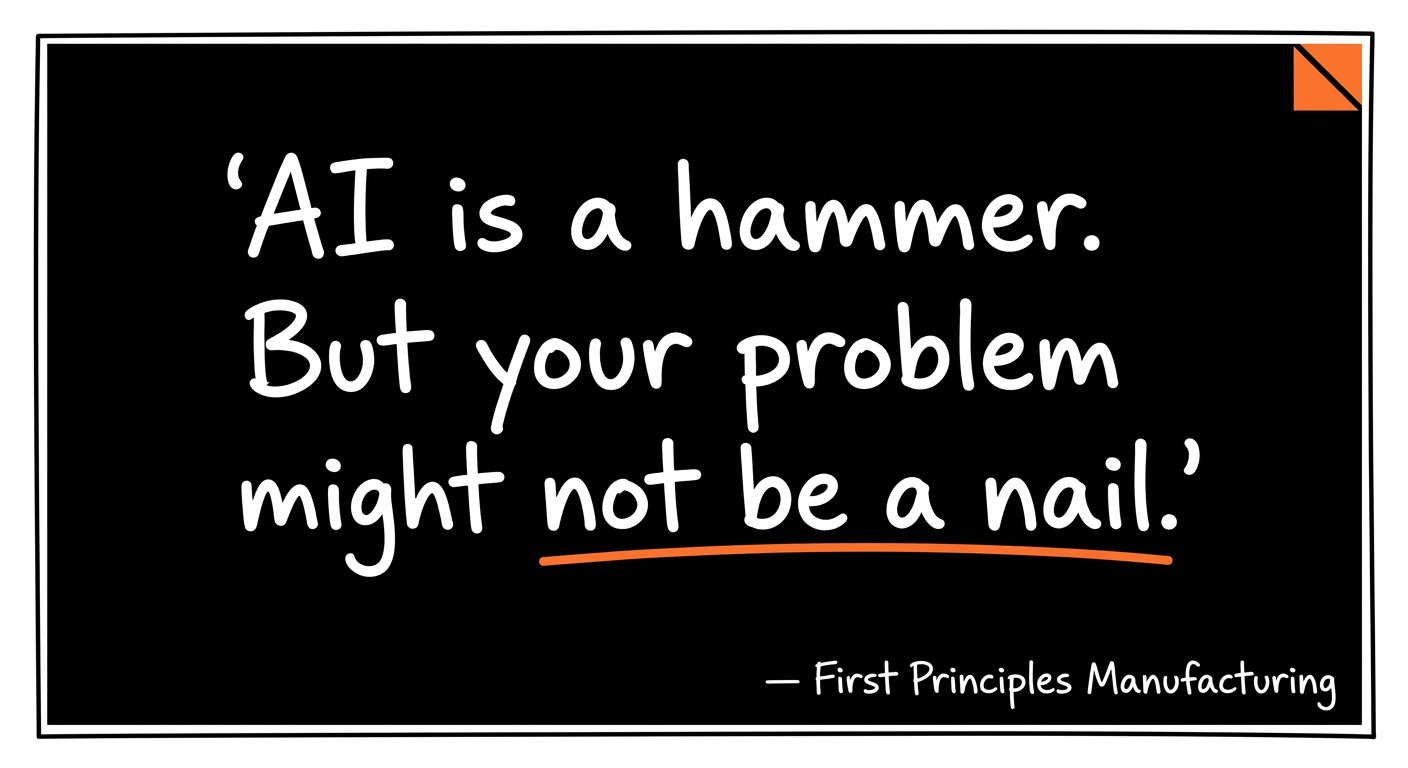
Not saying one is better. Saying if your product logic doesn’t match the market’s underlying worldview, you’ll die badly.
VI. A Concrete Manufacturing Example
At our lab in Novi, we work on robotic grinding.
The first question from American customers is usually:
“Can this system help my operator make better decisions about when to adjust the toolpath?”
The first question from Chinese customers is usually:
“Can this system run fully automatically so I don’t need an operator?”
Same technology. Two ways to sell it.
If we pitch “fully automatic, unmanned” to American customers, they feel you’re stripping away human value.
If we pitch “human-machine collaboration, enhanced decision-making” to Chinese customers, they feel you’re selling a half-finished product.
It’s never that you can’t do it because you don’t work hard. It’s that you can’t do it because you don’t realize it.
VII. Vision Determines the Future
After recognizing this divide, I looked back at my own product design and found many blind spots.
I used to think “the higher the automation, the better.” Now I know that in the American market, “the higher the autonomy, the better” is the correct North Star metric.
Not replacing people. Amplifying people.
Not eliminating human steps. Making human steps more valuable.
This cognitive shift is more important than any technical breakthrough. Because it determines:
Your product definition
Your sales pitch
Your organizational design
Your technical roadmap
Vision determines action. Perspective determines the future.
First Principles Manufacturing — Observations on physics, economics, and cross-cultural engineering from a nuclear engineering PhD in a Michigan shop floor. Subscribe: