

On September 29, I was walking the floor at NADCA's Die Casting Congress & Tabletop in Grand Rapids.
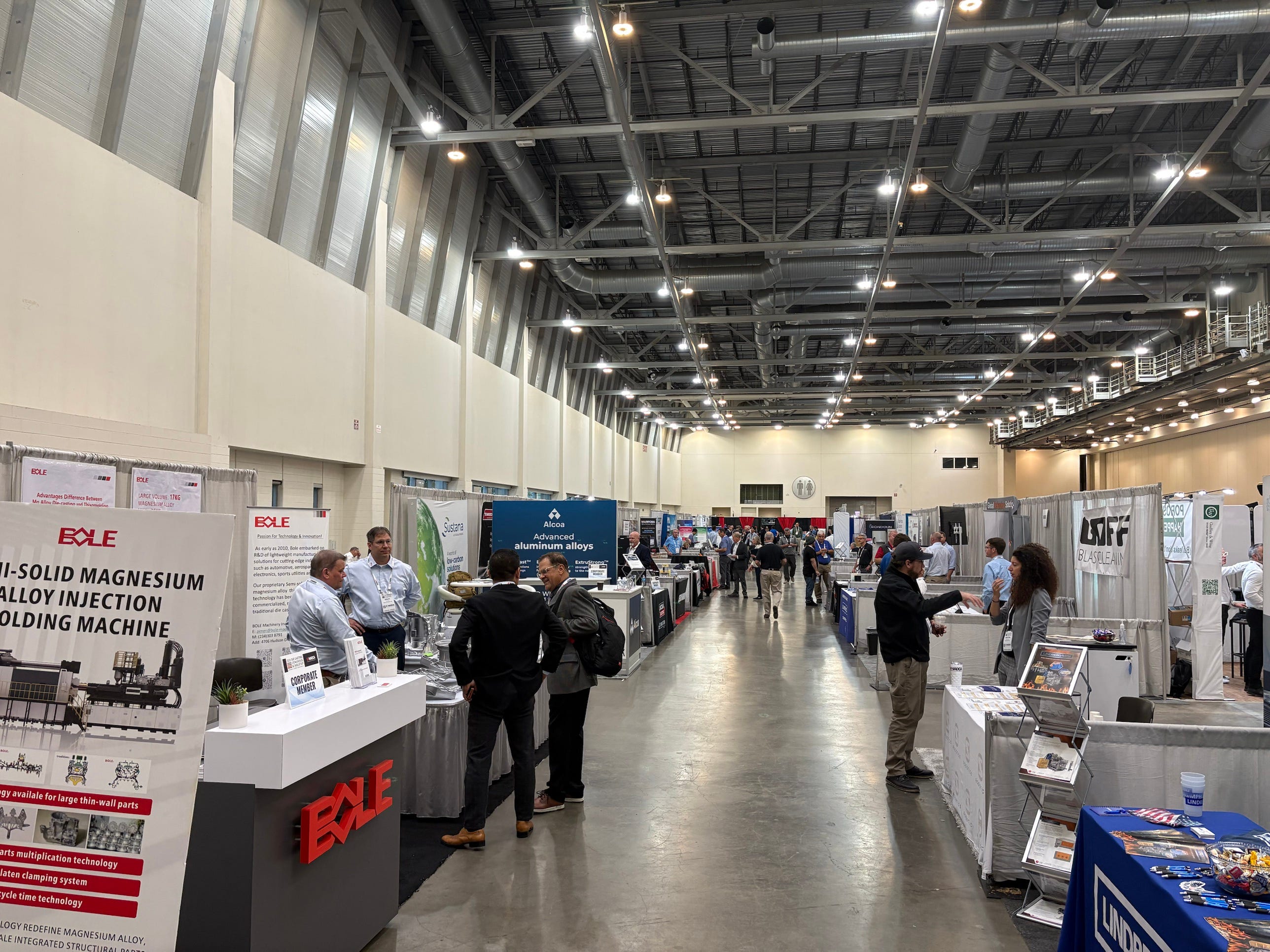
The show floor at NADCA's Die Casting Congress & Tabletop, DeVos Place, Grand Rapids, September 29.
Somewhere along the way I passed a booth doing industrial AI, and that caught my attention right away. The person standing there was Chinese, so naturally I walked over and started talking.
We had never met. It was just booth small talk, until it turned to a project from a few years back: the quality inspection system we built at Tesla. That got us going. The names he mentioned, I knew. A few minutes later we found people we both knew.
What surprised me more was how well he knew that project. How we built it, how we validated it, how the validation actually landed on the production line. I only had to start a sentence and he finished it. Running into someone at a trade show who knows your project that well is a strange and nice feeling.
Why they had been paying attention isn't hard to see. At Tesla, his team did data analysis, which in practice meant quality prediction and parameter recommendation. If our inspection worked well, quality data for every single part could flow into their system. For people doing analysis, that's more data, and much finer data. So they kept watching.
What they're doing now
The team later left to start a company, IndustrialMind.ai, founded by former Tesla manufacturing AI people. The person I talked to was Jeff Wang, the company's chief AI engineer. Before this he worked on AI-driven production optimization at Tesla and GM, and gigacasting is home ground for him. In October 2025 the company announced a $1.2 million pre-seed round.
They call the product the "AI Engineer." After the show I went through their public material, and the scope is much wider than what I heard at the booth.
The first half is engineering. It reads drawings, reviews them against the customer's internal standards, extracts features, and drafts BOMs, routings and cost quotes. When a new part comes in, it checks it against existing products so whatever can be reused gets reused.
The second half is production. It monitors in real time and predicts anomalies. When a quality problem shows up, it runs root cause analysis, correlating quality data with thousands of process parameters. Then it recommends parameter changes and validates them on the actual equipment.
The die casting parameters Jeff talked about at the booth sit in that second half. He said there are over a hundred of them: the machine's own settings, die temperature, and plenty more, all pulling on each other. Finding good settings used to mean people writing rule after rule by hand, which was painful. Now AI can do the wiring, and the whole thing gets built quickly.
One public deployment is ANDRITZ. In March, the two companies announced three agents running on hydraulic equipment parts: drawing review, BOM generation and root cause analysis. Early observations, in their words, point to drawing review time coming down by up to 30%. On the die casting side, Jeff said several plants in Europe, the US and APAC are already live, and the customers have been genuinely impressed. He didn't go into detail, so I won't either.
Why now
What I agreed with most was that they're doing this with the newest agents, and doing it the way a forward-deployed engineering team does: one industry at a time, inside each plant's existing workflow, instead of selling a platform and leaving the customer to integrate it.
The thing I think they do best is capturing what's in engineers' heads. Their ANDRITZ announcement describes it as turning engineering know-how into standardized, reusable digital workflows. In engineering terms, that's the harness layer: which data to connect (drawings, specs, MES, machine data), what standard to judge against, which step needs a human signature, and how to trace an error. Once that layer is built, an agent can be trusted to run.
Then there's the shape of the product in front of the customer. They don't hand over one big platform. They hand over one agent per workflow: one for drawing review, one for BOMs, one for root cause analysis. Engineers don't learn a new system. They get a helper. Their CEO put it this way in the announcement: "The biggest barrier to AI in manufacturing isn't the technology, it's knowing which workflows are actually worth automating."
Why was this hard before? The algorithms were never the problem. The problem was that every plant has different machines, protocols, data formats and internal standards, so every new plant was a custom job, and the custom work ate the margin. Now much of the wiring and cleanup can go to agents. People build the harness and encode the industry's know-how into it, and the cost of bringing on a plant drops. That's what makes this a business now.
Where it sits on the map
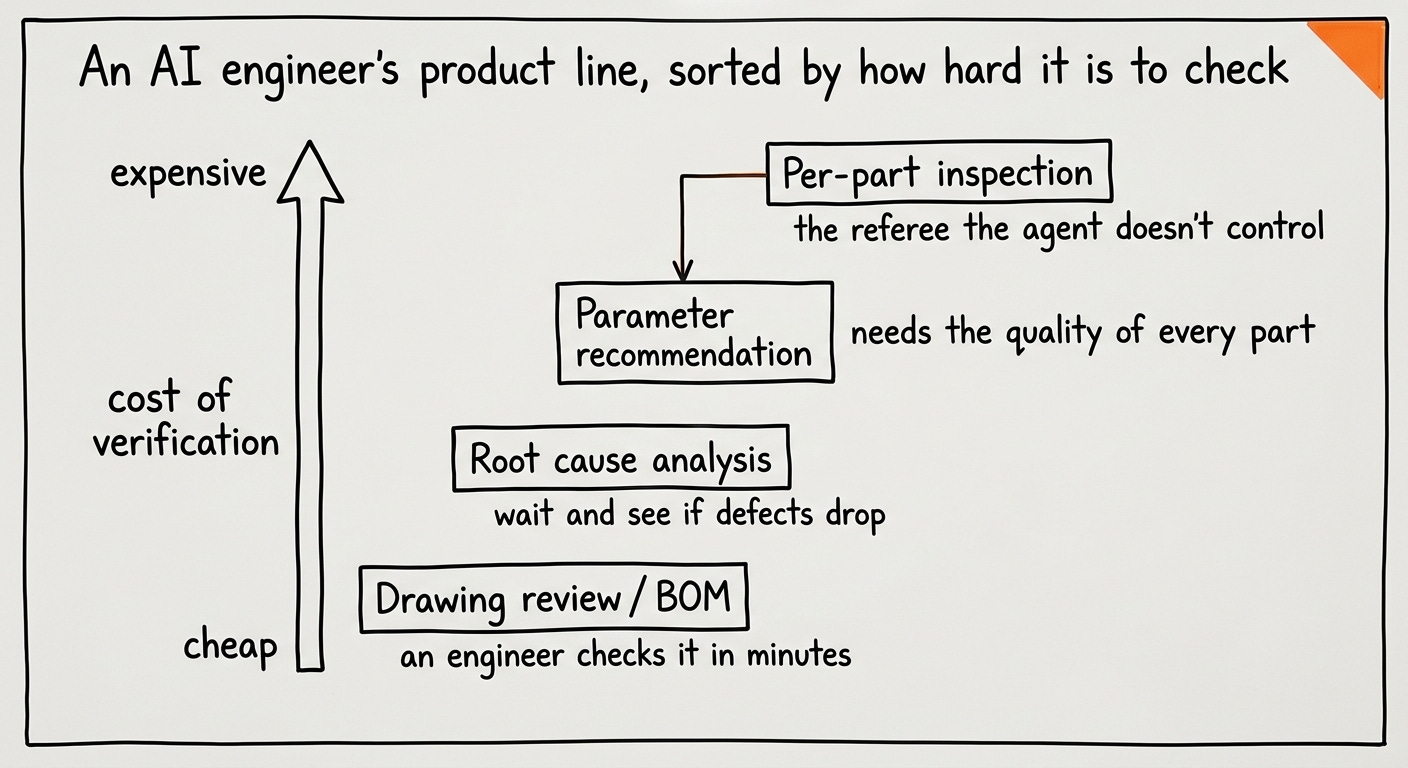
I've drawn a map before. The horizontal axis is the cost of failure, the vertical axis is the cost of verification. Automation happens first in the corner where both are low.
Put their product line on that map and something interesting shows up: it lines up almost exactly along the verification-cost axis.
Drawing review and BOMs sit at the cheap end. The agent produces a document. An engineer can read it, fix it and sign it in minutes, and if it's wrong, it's only a draft. It's also where the first public number came from: the ANDRITZ 30%.
Root cause analysis is one step up. The agent says this batch of defects comes from die temperature drift. How do you know it's right? You make the change and wait to see whether the defects actually go down.
Parameter recommendation, validated on real equipment, sits at the expensive end. To judge a set of parameters, you need to know the quality of every part made with them. Without per-part inspection, verification means sampling and tracing back after the fact. You find out days later whether the settings were good, and even then it may not be clear. In that world an agent can only recommend cautiously. With inspection on every part, and every part's defect distribution recorded, verification comes down to a single image. You know by the next shot.
That's where I think our inspection and their system fit together. Inspection gives the defect distribution for every part: what kind of defect, where, how big, and how it drifts from batch to batch. Nobody can hold that in their head. I've written before that veteran operators compensate for die drift by hand every day, and nobody records how much. When the shift ends, it's gone. Per-part inspection records exactly that missing ledger.
Feed that data in and their system can go a lot further.
There's one more layer. An agent that recommends parameters can't be the one who judges whether its own recommendations are right. The builder can't be the verifier. Inspection stands outside the recommendation, a referee the agent doesn't control. If parameter recommendation is going to make it onto real production lines, sooner or later it needs a referee like that.
Looking ahead
They're already working across several industries: die casting, other kinds of casting, and more. Die casting has the most deployments. The others are just getting started.
What follows is my own inference, not something Jeff said. Once they've gone through enough industries, the wiring, the harness and the domain knowledge they've built up could grow into an operating system for industry. Each new industry would need less built from scratch.
Die casting is a good place to start. Lots of parameters, tangled together, expensive quality problems, and veteran know-how that's hard to pass on. Put those together and you get exactly the place where an agent can help most, and prove itself fastest.
That day was the first time we met. I do inspection, they do analysis, and someday the two might connect. Even if they never do, I think they're standing in the right place. In this wave of AI, connecting and analyzing manufacturing data is exactly what agents can reach today, and they've done the homework.
If you know a process engineer at a die casting plant who still tunes die temperature by feel, send them this.